Archive Page 24

Candy, Travel and Love in Los Angeles

On a smog-sighing spring afternoon in Los Angeles, I met my soul mate. Possibly two soul mates.

Tuesday was a charmed day, my last full one before I hit the highway and headed back up the green spine of California. I ultimately failed in my scurrying attempt to cram in everything I hadn’t gotten to in the previous days—but I did encounter, sheerly by happenstance, two kindred spirits, cosmically bound in a coruscating tango set to the tune of my greatest loves: the unexpected beauty of travel, and sugar.

I got to Glaco’s Soda Pop Stop the round-about way. I learned about the Highland Park neighborhood (where Glaco’s has operated since 1897) through Trekking Los Angeles, a non-profit that aims to leverage cultural tourism to bring financial benefit to underserved communities. A pretty bad-ass ambition, and especially interesting given the recent spark in the ongoing debate about the cultural benefits/damages of tourism at World Hum and Matador. But how would it play out practically? I tried out one of their neighborhood guides.

The Highland Park guide focused mostly on art galleries and community spaces, which though interesting yielded a pretty incomplete neighborhood guide. I cruised past several of the galleries, finding only one open, and discovered the crowning Southwest Museum to be closed indefinitely due to earthquake damage.

What I ended up finding coolest was just wandering the streets. Far from trendy and slick, Highland Park is a diverse, working class community (not too different from Oakland) filled with raspado carts, 99 cent stores, auto shops, old women walking under the shade of umbrellas, panderias displaying Nescafe, Santeria markets, Food4Less, fast food chains, the lonely hiss of traffic. And art. Graffiti bloomed electric in the alleys, while murals covered the sides of buildings, highlighting local history, cheerfully advertising for businesses or bilingually encouraging you to recycle your motor oil. If it hadn’t been for Trekking Los Angeles, I’d never have ended up in Highland Park.

But Yelp led to me to the real gem of the neighborhood. Judging by the magazine articles taped to the front door, Glaco’s is far from undiscovered. Which is a good thing. Because under the fluorescence and atop the linoleum lies one of the most killer collection of sweets I’ve ever seen. I’d come to the holy land of sugar fiends. Cane sugar fiends.

I walked starry-eyed through the aisles, along displays of glass bottles and vintage candy. As I stocked up on candy cigarettes, Bubble Up and chocolate taffy, I perused some of the ingredients list. High fructose corn syrup was nowhere to be found. At the check-out line, I asked the grayed, smock-wearing clerk if the sweets sold were all in fact original recipes, free of all the chemicals and crap found in American candy today.

His eyes shone, a web of smile wrinkles appearing. “Our products only contain cane sugar.” My heart fluttered. My wallet opened.

Turns out the clerk was John, the owner of Glaco’s and the man responsible for turning it from an old-school deli to a cornucopia of candy. Being a fairly mellow Tuesday afternoon, John commenced to guide me around the store, explaining his philosophy and pointing out beloved brands.

John was all about the taste. He wasn’t a new-agey health nut (obviously)—to him, products made from natural ingredients like cane sugar just taste better. “The big companies are all about cutting costs,” he told me. “They don’t care about taste.” He told me how he remembered, as a kid, when 7Up switched from using lemon and lime oils to extracts. “It was terrible,” he lamented, with the touch of nostalgic heartbreak reserved for unhealed childhood wounds. “Now this,” he picked up a bottle with care, “is the good stuff. Original Dr. Pepper formula, with Imperial cane sugar.”

John and I proceeded to bro down about ingredients for about 20 minutes. Coming from the Bay Area dining scene, it’s all about quality, natural ingredients, even at the bar—squeeze your own fresh juices, make your own simple syrup, even your own small-batch Vermouth, increasingly. It’s a trend based on taste. But for John, it’s no trend. The vintage candy and soda thing isn’t a gimmick, isn’t hip. It’s just the way sweets were always meant to be. A square-shaped old man with smiling eyes and a die-hard passion for sugar, I almost asked if he had any single grandsons.

Thirty dollars and one mean sugar buzz later, I headed clean across town to Culver City, the undercover hotbed of hipness. Some of LA’s most prominent contemporary urban art galleries are housed in the unassuming tract of wide streets and windy sidewalks, including one often featured on one of my favorite street art blogs, unurth. I checked out the whimsical exhibition by Brazilian street artist Nina Pandolfo at Carmichael Gallery, and chatted up the friendly dude gallery sitting. He told me not to miss the current exhibition two doors down, at Roberts & Tilton. And oh man, am I glad I listened.

The white walls of the gallery’s main room were lined with a single ring of photographs, hung right at eye-level. The black-and-white images were haunting, gritty, unflinching, and ultimately beautiful. They were the work of Ed Templeton.

Ed Templeton is a kind of a Renaissance Man of contemporary cool—a pro skateboarder, photographer, artist, editor of a magazine, and, after reading the press release for his current show The Seconds Pass, a damn good writer, I’ve decided:

There is a scribble of asphalt and meandering ribbons of concrete tangled all over North America in a contiguous line of material that connects each of us to whomever else is also in contact. I sometimes marvel at this, walking from my front door and standing on the asphalt looking down at its grimy blackness, wishing I could rest my ear down on it and hear everything like the Indians in an old western film. The pavement I’m standing on is connected to other pavement, concrete, or steel to almost anywhere I can think of. Certainly everywhere you can drive to. Someone in Burnt Church, Tennessee is standing on gravel that is connected by touch to my street, just like someone is in Halifax, Nova Scotia. I can be in New York City in 3 days from my home in the suburban sprawl of Orange County, California without ever touching the earth.

All the photographs in the exhibition were taken from cars. On the road, in transit, the photos captured those fleeting moments, those “ephemeral winks” that slide past the glass like a poem of images, a slideshow of humanity and place. Walking, biking, waiting for the bus, staring out through the windshield—they were snapshots of those little moments, seemingly small and sometimes lonely, that are somehow connected, or connect us.

I’d been roadtripping for 9 days, riding the veins of America, the journey of it as much a destination as the places themselves. Dusty towns, gasping palm trees, billboards and cacti, strip malls and faces, faces—it was like a projection of something, a movie flickering on my windshield, disappearing in the side-view mirrors. And a thread of something laid underneath it all, tying it all together, like some obscure plot line I couldn’t quite grasp, but that kept nudging, whispering at me in its language of images, the roar of the wind. It was the road, the black asphalt itself—and god-damn, if I could take a decent picture, it’d look something like the ones lining the walls of that gallery.

It might have just been the cane sugar coursing through the blood, but things were beginning to make sense.

Interstate to the Underbelly: Digging Around Underground LA


Not my photo


Freeways are the subways of LA.

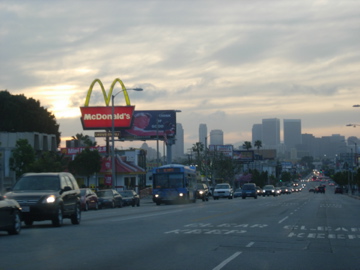
I had that realization as I ached red-brake-light through the afternoon traffic, slugging from Orange County to my sister’s apartment in North Hollywood. The New York City subway system seemed to me, on my first trip there, like a whole nuther underground world—its own city, separate from the other city, living and breathing and pulsing passengers just beneath the surface of the streets. And the freeways in LA are kind of the same thing, choked and crawling and lined with furry-necked palm trees—a world within a world, a sub-city. And it seems you could live your whole life within its concrete confines, going back and forth and never arriving, not needing to arrive, having come to a place beyond arriving. (And you may not be able to buy a hot dog in the middle of the LA freeways, but you could always pull off and grab some oranges alongside the exit ramp.)

It’s been a busy four days in Los Angeles, poking, prodding and trespassing into the underbelly of the biggest un-city of the US. I’ve got about 100 stories to tell, and even more poorly shot photos—marginal neighborhoods and abandoned places and esoteric cults, street art and Santeria markets and a female-run strip club. I’m debating how I want to organize and present it all and, as usual,chronologically seems the least linear, in terms of telling the story of it. The lines curve and arch and connect like the freeways, tangentially, seeming to move independently and with their own direction.

Most of my best finds and coolest adventures came as the result of totally serendipity and randomness. I dug for hours on the internet and then, three days before I left, I happened upon a not-quite guidebook in a bookstore: LA Bizarro (whose blog component can be found here). Cheesy in parts, genius in others and snarky throughout, the book brought me to some seriously hidden gems. And one that had fallen off the edge of the continent.

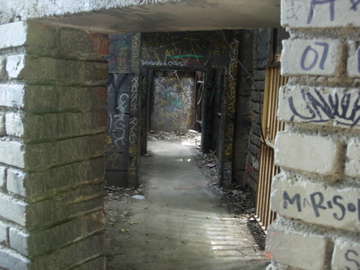
Sunken City was one of the coolest places I went to. A piece of San Pedro that had crumbled into the ocean during a mud/rockslide, Sunken City is the name given to the concrete, graffitied remains. Quardened off by a barrier wall and a couple of easily shimmied-under fences at the end of Point Fermin Park, Sunken City is technically off limits, but we found it full of about a dozen people—including a bunch of ballsy teenagers skateboarding the broken surfaces. Palm trees, grass and wild chard (from someone’s old vegetable garden?) punctuated the wind-swept rubble. It’s a wet dream for anyone who loves abandoned ruins, low-level trespassing, oceanside vistas—or anyone dreaming of the day California falls into the Pacific and floats away. Expect a photo essay soon.

I got word of another killer abandoned place from an old friend via Facebook. I drove into the green hill of Griffith Park, and poked around the rusty abandoned cages of the Old LA Zoo. Parts are a proper picnic/park area, while others lie behind a well-bent fence. The further into the hillside you go, the weirder and more graffitied the remains become. The zoo closed as a result of poor funding and animal deaths, and looking at the archaic cages, it’s easy to feel the suffering of the long-deceased captives. Especially since you can climb inside the cages.

Again, it was me and the teenagers—digging around behind broken fences is a fairly juvenile activity. We smiled and exchanged sunny day pleasantries, them choking on blunt smoke and remarking on all their friends’ tags, “Damn, blood, everybody been up here.”

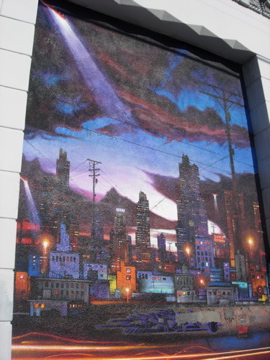
I don’t even remember how I stumbled upon the MAK Center’s How Many Billboards project, but it totally intrigued me: artists taking over billboards in one of the most heavily advertised/commercialized/image-obsessed cities on the planet. I missed the bus tours and I’d feared the whole exhibition, but a bunch of the billboards’ leases got extended beyond the show’s original run. I hunted around town and found a couple really cool ones:

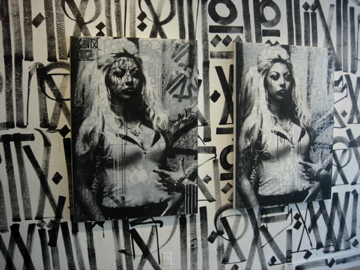
I also somehow stumbled upon the New Image Gallery, and found out legendary LA artist RETNA was having a solo show. I missed the opening reception on Friday, but stopped by today. Combining fashion photography with layered scrawlings, advertising with graffiti, glamour with grit seemed like the perfect collision of LA cultures. And it looked bad-ass.

Another thing I’m totally mystified as to how I found was Jetset Graffiti, my new favorite nerdy obsession. The site recently featured the latest Saber mural, part of the LA Freewalls project; I scurried down amid the warehouses and day laborers of 7th and Mateo to snap some photos. Expect a lengthy photo and word essay on LA street art I stumbled across, including stencils, wheatpastes and works by DFace and the ubiquitous Shepard Fairey.

Saber mural, "Pepper's World"


I discovered Esotouric by Googling “Charles Bukowski landmarks” (I said I was nerdy). Offbeat, indie and utterly obsessed with LA’s underbelly, Esotouric has an entire “Haunts of a Dirty Old Man” Charles Bukowski tour—plus John Fante, Black Dahlia and Tom Waits tours, among others. They only run tours once a week or so; I wasn’t super stoked on the one they were running while I was in town, but figured entrusting myself to people so dedicated to the strangeness of LA would be a damn good way to spend an afternoon, regardless of the subject matter.

“Maja’s Mysteries” focused on spiritual sites—the truly marginal and counterculture ones. Some might call them cults, some might call them New Agey nonsense, but all had found a home in the City of Angels. Maja, the White Witch of LA—tall and blond and subtly doused in glitter—grabbed the bus microphone and instructed us on karma and grace as we toddled up the hills and along the highways. We stopped at historic spiritual centers, founded by estatics searching for Utopia. They were all evangelists and mystics and soothsayers that prayed into crystals, channeled the cosmos, allowed the voice of Jesus to speak through their voicebox, clogged the old streetcars with thousands of revelers on a weekly basis, and generally used the power of prayer to create oodles of good mojo.

Though I didn’t connect to the spiritual eccentricity, and was downright spooked by the haunting recordings of George King’s contact with cosmic voices, I realized something on the Esotouric tour: all these people had come to Los Angeles from somewhere else. All of them seekers, searching for something, looking to fill a void or answer a question amid the swaying palm trees and quivering fault lines. Long before Scientology, long before Hollywood, long before reality shows about struggling actors and wannabe models, the magnetic currents of LA had drawn these misfits into the sunshine, the skin-piercing, cancer-blooming sunshine. They found followers, built philosophies, perfected their teachings, erected buildings—and fell off, eventually, into obscurity, settling into the dust between the hills, just under the surface of all that pavement.
Seen in that way, Hollywood isn’t some departure from the true, wild spirit of LA—it’s a continuation of the soul-hungry-ness, the seeking lonely and the elusive mirage that almost, but never quit fills the void—that circles and circumvents, glittering hoods and gleaming break lights—touches on a tangent, an overpass, for a moment, then glides off along the concrete arteries, the highways of LA, never arriving.

Searching for the Swallows in San Juan Capistrano

The air twitched with flies. Wild rabbits darted like phantoms from some hallucinogenic come-down; lizards crawled like insects out of the eyes of middle-school acid trips. Rocks and weeds tumbled down into a tight ravine; on the other side, trains rumbled past and the interstate roared like a wild thing. A weathered “No Trespassing” sign grew small behind me. I wasn’t concerned—this was bigger than trespassing. Down an abandoned road, amid the unkept overgrowth of a forgotten corner of Orange County, I was searching for what I’d come for—the swallows of San Juan Capistrano.

It started with the tattoo. I, like half of the tattooed population of the planet, have swallows. Not that I’m a sailor, bird enthusiast or have any particular affinity for traditional tattoos. But it means that every little old lady I meet asks me, “Have you been to San Juan Capistrano?” I found out that San Juan Capistrano was the town where swallows migrate back to every spring, after their trip down to Argentina. They arrive like clockwork every March 19, swooping around the old alcoves of the Mission there, building their bizarre nests and diving through the calm air and whispering history. I got tired of answering “no”—this year, I was going to the god-damn Mission and seeing some god-damn swallows.

I drove into the belly of the beast—Orange County. Motherland of every suburban California stereotype: sixteen lanes of chocked traffic, smog-smudged horizons, Del Taco and Starbucks, too-skinny arms and too-hard boobs. But somewhere amid all that was a kind of authenticity, a tradition, a natural phenomenon that hadn’t been strangled out by sprawl. I’d sat on the balcony of my cheap hotel in the Fez medina one dusk and watched the sky come alive with the swoop and screech of swallows: black, like shadows, fast, like phantoms, so that they almost seemed unreal. I wanted that rush again, that marvel and awe, in what seemed like a most unlikely place, this suburb of all suburbs.

The return of the swallows is San Juan Capistrano’s biggest event of the year. The Mission opens its doors to tons of visitors; I learned too late that the main event was the Swallows Day Parade on Saturday. But whatever. The main event for me were the birds themselves. I ditched my car about a mile from the Mission, hiked through the traffic and crowds of families and old ladies. I bought a couple $2 tacos, a pan dulce as big as my head, and entered the Mission.

Only the swallows weren’t there. Crowds milled around with their audio-tour headsets, their cameras and sun visors, through the neon flowers and crumbling edifices of the Mission, looking skyward at nothing but blue. “Ooh, there’s one,” an elderly man exclaimed. “No, dear,” his wife answered, “that’s a blackbird.”

What the hell? I sidled up to a ranger and asked, “So, um, where’s all the birds?”

“They don’t really come here anymore,” she answered in a hushed voice.

“Why not?”

“Well, we don’t really know. Some people think it’s climate change, but more likely it’s urbanization. The area was all rural when the Mission was built—lots of bugs and dirt for the birds. But now, you know—” she waved her hand at the hiss of traffic from beyond the Mission walls. “I’ve heard they’re mostly down by the creek.” She gave me directions to a creekbed just outside of town, where a small colony of swallows was rumored have nested, to be swooping through the skies. “Lots for them to eat out there,” the ranger told me with a smile.

I wandered around the Mission. It was beautiful in the way that Southern plantations are beautiful—peaceful and shady, but with something sinister inside the breezes and gardenia scents, a hint of haunting in the wild-blowing quietude, as though if you listened very closely, you could hear the echoes of crying, of cultural genocide and Christianization. I listened to my headset, watched the candles flicker in the chapel, observed the statue of missionary taming the savage, lion-cloth-wearing Native American.

“Are those swallows on your arms?” a woman wearing a swallow-studded t-shirt asked.

“They sure are.”

“Can I take a picture?”

I turned around and squeezed my elbows together, so that the birds on either sides of the arms were touching. The woman snapped her photo. “Those are the only ones I’ve seen today,” she told me wistfully.

I laughed. “Me too.”

Like everyone else, I kept looking up, searching the squinting blue sky for signs of the birds. Phantom swallow syndrome: kept thinking I saw the diving wings and forked tails of the elusive birds I’d come for. It seemed like a metaphor—like gentrification, like the more predatory forms of tourism, we’d descended en masse and through our seeking of something authentic and real, we’d driven out the very thing we sought. And I was, of course, one of them, in the way you never want to admit you’re really one of them (“I’m a traveler, not a tourist”)—with my digital camera, snapping photos at ghosts.

I’d find them, I decided. I got back into my desert-dust, dead-bug covered car and went creek-ward. I curved down a quiet road, spied the cleave in the green earth when the creek was, searched for somewhere to ditch my car that didn’t have an ominous “Tow Away” sign. I pulled up to a driveway and asked a little old man if he’d seen any swallows. He scratched his head, answered in a heavy accent, “No, but maybe down by the Church.”

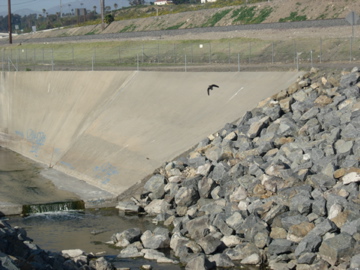
The grounds of Rancho Capistrano weren’t very welcoming—sprinkled with “No Trespassing” and “No Parking” signs. I left my car between two parked big-rigs on the street outside and tromped in, down through shady grasses and soccer fields, alongside a 6-foot chainlink fence covered in forbidding signs. The grounds gave way to open space, wild grass and small, rustling animals. The natural creek was swallow-less, but as I approached the cement embankments, I saw the diving black figures I’d been searching for.

About a dozen swallows moved through the half-shadowed concrete, white bellies and black wings. I crouched down, snuck under the tall fence and crawled over big rocks to get closer to the birds’ strange dance. I tried to snap photos, but they were too fast, too elusive for my slow fingers and cranky old lens. I put down my camera and just watched, thinking of the balcony in Fez, the long journey of the small creatures, the city they’d shunned and where they’d ended up instead.

Wind and Dust and Real Wild West

Two days in the desert—driving, hot wind roaring, through the pebbles and boulders, palm groves and dusty towns, the strange angles of the Joshua trees, arching up towards something, a sky as pale as eyes. It’s not hard to imagine infinity in the desert, that’s it’s all still at the bottom of some great prehistoric sea, that the sky were the lid of the sea and we were all swimming through it, rattling highway through it—the wind, waves; the dust, sand; the crunch under your sneakers some kind of ancient asking.

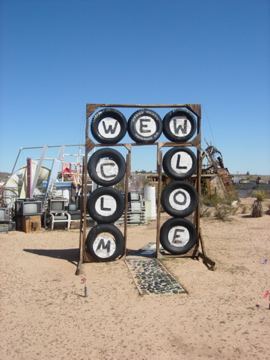
I arched over the hills, my tired car chugging, and arrived in Joshua Tree, went teeth-chattering down an unpaved road that dead-ended at open lot of strange, scavenged art. I’d read about the Noah Purifoy Foundation on Trazzler, and it immediately rose to the top on my list of things to do .

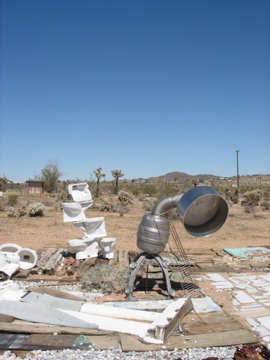
An LA artist that moved to the desert for more space and peace, Noah Purifoy erected whimsical sculptures out of found and salvaged materials—toilets, old vacuum cleaners, scrapped tin. During the 60s he’d directed the Watts Towers Art Center, and you can definitely see the influence of Simon Rodia—though Purifoy’s creations are more folksy, more political, less abstract. In fact, one of the most powerful pieces in the wind-swept lot was a piece made from materials found after the Watts Riots. To take a tragic, violent event, to sift through its remains and piece them together to create something new, something beautiful—this seems to be what Noah Purifoy was all about.

Admission to the Noah Purifoy Foundation is free; there’s a couple pamphlets at the entrance that guide you through your wanderings. There were only a couple other people there, and I hadn’t read about the place anywhere else. Except that, the next day, I saw on Twitter that it’d been featured in the New York Times. So much for having the edge.

Then it was off into the park itself. You hear a lot about the strange spiritual power of Joshua Tree, and I gotta say, they aren’t exaggerating. The terrain was other-worldly, to say the least. The tumble of boulders looked as though they’d been piled up by a toddler’s hand. The arms of the Joshua trees twisted and reached, fists full of beige spring flowers.  The shrubs had a slight purplish haze, like an old woman’s hair, and the air was full with a charged silence, the sound of wind.

I of course made a beeline to the site of Gram Parson’s impromptu cremation, something of a pilgrimage site for fans and aficionados of the bizarre. I drove out to Cap Rock and walked slowly around the massive formation, searching for the tributes and messages written on the rock that would signal the spot. And you know, I have to say, sitting there, the whole thing seemed much less odd. Well, the bit about stealing the body and having it actually burned on the spot is still a bit far-fetched, but being there—listening to the wind and watching the lizards dart—it seemed less like some kind of opiate-inspired fit of fancifulness, and more like an honest yearning to become a part of the place. It felt like somewhere, very far beneath the surface of it all, those plutonic intrusions that caused the rock formations were still boiling, still shooting up through the crust of the earth, and it didn’t seem so strange to want to become a part of it—to become smoke, twisting; dust, dancing; and at last the wind.

Across the desolation lay a supreme indifference, the casualness of night and another day, and yet the secret intimacy of those hills, their silent consoling wonder, made death a thing of no great importance. You could die, but the desert would hide the secret of your death, it would remain after you, to cover your memory with ageless wind and heat and cold.

John Fante, “Ask the Dust”

The next day it was off find the Wild West. I’d been stoked about Pioneertown, for nothing more than the kitsch factor. An old movie and TV set from the 40s, my trip to Pioneertown seemed ill-fated from the beginning. The Pionnertown Motel suddenly “closed indefinitely” the week before I left, and Harriet and Pappy’s Palace, billed as the best honky tonk west of the Mississippi, was closed the night I wanted to go boogie down. So I headed out in the morning and I have to say, if it would have been monumentally disappointing if Ice Cube hadn’t been there, in a poncho and a sombrero hat, filming a new video.

I headed back on the highway, through squat, peopleless towns of gas stations and boarded-up buildings. Did you know they grow dates in the California desert? I didn’t. Or that a date milkshake is god-damn delicious?

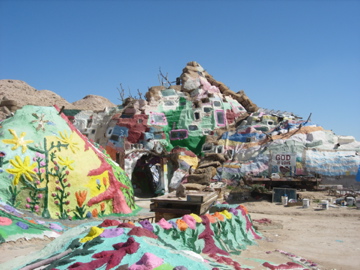
I made it to Niland, a windy little town with a couple shops, a no-name gas station and a stretch of trailers. There were two big sights there that inspired me to go 2 1/2 hours out of my way: Salvation Mountain and Slab City—the real, modern-day Wild West. It’s fitting that most people know about these places, if at all, from the movie and book Into The Wild, because they capture the kind of not-for-profit weirdness that can only take place in California.

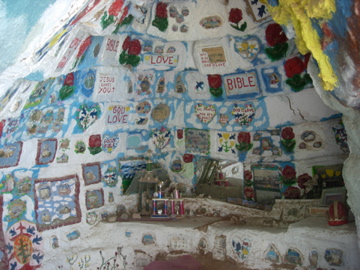
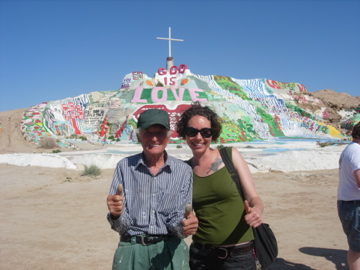
Salvation Mountain is Leonard Knight’s neon, latex-paint monument to God. Really. Radioactively bright, the art installation is covered in biblical passages, odes to God, and topped with a cross. The old dude came out to the desert in 1985, shortly after he was saved by Jesus, and began building the tribute, fueled by some kind of insane passion and other-realm vision.

Leonard was there that day, as he is most. Weathered, red-skinned and still mostly coherent, Leonard showed a small group of us around, spouting his message of God’s love and keeping it simple. He had a 10th grade education, he told us, and was one of the dumbest creatures on Earth, but because he’d repented, God had enabled him to build Salvation Mountain. He didn’t do it for money, he didn’t do it for fame—he did it spread the message.

His paint-stained pants were hitched up high, one of the legs tucked into his sock. The Velcro straps of his stained sneakers flapped, and he’d missed a button on his shirt. Three long hairs grew out of the top of his nose; he had a cold sore and one long thumb nail. He looked like a man that had become the desert, was the desert. He gave us each a handful of postcards and asked us to distribute them. He wanted nothing in return, just for us to spread the word. He repeated “keep it simple” like a mantra.

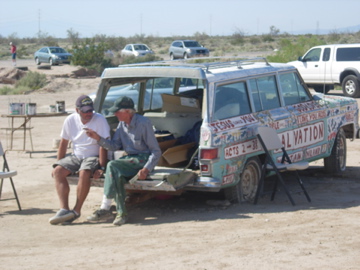
A quarter-mile down the road was the legendary RV squatter encampment of Slab City—“the last free place,” the sign read. Pebbly and stark and covered with trailers, Slab City is a piece of land no one wants. The government bulldozed a military base that was there in the mid-40s, leaving nothing but concrete slabs, covering the ground like graves. Word got out in the squatter community, and it became a wintering place for “snow birds.” There’s no water, no bathrooms—nothing, again, but wind and dust.

There were a number of “yard sales”—tables and blankets were random stuff was displayed, on sale for passer-throughs like myself. I pulled over to one and chatted with the people there, a desert-skinned man with a scabby elbow on a bicycle, and a sun-visored woman with obese ankles and a gap where a tooth once was. I asked them about life in Slab City, about the community and why they were there.

“There’s no rules here,” they told me. “No one bothers you, and you can do whatever you want.” They let the statement linger, and I didn’t ask what “whatever” was. As long as you were sociable with your neighbors and didn’t steal, anything went.

They told me how they easily lived on $200 a month in government assistance and food stamps, how people helped each other without payment or reward, how there were weekly live music shows and how the cops wouldn’t come out there (since Slabbers provide all the income for the nearby town Niland, they claimed). They talked about local goings-on, about drunk neighbors who’d stabbed each other and a dog that had recently died, a new church that had opened and was going to start giving out food on Sundays. Last year a trailer had burned; there was nothing to do but watch it blaze in the night.

“By April 1,” the guy told me, “everyone will be gone.”

“Where do they go?”

He shrugged. “Oregon. Canada. There’s not many free places left, places like this.”

He looked around the shrubs and dirt, squinted under the heavy sun—a place that had etched itself onto his skin, his sharp blue eyes. This was no OK Corral; this was the realeast Wild West I’d ever seen.

Through the Green and Into the Dust

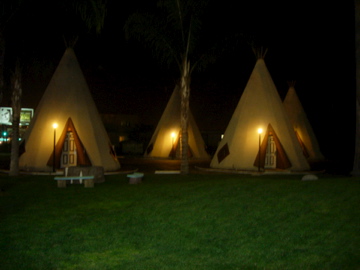
Blogging to you LIVE from the Wigwam Motel in Rialto—my own yellow, cigarette-stenched circle of heaven in the epicenter of strip malls, tract housing and Morrissey fans, the San Bernardino Valley. It’s the perfect place to end the drive down to SoCal, and to begin the journey into the dusty heart of whatever weirdness remains.

I started out on my roadtrip yesterday, sniffling and sore and in a DayQuil daze. I decided to press on with my plans, despite succumbing to a nasty cold that’s been going around, and if it hadn’t been so goddamn beautiful, it might have been painful. Spring arrived a couple days ago, with that certain lightness that makes everything seem young and hopeful and achingly pure. The coast was lit green by months of El Nino storms, a verdancy that’s rare in California. I twisted and turned on the skinny roads, blasting my stereo over the roar of wind through the rattlingly cracked windows.

I stopped in Big Sur, where I hadn’t been since I was a kid. I’d remembered it being so far away from home, which I suppose it is, but only if you measure in culture, not in miles. It was just as massively impressive as I’d remembered, with broad trees and heartbreaking cliffs and not too many tourists, being early in the year. I’d been too groggy to stop for a sandwich on the way out of town, so I pulled into Nepenthe, purported to be one of the better of Big Sur’s overpriced coastal cafes. Glorified Wonderbread, browned and soggy lettuce, and $20 later, I decided that eating a $7 sandwich from home of the hood of my car at some pretty vista point would have been a far preferable experience. Whatever—it’s Big Sur. You can’t stay disappointed that long.

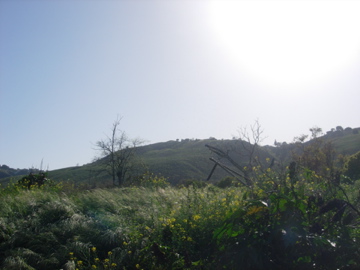
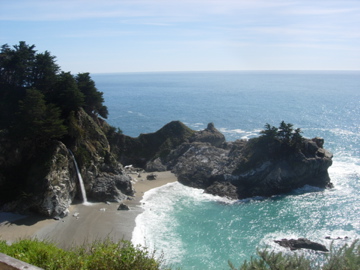
Feeling a little pepped up, I tried to do a quick hike, but discovered that a lot of the trails are currently closed due to the pummeling storms this year. So I tromped down a little coastal path, with bickering families and friendly Germans, aptly named Overlook Trail. It overlooks this:

and I felt pretty satisfied.

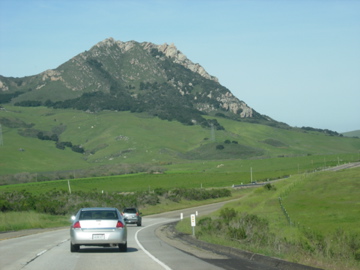
Back on the road, the coast got twistier, the pavement rougher, as I made my way down to San Luis Obispo. It’s a pretty typical California college town, with one major draw—one of the region’s few youth hostels. I grabbed a cheap bunk at Hostel Obispo, a cute old Victorian house, and took a leisurely stroll down to “Downtown,” which is really more of a high-end outdoor mall.

meeeeeat!

Traveling within the US is a novelty for me, and it comes with a couple major benefits, one of which is the use of my iPhone (far too expensive to use abroad). While the Cheap Gas and Public Restroom Finder apps have proven utterly disappointing, my old favorites are definitely coming through: Google maps and Yelp. I wanted to eat somewhere popular, that would give me a good feel for the town, and ended up at the Firestone Grill. It’s a BBQ joint heavy on portions and easy on the pocketbook, which makes sense in a college town. It was alright, about twice as good and half as much as my lunch—but 419 reviews? Then I passed the newly opened Chipotle, with a line literally out the door, and realized maybe, you know, I had had some of the best food in town.

I strolled around the town some more, filled with dudes in flip flops and girls in work-out clothes and pony-tails. It felt wholesome and relaxed—even the local riffraff felt quaint, in their barefoot belligerence. Everything felt cheerful and hopeful, like springtime and college students. I topped off the night with a much-needed soak in a hot tub at Sycamore Mineral Springs, a 12 minute drive from San Luis Obispo. My achy bones and sinus congestion thanked me.

This morning I backtracked to Montana de Oro State Park, for a little fresh air and strolling. Curving down a two-lane road, I went past coastal hills covered in purple and yellow wildflowers, orange explosions of poppies against the green green of the hills. The road took me into a tangle of eucalyptus trees; I pulled over where a bunch of cars were parked and scurried down a dirt path into a grove of trees.

The light cut through the leaves and branches and ocean mist in this dream-like haze, and all I could hear where birds and surf crashing. Over a hill and through a miniature valley (where a pelican glided past just as I rounded the corner), and I found myself at a surfer spot. I hung around a bit, sitting on the rocks and watching the waves and wet suits.

I headed back, this time inland on the 101, where flowers and green continued to line my journey. At home, I’m an impatient and cranky driver—I hate traffic, parking, street sweeping. Always an impediment to where I’m trying to go, what I’m trying to do. But driving down the coast, with my music playing and my broken skeleton doll dangling from the rearview mirror, I could let go and just go with the rhythms of the road. There was little traffic, just fresh air and beauty and my own wordless thoughts. The road was the place I was trying to go.

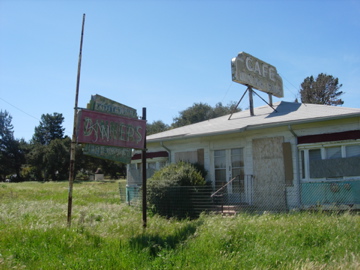
The roadside kitsch of Pea Soup Anderson’s was too much to pass up, so I made another stop—plus the soup felt good on my sore throat. Then I went to do a little un-urban exploring, swishing through thigh-high grass to poke around an abandoned diner I’d spotted from the highway. I peered through the windows at the stacked chairs, the silent booths, feeling a strange kind of nostalgia for a place I’d never been.

Things were starting to get cool.

As luck (or unluck) would have it, my iPod died just as I was cruising past Santa Barbara, so I pulled off to find a cafe. It’s hard not to feel alienated in a town like Santa Barbara, wealthy and white and homogenized and nice. Very very  nice. It’s the kind of place that feeds all your Southern California stereotypes, both the good ones—sun and long, tan legs—and the bad ones—everything else.

I got back on the highway just in time for rush hour. The green gave way to brown and billboards, the ocean mist to heat and just a thin layer of smog, the free flowing to break lights and miles of congestion. My 2 hour drive took 3 1/2. I climbed over the spine of LA, snuck around the backside, through one valley and into another. And finally pulled into the Wigwam Motel. It’s not as run-down as they say, the area not as “rough” as some reviews claimed. It’s a working class “ethnic” suburb and, hey, I’ll take that over a wealthy brofest any day. Even if it is damn hard to find a salad.

Blurry, but it does say "Get Your Kicks on Route 66." A better photo by daylight tomorrow.

So I’ve made it, my little car and me, crawling down the lip of the continent, down through the legendary beauty of coastal California, made more ridiculous by the green and tender spring. I’ve gotten reminded of what I already know of Southern California—bros and traffic—and am poised to head into the desert tomorrow. Found art, a rock n roll pilgrimage (and human cremation) site, and a honky tonk await. And that’s just tomorrow.

Los Angeles, Give Me Some of You!

“Los Angeles, give me some of you! Los Angeles come to me the way I came to you, my feet over your streets, you pretty town I loved you so much, you sad flower in the sand, you pretty town.”

John Fante, “Ask the Dust”

Us Northern Californians are prejudiced.

That’s right: prejudiced. We look down our noses, down the long craggy coastline, at Los Angeles as though it were the traffic-clogged  layer of Hell Dante forgot to mention. Tanned and Botoxed and full of silicone, Southern California steals our water, votes Republican, gave us the Governator. In its smog-laden haze of red carpets and reality shows, it skews our state’s reputation, bogs down our ethereal quest for Prius-driving utopia of gay marriage and legalized marijuana. It’s Sparta and we’re Athens, the “LA face and Oakland booty” that never quite make it onto the same person, never combine to create the ultimate bad-ass state, but instead go careening on their own individual, bickering paths of disapproval (NorCal) and complete unawareness/indifference (SoCal).

I once read an essay that whittled the whole Northern-Southern divide down to the difference between internal and external—Southern California was the glossy, teeth-whitened facade, Northern California the soulful, spiritually searching inside (you can guess which side of the debate the author fell on). It’s Bikram and we’re Hatha. And while Southern California remains too self-absorbed to even notice our despising of them, people write whole books on the cultural clashes of the US’s most populous state.

But I’ve long suspected that there’s more to Southern California than SUV-driving anorexics and flip-flop-wearing bros. It may have given us Kardashians and Speidi, but what about Charles Bukowski and John Fante, Camille Rose Garcia and The Date Farmers, The Germs and NWA? There must be, I’ve thought, a whole nuther Los Angeles, down beneath the glittering grotesque surface, that most people never see—hidden and raw, like an open wound or a small, beating heart.

I’m going to find it. I’m going, filling my beat-up car with gas and kicking the tires to check the air, going down the writhing road of Highway 1, past old Missions and crumbling cliffs, sleepy mansions and under-funded state parks. I’m headed into the desert, to psuedo-Old-West honky tonks and lawless squatter encampments. I’m watching swallows return from their long flight, to build strange nests and swoop their shadows through the dusk. And then I’m headed into the city itself, the city of Angeles and dreamers and dirtbags I’ve adored. I’ve got no traditional guidebook, no road map—just my phone and a smattering of tips divulged by friends and dug up on random websites.

Oh, and I’m taking you along for the ride.

Temporal Permanence: Ruins, Street Art and the Narrative Beneath

The speechless candlelight made the images more powerful. The way the sage billowed, the music groaned, the little light flickered—it made the images seem less like a mural and more like the hallucinogenic remnants of a dream, bloody and hand-smeared on the walls of a very dark cave, or on the inside of your skull—which may be the same thing. Dancing on the under side of your eyelids, before swollen and searching pupils, this was the stuff of mushrooms and all-nighters, of contemporary graffiti and ancient cities, of Latin American travels and my Friday night in Oakland.

The showing of Obi Kaufmann‘s mural The Feathered Serpent at The Oakbook was less like an art show than a ceremonious seance. Painted in the fever and fury of a single day and night (and mushroom trip), the mural was inspired by the artist’s recent travels through Latin America. The distinctive flavor of Santiago’s street art scene and the whispering ruins of Oaxaca’s ancient city Monte Alban swirled around in the artist’s subconscious until a dream pushed images out, from one side of the brain to the other, through his fingers and onto the wall of the gallery.

I am not an art critic, journalist, collector or student, so I won’t try to review or surmise. Instead, I’ll let the artist speak for himself. Here’s his photo essay of Santiago street art on Artopic, and his written essay about the genesis and symbolism of the piece on The Oakbook’s website.

After checking out the essays, I got pretty stoked to see the mural. The work being travel-inspired got my antennas twitching. I’d been to both Santiago and Monte Alban, I love crumbly old ruins, and I really love street art (as you’ve seen before)—often for the aesthetics but more because, as a traveler, I find it reveals so much about the beating heart of a place. I was curious to see how it all connected.

Indeed, what I found most compelling about the work (aside from the spooky images and skeletal figures) was the way it blended seemingly disparate influences. There doesn’t seem to be a lot of similarity between the streets of Santiago and the ruins of the Zapotec city Monte Alban: vibrant color versus crumbled stone; modern versus ancient; temporality versus remains—a continent, culture and two millennia apart, what commonality did these two places hold? For the artist, it was some kind of communalism, each place informing part of a narrative that was at once universal and personal, regionally distinct and part of a bigger story. Obi saw the world, human history, in the cavernous, torch-lit intersection of two places that don’t seem to intersect. And if that’s not some damn good traveling, than I don’t know what is.

The artist

Travel often brings up puzzling paradoxes (thus the tired line, “land of contrasts”). How does one hold, in the same hand, the transience of graffiti and the permanence of hard stone foundations? Or, to extend the metaphor, how does a traveler simultaneously love the spontaneity of the open road and the rootedness of home? I think the answer, if there is one, must lie somewhere down beneath all that, in the narrative thread that ties this big world together—in the collective unconscious, if you wanna get real heady. Or at least, you know, in the images and scrawlings and paint smears that have now been painted over—a wall blazing white and sealed-lipped about the stories it holds.

Would You Like Travel With That?: Why Being a Waitress is a Killer Job for a Traveler

As I’m planning my California road trip, buying plane tickets to Hawaii and Texas, and feverishly saving for a three-month galavant through Southeast Asia, I’m sometimes asked a question about work. Someone that doesn’t know me that well will wistfully gasp, “Your job lets you take that much time off?”

It’s at times like those that I realize how good I’ve got it. As a waitress.

That’s right—a waitress. It’s an inglorious job that people outside of the restaurant industry tend to look down on. It doesn’t exactly scream “motivation,” and at its worst, it screams “uneducated” or “Hooters girls.” Sigh. But the more I dig into the travel writing world, the more I’ve come to appreciate my “day” job. And despite the lack of benefits and security, it couldn’t be a better gig for me right now.

I didn’t plan it this way. But I majored in Creative Writing, and it’s not like there’s full-time gigs writing poetry. I hosted and served (and managed a local swimming pool) to get through college. I left the country for the first time after graduation, fell in love with traveling, and decided to stick around restaurants, if for nothing else than the time off (and getting to sleep in).

I’ve never worked a 9-5, never worked in an office, and never felt stifled or constrained by my job. I forget about the corporate trap of 40+ hour work weeks, because I’ve never lived it. I come across blogs with lengthy “About” descriptions detailing the karate-chop someone gave to the confines of corporate life (“I quit a job with XYZ company, sold everything and took to the road”), and I think, “Huh. That’s a life experience I totally can’t relate to.” I’ve certainly felt claustrophobic and stuck in my own life, but never because of my work.

There are trade-offs for the freedoms that come along with being a waitress—big ones. I work holidays and weekends, have never had a paid day off in my life, and the idea of a retirement plan or dental insurance is for me as exotic a fantasy as, say, traveling around the world is for some. But I swap all these securities for the one thing I can’t live, or travel, without: the ability to pick up and leave, yes, but also to not feel trapped.

And while I sometimes stress about the fact that it’s been nearly 10 years since I graduated high school and I’m “still a waitress,” I can’t help but feel I’m exactly where I’m supposed to be right now. Here’s why:

Time Off

Earlier in my “career,” I nervously asked my manager for an additional 4 days off during a month when I was already out of town for 2 weeks. He laughed. “Of course you can have the time off. That’s why you’re a server and not working for an insurance company.”

The number one plus of restaurant work for a traveler is the ability to take time off. It’s just a part of the culture—and why the cliche of a struggling artist or musician working as a server is so prevalent. The idea of being constricted to 2-3 weeks of vacation a year—paid or otherwise—scares the crap out of me. No wonder people quit their jobs to travel the world.

Flexibility

Allowing for time off is rooted in a deeper aspect of restaurant culture: flexibility. At most places it’s totally acceptable to switch shifts and in-times in order to accommodate whatever else is going on your life. Which is great for me now.

Short Hours

Shifts in most restaurants aren’t the grueling 8+ hour affairs they are in offices. My shifts currently average 5-6 hours, and are sometimes as short as 3 hours. This means that, even on days I work, I have time to write, and take care of all the tedious tasks/errands that come with being alive.

Internationalism

Because restaurant work is tough and doesn’t require traditional education, it’s chock full of immigrants. Mexicans and Central Americans fill the restaurants of California—which means you’re constantly immersed in Spanish. It’s impossible not to pick up a little Spanish in California restaurants. I’ve given myself pre-trip crash courses when I declare that no one should speak to me in English (this doesn’t really go as well as planned). As of late, I’ve been pretty lazy on the language tip; even still, I hear Spanish all the time and understand a fair amount (“Oh, Lorena, tienes un novio?”). I’m even picking up some random Mayan words (“pibil” means “baked”).

Being Active and Talking to People

Last year, I interned for several months at a rad travel website. Everyone was super nice and I enjoyed all the writing work I was doing, but the work environment felt totally alien: everyone sitting at desk, quietly clicking away on their keyboards. I was not used to the quiet, the immobility, the comfort and niceness of it all.

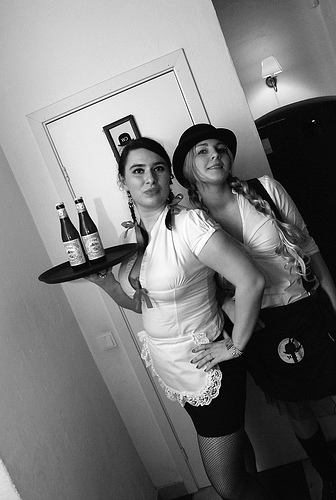
Restaurant work is visceral, and I like that. I tromp up and down stairs for hours, carrying trays of drinks and stacks of plates up my arms. I sweat. I spill salsas and half-eaten food down my apron. I sometimes have to pee for an hour, but am too busy to go. On a busy night, I’ll wait on over 100 people—interacting, reading them, talking and joking, making sure they have a good time. It’s intense and draining and I kind of love it.

But before you swap that comfy gig at the stifling job you say you hate, check out the other side of the scale: the restaurant work bummers.

When waitressing sucks your soul out...

No benefits

And I don’t just mean health benefits. These days, most restaurants in the Bay Area offer some kind of health insurance (albeit chintzy and hard to qualify for). What I mean are all the other “kushy” benefits (benefits that are automatics for all workers in some other countries—but that’s another post…).

I can take all the time I want off, but none of it is paid. That extends to paid holidays and sick days. If you’ve got the flu, tough. Maybe your landlord will accept a doctor’s note. Even those legally required 10 minute breaks are the stuff of waitress fantasy. Maybe someday we’ll unionize. Until then, we pop DayQuil and work sick.

No security

It’s not just the lack of unions; the lack of security in the restaurant world again goes down to the very nature of the job. When times are hard, as they are now, one of the first things people cut is eating out. Or worse, tipping. And there’s no safety net under the waitressing tightrope.

In most restaurants, you earn minimum wage (in some states, they can pay you under minimum wage; I knew a server in NYC who made $3.12 an hour!), which is usually just enough to cover taxes. So essentially all the money you’re making is from tips. If you have a slow night, get a string of 10% tippers, or, oh say, the economy totally falls into the shitter, you’re quickly screwed. There’s no guaranteed income to fall back on. By the same token, though, you can make insane amounts of money when times are good. But if you don’t know how to budget, it can devolve into a feast-or-famine lifestyle.

Hard on the body

The restaurant industry is great when you’re young and energetic and can’t stand the thought of sitting in a chair all day. But it’s not an industry to grow old in. Long hours on your feet, carrying trays and plates, seriously wears you down. By 23, I already had chronic lower back pain and an interstate roadmap of varicose veins criss-crossing my legs.

But these are the markings of someone who works for a living, like the calluses of my dad’s hands, the unwashable black under my brother’s nails: work you wear, that wears you. Whether I planned it this way or not, waitressing as become a part of me. And until I scramble my way to the top of travel writing heap (wink, wink), it’s not a bad way to earn my rent, fund my travels—and get the hell out of town.

Lascivious Voyeurism, and The One Double-Decker Bus I’d Totally Ride

Flickr Tourist

To tour or not to tour? Or, better yet, to cruise.

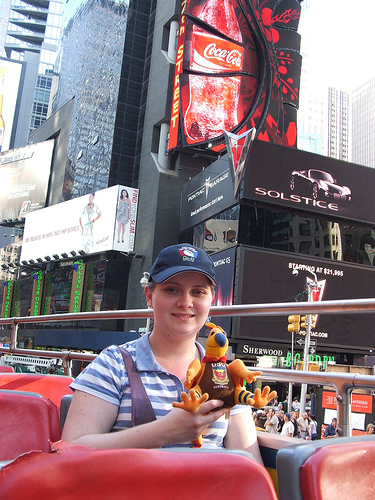
Tours are almost not debatable. Independent travelers are supposed to be “too cool” for them. “Tour” is the very root (not just linguistically) of that dirty word, “tourist.” One of my favorite “knower of things” Mike Barish recently wrote a post on why it’s ok to take tours, referencing another article that also advocated for tours. Both articles received a fair amount of comments, in which readers debated the pros and cons of group tours.

While die-hard backpackers and shunners of all thing commercial loathe any type of tour, there’s one thing I’d venture to argue all independent travelers are averse to: the double-decker tour bus. Amplified, elevated symbols of all things cringably touristic, the most vile and offensive of guided tours, full of fanny packs and clicking shutters, whisking you here and there so you don’t have to actually interact with the place, and its full, living, breathing placeness. They’re bland, overpriced and utterly nerdy.

Unless you ended up in Manhattan in the 90s, with Timothy “Speed” Levitch as your guide—spouting facts and philosophies, possessed with passion, quoting everyone from Ira Gershwin to Thomas Paine to Henry Miller, monologuing, ad libing and waxing poetic about the city that stole his heart on a regular basis. Then it’s about as uncommercial as you can get.

Last night I watched the 1998 documentary, “The Cruise,” a profile of Manhattan double-decker tour bus guide Timothy “Speed” Levitch. To say he’s eccentric doesn’t begin to get at it; a reviewer on the DVD jacket calls him, “the guy Woody Allen can only dream of being.” The 76-minute movie is a peak into the mind of a madman/genius that turned tour guiding into an art. Now that’s an accomplishment.

[I couldn’t get the embedded url to work, but please follow this link to view “The Cruise” trailer.]

In a fevered frenzy of poetic genius, Levitch uses Willy Wonka and Virgil as his muses for tour guiding (um, bad-ass). For him, tour guiding—an extension of his life philosophy of “cruising”—is his chance to divulge riders of the glorious aliveness of New York City, and of life, in a loop of “lascivious voyeurism.” Clips from his tours are more like performance art, aching with a sensitivity and a passion that makes you want to cry—and laugh out loud at the absurd beauty of it.

Levitch is a tragic, intense, complex figure—in short, an artist. He goes off on the alienating confinement of grid-pattern urban planning, has a near orgasmic experience with architecture, relates to the stones of the Brooklyn Bridge like a living thing. It reminded me of the song “Under the Bridge,” in which Anthony Kiedis related to LA like a person, a comrade, a true friend. Levitch relates to New York City as a “living organism,” and has one of the most intense relationships with place that I’ve ever seen documented.

Of course, a person can’t be that insanely sensitive without being a little, well, off. This isn’t a kind world for people with such profound passion, who haven’t learned to filter things out, grow desensitized and most-of-the-time immune to the “frantic chaos of this limitless universe.” Levitch’s life philosophy of “cruising” (exploring/adventuring/seizing the moment and being completely free) versus “anti-cruising” (being confined and held back by societal norms and mediocracies) offers a fascinating glimpse into the psyche of someone that has sought to “transcend… air conditioning, comfortable couches… the magnitude of static that surrounds us.”

After the documentary came out in 98, Levitch enjoyed semi-celebrity, the object of a modest cult following. He relocated to the Bay Area for a time, where he led San Francisco tours and lived in—where else?—Oakland. Promos for his SF tours feel less inspired—by no means generic, but lacking the spark of genius. His band played in various Bay Area nightclubs from time to time, Levitch appearing grayed and reclusive. It seemed as though the light, the fire, had dimmed.

The documentary isn’t strictly a travel piece, becoming more of a tender glimpse into the heart and soul of a true eccentric, but I couldn’t help but wonder what must have been going through the minds of the people on those double-deckers. Unsuspecting, herding onto the bus, thinking they’d learn a little history and snap a few good photos—and then delivered a fantastic, fanatic monologue that captured not just a love for a city, but for life. That included little gems like: “Down the street, commuters, running towards their destinations—and from themselves.”

If a double-decker tour can be turned into a work of art, well, traveler scene cred be damned. Sign me up.

It Itches!: Feeling the Burn of Wanderlust

Itchy itchy...

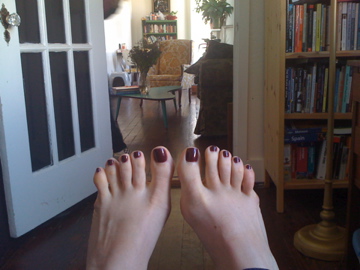
“I’ve been home for nearly 4 months. My feet are so itchy, it feels like I got athlete’s foot.”

Okay, it was a bad joke. But that’s what Twitter’s for, right?

It’s not that I’m counting the days (not really). It’s not that I’m unhappy in my life at home or looking for escape. It’s just that I have this “incurable wanderlust” (what @cultoftravel speculated was worse than swine flu), and the more I read about travel, write about travel, tweet about travel, and am generally immersed in a virtual sea of travel, the worse it gets. I don’t have any problem going to a bar and not drinking, but reading travel blogs and knowing I won’t be doing any serious adventuring for a few more months—well, that’s tough. Ever since my first trip, I’ve gotten antsy when I’ve stayed at home too long. This whole travel writing business is adding a little more heat to the ring of fire.

I may be chomping at the bit, but it’s all good stuff that’s keeping me home. I have a niece on the way, my dad is retiring, and I have four friends getting married in the early half of the summer. All totally happy, exciting things that I’m grateful to be a part of. Plus it gives me a chance to save up for my next long trip, a three-monther around Southeast Asia.

In the mean time, I’m plotting a little solo California roadtrip for next month. Partly to visit an old friend, partly to see the swallows of San Juan Capistrano. Partly because I haven’t driven down Highway 1 since I was a kid, and partly because I’m curious what kind of conversations you get into with yourself after days of driving solo. Partly to debunk my own stereotypes of Southern California as a cultural wasteland of SUVs, strip malls and Kardashians, and partly to practice toting my laptop on the road with me. But, honestly, the trip is largely a keep-me-sane tide-me-over until the funds and circumstances—aka The Travel Gods—see fit to unleash me on the world again.

So as my feet are itching, my fingers twitching and my plans to high-tail it down the highway taking shape, I uncovered an old poem about restlessness, impulsivity and the physical road that hit the spot.

MacArthur Maze

Let’s drive this thing

into the blood burning sky.

/

Let’s take this road

potholed and hissing

past the pitched roofs

and pigeon wings,

past electrical wires

and blown-out streetlamps,

brown hills

where the grass cackles

and waits

to be lit.

/

Let’s curve

into the black, under

the overpass, past

the vacated bodies,

curled in and sighing—

/

Let’s take this thing

where it leads,

if it leads,

or stampedes

/

us into a sunburnt sky

the color of our own

sunburnt skin.

Now get me on the road!


Lauren Quinn is a writer and traveler currently living in Hanoi. Lonely Girl Travels was a blog of her sola travels and expat living from 2009 to 2012. She resides elsewhere on the internet now.

Join 490 other subscribers

Buy This Sh#t

Categories