Archive Page 29

Legzira Love

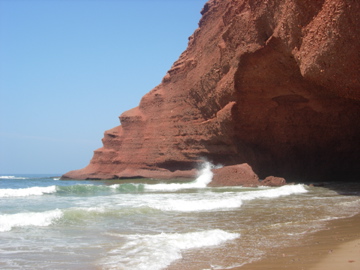
DSCN3456I think I may have just found the most beautiful beach in the world.

Yes, it’s a sweeping statement, and no, I’m not a beach afficionado. But if red cliffs diving into pebbled sand coves count for anything; if lazy waves crashing against sandstone arches score points; if a tourist to local fishman/swooping seagull/stray dog/donkey (hey, it’s still Morocco) ratio of 1:5 means much—if these are the elements that create that “paradise” thing all the guidebooks talk about, well then, I just spent the night there. And slept with the windows open to the ocean. Cause why not, you know?

Legzira Plage is pretty incognito—it warrants not more than a paragraph in my guidebook and a weathered-beaten, graffitied roadside sign along the pretty two-lane highway connecting Tiznit, Mirleft and Sidi Ifni. Down Morocco’s Atlantic coastline, just before the Western Sahara and a disputed border, the area as a whole doesn’t attract the hordes that the country’s other wonders do—which is why it attracted me. A near-deserted beach away from any big city or pushy tout? I’m in.

I took the local bus from Mirleft, got off at the faded cement block sign at the access road, and took the 20 minute walk down to the beach, a lazy slope washed in ocean breezes. The scenery revealed itself like a striptease: a sweeping hill view, a peak of ocean, the sound of waves, the pink edge of a pink building. I turned into a small dirt parking lot, and almost started laughing—it was so beautiful, it was almost obscene.
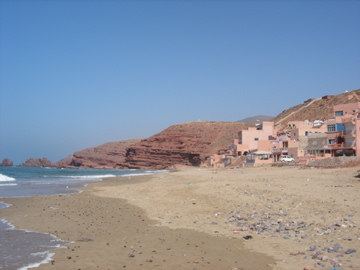
DSCN3464There were half-a-dozen pink buildings cascading down the cliff to the beach. Sweaty and shoulders aching, I set my backpack down in a cheap but cheerful hotel room with windows that flung open to the ocean. (Now thoroughly “off the beaten path,” the room costed only a little more than my smelly toilet- and shower-less hole in Essaouira.) I kicked off my shoes, grabbed my camera, and went for a walk.

I’m not much of a shutterbug, but I exhausted both my camera battery and memory card. I walked for over an hour; each cove was more secluded and empty than the last. On the first few beaches, I passed a small group of teenagers playing soccer, a fisherman, and a handful of sun-bathing tourists, many of them Moroccan (tell-tale sign: the lady’s swimming fully clothed). We “bonjour”ed politely. I rounded a gently jutting set of red rocks, and was alone. I closed my eyes, and let out a long exhale.

I’ve really been liking Morocco, but I can’t tell you how good it felt to be alone, away from any non-human sound—just me and the seagulls, you know? Later, I stripped down to my swim suit, and wave-hopped and sun-bathed without concern for modesty. I soaked up much-needed sun, vitamin D sparking wildly through my body. I didn’t worry about, well, anything.

I had a simple dinner of grilled fish (yes, caught that afternoon) and pommes frites, washed down by that killer mint tea. The hotel’s patio was sparsely populated with about a dozen dining guests. If there were any less people, I realized, it would have felt creepy. Like The Shining or something.

The hotel only ran electricity for prime hours during the evening, so I read by candlelight for awhile before crashing out. It was warm enough, so I left the windows open and slept to sound of the waves, to the smell of salt.
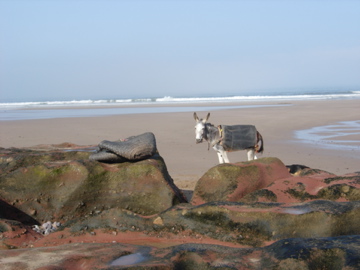
Donkey on the beach!

Donkey on the beach!

In the morning, the fog outside the window was thick. The tide was so far out that a previously offshore crag of rocks connected to the beach. I sipped my freshly squeezed orange juice and nibbled on my still-warm bread breakfast, and watched the fishmen trod out for the day, the sifters search out clams and mussels (I think) in the tide pools. A waiting donkey with two empty sacks on its side bickered with a yapping stray dog with a wobbly magazine of stretched-out nipples. The fog thinned, turned to a fine mist, and slowly, so faintly I could hardly notice, was gone.

I don’t know why Legzira Plage is so under-visited, under-promoted and unknown. But I’m not complaining. My camera battery may have konked out, but my personal battery is fully recharged. Just in time for Marrakech.
The Best Tour Guides in Mirleft

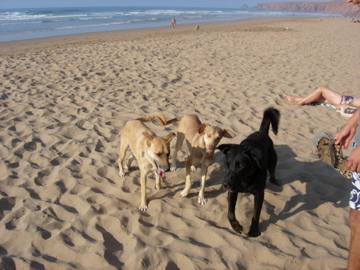
DSCN3389Yesterday I found the best 3 tour guides in town. No, they weren’t the touts that surrounded me shouting in 3 different languages and tugging me in 12 different directions the second I stepped out of the grand taxi from Tiznit. They were a rag-tag group of stray dogs that led me around the Berber beach town of Mirleft for over 2 hours.
We met outside my hotel, Hotel Atlas, the cleanest, cutest and most well equipped of my trip thus far (hot water, flushing toilets AND toilet paper—hot damn!). The leader, a German Sheppard looking female with a mangled hind leg and a black patch of furless scar tissue, greeted me as joyously as an old friend. I politely explained that I didn’t have any food, but she didn’t seem to mind. I’m not as worn out by the street dogs as everyone else in town is; I didn’t shoo them away, just kind of smiled and kept walking down the dirt main road toward the beach.

The dog immediately took the role of loyal and ardent defender, barking and growling at every scooter and donkey that passed, as well as a couple old men and frightened schoolgirls. I smiled and shrugged at them; we exchanged chuckles.

Along our pebbled-path way, we picked up a couple other boney-ribbed dogs who displayed proper supplication to the leader. I didn’t know where I was going other than coastward; Mirleft is too small to warrant a map in my guidebook. So the dogs would trot off ahead of me, sniffing through refuse and gnawing on plastic bottles. When we’d reach a crossroads, they’d pause and wait for me to catch up before continuing waggingily along whatever way they thought was best. Who was I not to follow? They knew the town better than me, and I was grateful for the speechless company.

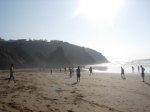
DSCN3394They led me down a steep flight of cliffside stairs into a cove of jagged rocks and gleaming sand. Shirtless local boys were playing afternoon soccer and a couple tourists sat out on blankets. My guides dashed off to leap in the waves; I rolled up my jeans and waded behind them.
I wanted to tip them—I certainly would be expected to if they were people—but thought they’d be terribly uninterested in my pocket full of coins. I rustled some stale crackers out of my bag, and they chewed them gratefully. I sat in the sand and watched them trot off, skinny and mangled and more-or-less happy.

Vomit Ride Through the Heat-Land: Part II

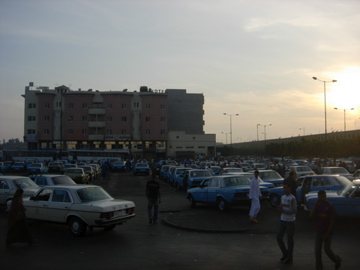
Grand taxis outside the bus station

Grand taxis outside the bus station

We groaned our way along the highway, rocking and swaying with every dip in the road. The air-conditioning had completely given out; I was grateful to be sitting by one of the few curtains, blocking out the mid-day sun. I shifted around the cheap shawl I had covering my bare arms and realized I was sweating so badly the blue dye was wearing off on my sticky arms.

I devolved into lamaze breathing. Well, no, not really—but I did employ the breathing technique I learned in yoga class to release heat: exhaling with a “hah,” like you’re fogging up a mirror (or a steaming bus window). Burning it up in a power lunge or cramped to hell on a sweat-bomb bus, it really does help. It also took my focus of my increasing nausea, not at all abetted by the chorus of gagging and spitting surrounding me. Despite having passed all those littered landscapes, I felt immensely grateful for plastic bags.

Others around me weren’t so lucky. The poor boy left crouching in the stairwell—some kind soul had supplied him with some newspaper to sit on—had been puking more or less constantly the whole ride, now approaching 3 hours. He’d been provided with an arsenal of plastic bags, a supply he apparently exhausted. That’s right—I saw his desperate face, checks full and eyes searching, then heard the sound of splattering on the stairs. A chorus of shouts erupted; the tout appeared with a fist full of newspaper and women waved robed arms in an effort to fan away the smell. It didn’t help much—in the heat, the vomit pile festered, wafting odiferously through the bus carriage in rank waves.

Any minute now, I told myself, we’ll get to Agadir. It wasn’t my destination, only a little more than half-way along, but a big transfer point. Hopefully the stop would be long enough for someone to hose down the floor.

We careened past a cliffside, a gorgeous view that I could almost enjoy through the misery. We passed construction cranes and cinderblocks outside Agadir, a package holiday town more akin to Miami than Morocco. Traversing a tangle of traffic, we pulled into the bus station. Doors sighed open and people pushed towards the front stairs to disembark.

Most of the passengers weren’t staying on for the rest of the ride, so I took advantage of the time before the next batch of grim faces boarded and got myself a primo seat: closer to the front, on the unsunny side, under the blowingest vent I could find. I smiled to myself, privately pleased that I had endured the trip without vomitting. You’re tougher than you think, I congratulated myself. I felt validated,  rewarded by the best seat on the bus.

We sat for awhile. This didn’t surprise me; most non-first-class buses don’t maintain timetables, just wait until the bus is full—or overly full—before departing. A new round of unsmiling people trickled on, along with the usual tissue, jewelery and snack sellers that enter through the front doors, shout the names of their goods as though you couldn’t see what they were, then exit through the back doors. Additionally, a sullen woman with a dirty scowl distributed those Xeroxed scraps of paper, telling her story of hardship, to each passenger; as per usual, she made her way back down the aisle, recollecting the papers and giving an even dirtier look to anyone who didn’t give her a couple coins. Though the paper was hand-written in jagged Arabic and I could have feigned ignorance, her bullying expression inspired me to give her some change.

No one, I noted, was coming to clean up the back stairs. I sighed, taking solace in my good seat and that fact that the worst heat of the day had passed.

The tout poked his head through the open door and pointed accusingly at me. “Tiznit?” he bellowed. I felt all eyes on me. “Tiznit,” I echoed with a nod, confirming my final destination. He gave one hard nod and disappeared.

He came back a couple minutes later, placed his hand surprisingly softly on my shoulder and launched into a choppy French explaination I couldn’t begin to understand as he ushered me off the bus. “Tiznit?” I asked feebly, pointing at my well-earned seat, fading as I stepped down the bus stairs. “Oui, oui, Tiznit,” he replied as he dug my dirty backpack out of the luggage compartment, hoisted over his shoulder, and walked me over to another, scrawnier bus. He tossed my bag into its luggage compartment, patting his hand firmly against the dented side of the bus. “Tiznit!” he assured me, and then was gone into the scurry of bodies and glint of steel that filled the station lot.

I stepped disheartened onto my new bus. The seats were scattered with a couple forlorn looking faces. They looked like they’d been there awhile; from the number of empty seats, I didn’t anticipate leaving any time soon. I flopped into a sun-baked vinyl seat and scowled. Through the window, I watched my sense of victory lumber away on the previous bus.

It was an hour before we left the station. Night fell pinkly and hazily between the palm trees and pebbles outside the window. Exhausted, I surrendered to a neck-jerking broken sleep; I woke just as a row of lights was growing closer.

Instead of a bus station, I was deposited on the side of a half-deserted road. Some teenagers hooted at me as I hoisted on my backpack; I gave them the finger and crossed the street to the Teleboutique. I had to call my hosts—at last, I had arrived.

Vomit Ride Through the Heat-land: Part I

1009173272_3ef7bfbbe6Yesterday I had the most authentic Moroccan experience of my trip so far. It wasn’t in a medina, it wasn’t at any monument; it wasn’t outside of a mosque or inside of carpet shop. It wasn’t in some exotic spice souq, or even with a witch doctor.
It was knees-to-chest, sweating obscenely, holding my breath and trying not a vomit in a catastrophic cauldron that careened its way through the countryside. That is to say, it was on a bus.

There’s two kinds of buses in Morocco: the first-class and the “other.” My previous two bus rides had been on the plush, first-class CTM company. The guidebook doesn’t just recommend CTM; it virtually doesn’t list the times, prices or destinations of other companies. In most cities, CTM’s buses depart from their own seperate offices, far from the chaos and heat and exhaust-laced smell of rotting ass characteristic to most bus stations, not just in Morocco, but around the world.

CTM accepts credit cards and assigns seats; their desk workers speak English. These are not the buses of screaming children or those checkered mesh bags fraying at the plastic seams from the weight of all some old lady’s worldly possessions. These are the buses of laptops and exquisite scarves, polo shirts and heavy gold rings. And independent travelers with Western standards and a low tolerance for long-distance discomfort. Together, we bound competently down the highways, stretching our legs and basking beneath the gentle blow of air-conditioning vents.

Once on board a CTM bus, you usually make a stop at the big messy main bus station before departing a city. In Tangier, I parted my curtain and peered out at the shouting, scrambling insanity of the real bus station. Jam-packed buses, a jumble of children’s bodies and grim faces pressed against tinted glass, heaved and wheezed and lurched haphazardly through the lot, shouting touts hanging from still-open doors. I have to say, I felt kind of like a chump from my kooshy assigned seat in a half-empty bus. At least once on this trip, I told myself, I’ll ride a real bus.

I intended to fulfill this brazen commitment on some short-distance route—45 minutes, an hour tops. Just, you know, to feel like I’d done it, gotten a taste and promptly gotten out.

The problem is, CTM runs infrequent services to only a few destinations, especially towards the south of the country. In my great haste to flee dishearteningly over-touristed Essaouira, I weighed my options: languish at the bus station and continue to get hassled by hotel and taxi touts for two hours while I wait for the CTM bus, and then have to make a connection mid-way through my journey, or hop on a direct “other” bus leaving in 15 minutes. Comfort flew out the window as I climbed the sticky stairs of the second-class bus.

I found an empty seat towards the back, and observed. This was the bus of acne and deep wrinkles, missing teeth and stern expressions. Children didn’t get seats, were left to swim on the laps of their parents. Upholstery was browned; I could feel the springs through the thinned seat fabric. A tout with a scar on his chin and impossibly stained fingers came off and on the bus, taking money, scribbling crude tickets, counting seats. I was grateful for the wobbling vents that blew a little air down from above my seat.

As the seats filled and the horn honked, people continued to pile on. The tout appeared with a stack of plastic stools; he strained to tug them apart and, after some shouting and coordination, placed them in the narrow aisle. Women were given stool seats first, then men; an adolscent clutching a book and a plastic bag was left standing. As the bus began its lumbering, the tout yelled at him to get down. The boy curved himself into the back stairwell—we slid past the officials at the station gates and were on our way.

The tout continued collecting fares and writing tickets as we lurched through the taxi- and scooter-swarmed streets—not an easy task on an old bus with poor shocks and an aisle full of huddled bodies. To get the job done, he balanced his feet on the edges of seats and literally climbed over people, his crotch in this lady’s face, his elbow in that guy’s chest, his entire torso smashed against my already-sweating body. He clutched a fistfull of bills, carefully folded between each finger, and with each new fare, made an almost tenderly careful note on a worn piece of paper.

We left the city center and began up a steep hill. The bus struggled, slowed to a speed scantly faster than a donkey cart. The effort cut out the faint blow of air-conditioning, and arms raised to fiddle hopefully with vents. The boy next to me unscrewed the top to a pocket-sized perfume bottle, pressed it against his nostril and inhaled. The tout distributed black plastic bags—vomit bags, I suspected. Beside me, the boy tossed a jacket over his head, leaned against the window and was gone.

Less than 15 minutes after departing, the adolscent in the stairwell began politely hurling with a liquidus sound into his plastic bag. I could make out, displayed proudly on the top of the windshield, just the last words of the bus company’s name: “Fadl Allah.” I jokingly translated this to myself as “pray to f%^*ing God.” The boy in the stairwell caught his breath and discreetly tied the handles of his bag together.

We made our first stop, and much shouting and shuffling ensued. The tout had the disembarkers already climbing over the aisle-sitters before the bus was stopped. We paused only momentarily; those getting off were left on the dusty roadside, struggling with heavy bags. Stools were cleared for vacated seats, and a new slew of stern faces took their squatting place on the plastic as we bumbled back on the road.

We fell into a determined quiet, just the struggle of the bus, soft conversations and the gentle gagging of vomiters. The scenery was pebbled and stark, branches bent cryptically; with the vent back a’blowing, I was almost comfortable enough to fall into a ragged sleep.

The Case for Casa

2501980441_83e5e9331eI didn’t plan on spending a night in Casablanca, but my bowels had other ideas.
Traveler’s diarrhoea—whatever, it happens; I’ll spare you the sordid details. Let’s just say that dehydration, gurgling cramps and lack of sleep, coupled with the stifling heat and constricted leg room of the 3-hour train ride from Meknes (this ain’t no Eurostar), were sufficient impetus to delay my connecting 7-hour bus ride in favor of a bed and flushing toilet. And so I ended up spending a night and morning in “the least Moroccan” city in Morocco, famous more for old Hollywood than medinas.

Most travelers and guidebooks will advise the eager tourist against anything more than lay-overs in what is arguably Morocco’s most well-known city. It’s too Westernized, they say, not exotic enough—full of all the traffic and shiny buildings and business men of home. It’s not the real Morocco, the cumin-scented crumbling alleyways of your fantasies.

During my lovely 2-day London lay-over, I read a Guardian travel article about Casablanca that my host had thoughtfully set aside for me. The author argued that Casablanca was just as much the real Morocco as anywhere else—and lacked the hassles and over-tourism of many of the country’s more popular destinations. I nibbled my morning toast and read with skepticism—sounded like a writer working a little too hard for an angle, to say something fresh and different.

Well, I’ll be god-damned if he wasn’t right.

Now, don’t get all excited. It’s true that Casablanca is not a beautiful or artistically cultured city; it doesn’t “boast” a lot of sights and its stray-cat- and donkey-less medina feels more like an outdoor strip mall than a relic of ancient urbanity. But Casablanca reveals a different side of Morocco, the struggles and tensions on the other end of the booming economy and rapidly growing tourism. I’m grateful for my extended stop-over in the city; without it, I don’t think I’d have gotten as full a view of the country.

Casablanca’s streets are filled with a different kind of energy—people swarming rhythmically and cross-walk-less across vast boulevards of sleek new cars and gasping palm trees. French business men and snappily dressed black Africans drop coins into the gnarled cupped palms of beggars. Less fortunate immigrants walk slowly along the sidewalks, displaying goods: tissues, random electronics, watches; they have thin arms, impossibly high cheekbones and a kind of dignified desperation. Young girls wear jellabas like bathrobes, carelessly; just as often, they sport bare arms and skinny jeans. The air is thick with honking horns, the streets grimy and littered. Colonial building facades look as though they’ve grown tired of being elegant; beside them, mirrored-glass new construction shoots into the sky arrogantly.

Despite an thriving economy—it grew nearly 6 percent in 2007—around 19 percent of the Moroccan population lives under the poverty line; no where is this more evident than in Casablanca. On the train ride in, we passed through scores of squatter settlements, sagging structures whose tin roofs were anchored with old tires and heavy rocks, sometimes a satellite dish. In direct contrast is the oceanside Hassan II Mosque, a half-billion-dollar monument to opulence and Islam that would have been offensive if it weren’t so damn impressive.  Since the 80s, Casablanca has also been the site of political uprisings, brutal repressions and suicide bombings.

You get a sense of this all walking the alternatingly busted-up and newly paved streets of the city—or slowly sipping mint tea at the cafes, what my sore stomach called for. I sat and watched the city, its people, pass; it fascinated me past my exhaustation and illness. In exchange, the city largely ignored me; I was just another poorly dressed, sallowed foreigner, totally uninteresting.

Casablanca’s not the kind of place to top itineraries. It’s not for the tourist who gushes glowingly about the authenticity of the Fez medina, or the simple quiantness of mountain village folk. It’s not for those seeking out some preconceived vision of exotism, doesn’t even try to live up to any stereotypes. It’s not for people looking to “get away” from it all. But if you wanna get a glimpse of what’s going on behind the carpet shops and faux guides, if you’re interested in seeing all of a country poised forever at a  crossroads of cultures and continents, if you’re traveling and not vacationing, I’d give it a look. Just be sure to buy some tissue along the way; you’ll need it in the bathrooms.

Bonjour guapa, you want sex?

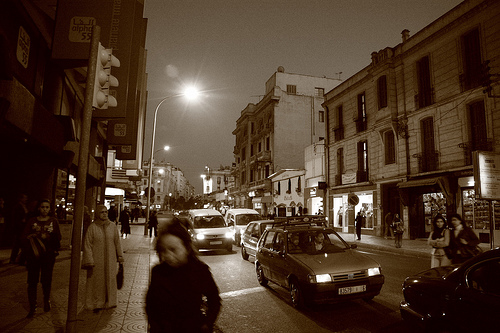
No way did I flatter those boys with a photo. Here's a busy street in Meknes instead.

No way did I flatter those boys with a photo. Here's a busy street in Meknes instead.

In Fez and Meknes, I finally got a taste of the street harassment all the guidebooks warn of. It was still a lot tamer than anticipated, a multilingual assault of adolescent bravado more than an actual threat. Though the intention spans the confines of language, it’s easiest to brush off these comments when they’re in French or Spanish. It’s a little like having monkeys hurl feces at you; it sticks less when you don’t know the actual words being said.

But those boys are a cunning lot, and have managed to master a few key phrases in English: “massage”, “sex”, “fuck”, and most telling of all, “you like me?” Just to be safe, they like to mix it up, covering all linguistic bases, just to make sure their intention is entirely communicated.

The harassment comes nearly exclusively from one group, teenagers in Western clothing. Adult men are by-and-large very respectful; if anything, they want to sell you something, but I’ve had far more pleasant exchanges with adult Moroccan men than not. The young guys dressed in traditional jellabas tend to just ignore me, which is A-OK; same with the poorer young men, who just want to shine my dirty sneakers or sell me some tissue. It’s the 12-18 year olds in faux Western clothing you’ve gotta watch out for.

They hang in packs, pushing and nudging and teasing one another. They’re a kind of pathetic lot: thin and self-conscious, somehow lost in their t-shirts and blue jeans, short hair over-gelled and haphazardly spiked. They are consumed by this proposterous posturing, seeming at once to resent and idolize Western culture. They desperately strive to emulate it, can’t quite get it right; their cat-calls and gross comments feel like a plea for acknowledgment, validation. They want so much to be taken seriously, to be something other than what they are—and in that way, I suppose they’re not unlike any other ill-at-ease teenager. I can relate to the insecurity, know so well where it springs from, and I almost feel sorry for them when I see them all there, so sadly absurd in their metallic G Star Raw shirts and bedazzled-pockets denim.

And then they say some dumb shit, and I don’t feel so sorry for them anymore.

It’s a pain in the ass, for sure, but it seems to be something that comes with the territory, part of what it means to be born female in this world. It can wear you down—I may or may not have snapped and thrown a banana peel at a man in Venezuela once—but I’m sure as hell not gonna let it stop me from seeing the world, from being in it as fully as I can. I’m just gonna cover myself in thick-ass skin, maybe a tarp or something. You know, so the feces doesn’t stick.

The Glamorous Life of a Budding Travel Writer

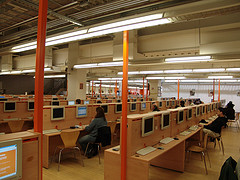
Internet cafes usually lack the "cafe" ambiance

Internet cafes usually lack the "cafe" ambiance

Sure, I wandered the cobbled streets of Tarifa’s old city, took a walk along the deserted pebbled beach, sipped cafe con leche and watched the comings and goings from a streetside cafe. I also holed up in an internet cafe for over two hours and wrote. Some of it was catching up on my blog, some of it was checking bank accounts and responding to emails, and some of it was writing an article on credit card rewards programs.

I know, I know—you’re jealous, and it’s wrong of me to rub in your faces the glamour of the profession I’ve so haphazardry embarked upon. But this is the truth of it, from what I’ve acertained and thus far experienced: the majority of writing a travel writer gets published, at least on the on-set, is service-oriented and, well, kind of unexciting.

But it’s extremely useful—I’ve advised friends on how to make the most of rewards programs, and I’m certain other travelers will find value in this nuts-and-bolts type of article. I get to plug my own blog, make connections with editors and readers, and add one more piece to my portfolio. Is it earth-shattering, thought-provoking or emotionally stirring? No. But is it a start; is it still my name in print and a little more experience? For sure.

With that long-winded intro, you can check out the article, published on StartBackpacking, here.

I’ve been puttering through Lonely Planet’s Guide to Travel Writing, written and edited by Don George, co-founder of the Book Passage Travel Writers & Photographers Conference I attended, a heavy-weight in the industry and all-around nice guy. The book includes a lot of great information; I’ve especially been enjoying the author interviews. All of the the folks interviewed, well-established and successful travel writers, say the same thing: there’s no glamour or money in travel writing (I’d extend that to most types of writing). You’ve gotta do it for the love of it, cause you can’t think of any other way to live your life.

If that’s the case, I suspect I might be on the right track.

Fez Through the Window

DSCN3272I arrived last night in the swarming, honking, neon-lit mess of life that is Fez.

The excruciatingly haggled taxi I shared with a mother-daughter duo from the bus station to the medina (we were accused of being “cheap like Berbers”—is racism usually an effective bartering technique?) deposited us at the gates to the 1200-year-old medina, what the guidebooks call the entryway back in time, into another world. After eight hours on a rattling first-class bus through plastic-littered landscapes and vast expanses of mountains, forests and fields, it felt like I had been belched into a place where millennia collided. I was swarmed in the frenzied, electric chaos of humanity—and, as always, I loved it.

I grabbed a room in the first cheap hotel I spotted, a simple space not much bigger than the double bed that occupied it. The wooden shutters were thrown open, revealing the light and noise, the smell of strange spices and the hum of motorbikes, the grit and life and incessant sea of people on the throughfare below. It didn’t matter that the threadbare room was only 80 dirhams (about $10) a night; I wanted it for those windows.

I knew it would be noisy (why one should always travel with earplugs), and I’m sure the novelty of the hustle-bustle will wear off, but so far, I’ve loved sitting hunched over my notebook on the lumpy mattress, staring out through the wrought-iron bars at the street—my own private perch, where I can spy like a secret, and take it all in.

I closed the shutters around 11pm last night, with stereos still bumping, engines groaning, dogs barking and cats crying and men shouting intermittenly. The glass of the shutters had been crudely painted over, so some of the street still got in, a thin illumination reminding me where I was. My earplugs only slightly muffled the medina din.

When I woke, I took out the earplugs and just laid, listening to the street as it arose, stretched, came alive. Birds shrieked in a high-pitched panic; a voice boomed from a loud speaker, wailed in prayer. Metal shutters rattled awake and voices called to one another; somewhere, a rooster crowed. I wiggled the warped wood apart; the smells of cooking meat and mint burst through. I sat and stared from my bed at the ancient city, its beaten streets and ashy rooftops, its sand-colored crumble of stone on stone, its endless passing of colored robes.

I had arrived in the heart of it, and was ready to join in.

Morocco: First Impressions

DSCN3259As I staggered off the Tarifa ferry, through the desserted port gates and into the quiet Tangier morning, I had a thought I’ve had before. It was the same thought I had as I first stared through a taxi window at the hazy Lima streets, when I first stepped out the Bogota airport, when I walked around big bad cities like Caracas and Mexico City. The thought is, “Oh. This is it?”
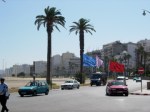
And I don’t mean it in a disappointed, anti-climatic way. The opposite, in fact. After all the hype, all the warnings and precautions, horror stories and wayward looks, my initial reaction to notorious destinations I’ve encountered is, “Hey, this isn’t so bad. Or so scary or different.”

Okay, I admit the squat toilet I used earlier in a restaurant bathroom was a little different. And I didn’t expect that hooded jellabas would look so curiously like clan robes. But, really—the intense cultural shock I’d been prepping for, again, didn’t hit.

My guidebook had prepared me to be inundated with pushy faux guides as soon as I left the port gates, to be lured into medina shops and held captive till I bought something, to be oogled and followed like a celebrity by sex-starved adolescents because I’m a solo Western female. Guess what? None of these things happened.

DSCN3241What did happen: I left the port gates, took a moment getting my orientation, and found the left luggage office. The clerk and I fumbled with mutally poor Spanish, and I left my backpack secure. I headed uphill, largely ignored by every passerby, and parked it at a cafe along the Grand Socco. I lazed, and have been wandering the Medina and Ville Nouvelle ever since. I plan on getting a coffee at the Beat-beloved Cafe Paris before meeting up with my couchsurfing host (only slightly concerned we won’t actually connect).
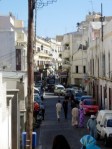
So far, the street harassment I so feared is, well, about what it is at home. Maybe less. A few young men have said hello in whatever white-person language they think I might speak; I’ve been the target of one gross kissing sound, and received one offer to be bought coffee. In short, Latin America still wins the prize for harassment, cat-calling and all-around-demeaning (but what kind of prize would that be?).  Attempts in Tangier have thus far proven half-hearted, generally good-natured and easy to brush off.

DSCN3236I’m also surprised by the dress of the women. I wasn’t expecting burkhas or even necesarily hijabs, but I’ve even seen some short sleeves—on the younger women, that is. I’m tromping around town in long sleeves, but I’ve seen many tourists in spaghetti straps and shorts. I have yet to see visible tattoos (does a knock-off Ed Hardy shirt count?), which I’ll take as a que to keep mine covered.
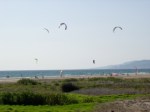
One thing I wasn’t expecting was for half the city to still be shut down for Eid (thus the killing of time in an internet cafe). The attractions I’d starred in my guidebook have all been closed, and I haven’t been able to find any open shops in which to buy better long-sleeve shirts in. I’m hoping for tomorrow.

As I wandered around the Medina’s narrow Medieval “streets” (some aren’t as wide as my arms’ reach), I came around a blind corner and narrowly missed walking dead into a hijab-donning middle-aged women. We paused, made eye contact; we both smiled and laughed, then went on our way. I guess this is the oh-so-frightening Morocco, Muslim, African and not all that different.

On the Edge of Continents

Flying over, on the way back

Flying over, on the way back

A languid, palm-fringed town perched on the edge of worlds feels like the perfect place to end the Spanish leg of my journey.

English derives the word ¨tarif¨ from the town Tarifa, a port city and entryway into Europe for thousands of years. The city occupies the wind-swept space between places: the end of the Atlantic, the lip of the Mediterranean, where two continents nearly kiss. Instead of the edgy instability of a lot of border towns, Tarifa lazes comfortably in this in-between space. It´s not unlike any other beach town: surf shops and gently weathered buildings, sniffing dogs and barefoot children, blown-out tattoos and sun-bleached hair. The surrounding skies are populated with the cheerful kites of windsurfers, punctuated with the horns of the Tangier ferry. Just across the azure waters (for all its hype, the Mediterranean is truly gorgeous), vampiric African mountains crest hazily—¨vampiric¨ because, despite seeming so touchably close, they´ve eluded all my photography attempts. The narrow passageway of streets in Tarifa´s historical center tell the town´s history like lines dug in a palm: an old city wall, a crumbling castle, the remains of abandoned structures stretching lazily into the waters. And always, in every part of the city, a persistent wind rushes through, a transient resident itself.

DSCN3205I can´t think of anything better than to spend a chilled-out day wandering the streets, sitting at the beach, reading, catching up on writing (and sleep), and generally getting ready for tomorrow´s ferry embarkment. The 35-minute ride will deposit me at sister city Tangier, another meeting of worlds, where I´ll begin my Moroccan odyssey.
Europe is a pleasant, lovely place to travel—it´s clean, safe, everyone speaks English, buses arrive and depart on schedule and people generally leave you alone (even construction workers refrained from cat-calling this afternoon). It´s almost too easy, to be honest, feels like something other than traveling (vacationing?).

The real challenge of Europe is the punch-to-the-kidneys expense. I´ve done it about at cheaply as possible, and am still woefully over budget. Transportation costs took me by surprise. My last European adventure rang in at €36 per day; however, the Eurail pass I prepurchased meant I didn´t pay anything in travel between destinations. Of course, I anticipated Spain to be the most costly leg of my journey, so Morocco and Portugal should even things out, if I behave myself.

Here´s a wrap-up of my Spanish travels:

Number of days: 10

Number of cities: 4

Number of nights in a hostel: 2

Things I liked more than I expected: Flamenco, Madrid

Favorite new travel accessories: hat, spray hand sanitizer

Travel accessories as-of-yet unused: sleeping sheet, laundry detergent

Biggest travel splurge: a universal adaptor from El Corté Ingles (€18, adaptor I brought was busted)

Budget Break-down (frighteningly, I keep this scrupulous of track of my finances even at home…)

Daily average: €45

Transportation: €130.5

Food: €170

Lodging: €46

Entrance fees (museums, attractions): €21

Internet: €21

Coffee and sweet treats (gotta have my indulgences): €26

Other (laundry, adaptor, etc): €31.5


Lauren Quinn is a writer and traveler currently living in Hanoi. Lonely Girl Travels was a blog of her sola travels and expat living from 2009 to 2012. She resides elsewhere on the internet now.

Join 490 other subscribers

Buy This Sh#t

Categories