Archive Page 5

8 Reasons I’m No Longer A Backpacker

1. I am embarrassed by my backpack.
It’s big and heavy. There are buckles and pouches and straps; they bunch my clothing and create sweat stains. I can’t make sudden turns without risking collision with pedestrians.

The physical backpack is a quintessential signifier of a backpacker. It says “everything I need I can carry on my person, without the help of doormen or rolley luggage wheels.” This idea is central to the identity of a backpacker and one to which I once felt a certain pride: “Train station steps? No problem.”

But something has changed. The backpack has become unwieldy and cumbersome. It probably doesn’t help that mine permanently smells like a Venezuelan waterfall (NOT as romantic as it sounds). I’m embarrassed by the sheer bulk of it, the way it reduces me to a sweaty blundering bumbler. It’s like a walk of shame every time I arrive somewhere—eyes lowered, head down, rushing to wherever I’m staying in order to dump the evidence and try to pass as a non-backpacker as quickly as possible.

The problem is, proper luggage is proper expensive. So until my income matches my new travel status, I’ll be lumbering down foreign sidewalks with sweat dripping down my back. (But at least I can make it up those stairs.)


2. I don’t like staying in hostels.
I’m all for meeting people and being social. But at the end of the day, all I really want to do is sit in my underpants and putter on the computer. And while I suppose I could do that in a hostel dorm, I don’t think it’s exactly the message I want to be sending (see #5).

As I’ve gotten older, I find I really need my own space when I travel—somewhere to relax and zone out, where I can sleep without earplugs and an eye mask. In Rome, I recently forewent the cheapo Termini hostels in favor of a bed-and-breakfast in a hipster neighborhood 30 minutes outside of center. The extra nightly cost: 25 Euros; amount which I enjoyed myself more than previous visits, on a scale of 1-10: 8.


3. I’m willing to spend more for comfort.
It used to be like a competition I had with myself—what’s the absolute cheapest I can do a trip? Pretty fucking cheap, in turns out. I managed to travel Western Europe for six weeks on 36 Euros a day. But guess what? It was the most miserable trip of my life.

Looking back, if I’d waited till I had a little more money, I could have traveled with more comfort—getting a sleeper cars on night trains, for instance, or eating something other than falafel. I would have enjoyed myself a lot more.

Moreover, I’ve learned that cheaper does not always mean more authentic. Some of my richest travel experiences have been those I’ve had to spend a little more for—on transit to remote regions, for instance, or on lodging in places where a backpacker ghetto doesn’t exist.

So, the $5, 8-hour bus to Siem Reap or the $10, 4-hour minibus that stops at a café with a western toilet? It’s a no-brainer now.


4. The “hostel conversation” makes me want to rip my eyeballs out.
Some destinations don’t have the mid-range bed-and-breakfast type accommodations I now favor; Tirana, Albania is one of them. So instead of staying at one of those cement-block high-rises cast in uplit neon, I bit the bullet and stayed at a hostel.

It was a nice hostel, with a patio and an herb garden and a daily breakfast of hard-boiled eggs and Nescafe. Every morning I’d wander downstairs, braless in my stretch pants, and fix myself plate. Invariably this scene would play out:

Someone walked in.

“Good morning,” I mumbled, waiting for the hot water to boil.

“Hey!”

Silence.

“So,” the cheerful backpacker said, “where are from?”

“The US.”

“How long have you been here?”

“Coupla days.”

“How long are you traveling?”

Shrug.

“How long are you staying here? What’s your itinerary?”

Shrug. “I’m just kinda here.” Then I walked out to the patio with my plate and mug.

It’s not like I was trying to be rude, though I’m sure it came across that way. But when you have the same conversation every morning for two weeks, it starts to wear on you.

I used to be enraptured by the hostel conversation, excited to be meeting so many different people from so many different countries. But it slowly became a kind of script—sizing up, determined someone’s stats. I realized that while I may be meeting different people from different places, we were all having the same conversation.


5. I’m not attracted to backpackers.
Ok, to be honest, I’ve never done much hooking up on the road. “A Guide To Hostel Sex” might still be one of Matador’s most popular articles, but the very premise has always struck me as utterly unappealing—the bunk beds, the moldy bathrooms, the condoms of questionable expiry. And there has never been anything attractive to me about a grown man in flip-flops and a tank top.

But there’s a new element that’s recently come into play: all the backpackers I see don’t look like grown men. They look like children. Sunburnt, drunk children.

Aside from being fresh out of their parents’ houses and relatively inexperienced in dating, I wonder what the hell I’d say to them. “So, you a Facebook account in middle school—what was that like?” “You were how old when 9/11 happened?” “Biggie is not old school!”

Wait, Biggie is old school. If you’re nineteen.


6. I want to do boring things.
Go to the shooting range and fire M-16s? Get shit-housed tubing in Vang Vieng? Rave at a full moon party on Koh Phangan?

Ugh. I’d rather sit at a café and stare at the street. Maybe read the local newspaper. Really, I could do that for hours. Which does not mean that I’m more cultured or intellectual than a backpacker, as much as I may want it to. It just means that I’m old and boring.


7. I’m less concerned if something’s “touristy.”
You know what place I like? Hoi An. It’s an old Vietnamese port town with crumbling French colonial buildings and tailor shops and bomb cao lau. And shittons of tourists on bicycles.

In previous years, the mere presence of other Westerners would have made me deem Hoi An as touristy and thus not the “real” Vietnam. And maybe it isn’t. But I like its mellow atmosphere. I’ve let myself like it.

In recent years, I’ve found myself caring a lot less about whether a place is touristy or authentic, or whether I’m a traveler or a tourist. In a lot of ways, I’m less self-conscious about being a foreigner in a place; I feel less of a need to define a place, or my position in that place.

I’m an outsider. And I’m okay with it. Now give me my cafe sua da and let me soak in the Hoi An vibe.


8. Backpackers make me smile.
I used to feel competitive with other backpackers (see the “sizing up” above). Why would some of the girls looks so effortlessly boho-chic while I was heat-rashy and varicosed? Why did some of them have cooler itineraries and longer trip dates? Why did they all speak better Spanish than me?

Living in a well-touristed city now, I see a lot of backpackers. They walk in droves along the riverside, long legs and smooth skin. Sometimes they walk slowly, and that’s annoying. Sometimes they’re really loud and drunk, and that’s even more annoying. But mostly I don’t even see them—they exist on a different plane and fade into the static of city life.

But every now and then I do see them—eating at the next table, buying bootleg DVDs at the market, lumbering lost with their big backpacks and asking me, “Hey, do you know where the Nomad Guesthouse is?”

And the thing is, they don’t annoy me in those moments. I look at them and it’s the same feeling I’d have when I’d go to the old punk club Gilman in Berkeley and see a group of teenage girls, huddled together and giggling. It’s a kind of tenderness I feel, like I’m looking at a younger version of myself. I see all the same immaturity and naïvity and excitement, and I know it so well it makes me smile.

But I also know that it’s not me anymore. That time is gone for me—it’s been passed down to these other, younger kids, with glowing skin and slim legs. I didn’t even notice it happening.

But I hope they enjoy it.

Bones In The Dirt, Best Women’s Travel Writing and Thank Yous

So… this is big news:

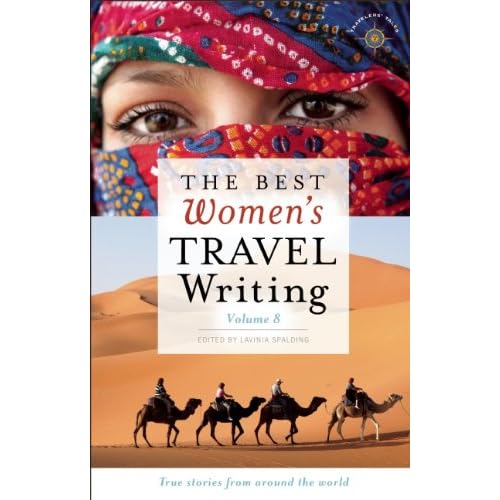
“We are interested in including your story ‘Bones Surfacing in the Dirt,’ in our forthcoming book, The Best Women’s Travel Writing Volume 8, to be published in April 2012.”

Which is great for a number of reasons, perhaps chiefly that it delivers a boost of encouragement just when I need it most.

Some of you may remember the crowdsourcing I did on IndieGoGo a few months back, raising funds to help me move to Cambodia and extend my Glimpse project into something book-length. Some of you may have even kindly contributed. And some of you may be wondering what the hell is going on with the project and when the hell you’ll be getting your postcard/zine/etc.

Well, answer number one is that a lot depends on the Cambodian postal system. Haha. But a lot has been shifting and taking shape for me in terms of my project, and I was waiting for official word from the BWTW folks to write an update.

It was a year ago now that I first came out to Cambodia. I thought I was here to write about someone else’s tragedy, someone else’s story. But the more I worked on the “Bones” piece, the more I realized that the story I had to tell was much more my own than I’d thought.

And I guess you could say the same’s true this time around, with this project. I most definitely still plan on writing something book-length, and I most definitely still plan on writing it about Cambodia. But over the course of my 4+ months here, the focus has begun to shift. I’m still super interested in the long-term effects of the war, on trauma and the ways it affects both individuals and a society. But I’ve realized that’s only one of the fascinating stories out here. Or rather, it touches on all the fascinating stories, is like a kind of thread between everything.

It gets draining, all the Khmer Rouge talk. It’s mostly among the foreigners. As one friend says, there’s a certain breed of expat here who’ll chalk everything up to Khmer Rouge—any problem or quirk or peculiarity in the culture.

It’s both true and untrue, both a legitimate reason and a scapegoat for all the country’s problems: “the war just ended.” But when you put that beside the general silence of Cambodians, it’s an uncomfortable contrast. And not one I’m sure I want to participate in.

But that’s not the only thing going on here. It’s a crazy intense confusing place, utterly confounding for a Westerner—and it’s modernizing super rapidly. There’s construction all over the city; there’s people getting kicked off their land to make way for foreign-owned development projects; there’s millionaire pedophiles getting royal pardons and dodging extradition; there’s human trafficking and sexpats; there’s shady NGOs and fake orphanages; there’s all the wayward foreigners that wash up on the country’s shores—myself not excluded. (Because no one ends up here on purpose; we’ve all got a fucking story—a deep inhalation and a “Well…” If we lived in Paris or Rome, that would be the reason: we’d be in fucking Paris or Rome. But we’re in Cambodia. We’re all a little wonky, some more than others.)

A journalist friend here was complaining about his deadbeat staff. Cambodia is kind of the place were “Australian journalists go to die”—his words, not mine. He was talking about someone saying it’d been a slow day, and he’d said, “Bloody hell, this is Cambodia. Don’t tell me you can’t find a story—you can’t walk outside with tripping over stories.”

And it’s true. I’ve started to realize that, beyond just the war history and its effects, I wanna write about that: Cambodia, now, in this moment, and what it’s like being a foreigner here. Of course, the Khmer Rouge is a part of that—even if you hear about it ad nauseum, there’s no escaping the fact that so much of what I see everyday is a result of it. But that’s not all is is, you know? I guess it’s like childhood shit, friends of mine who survived fucked-up and horrific childhoods—it’s always kind of there, but it’s not all that’s there.

Is this making sense? Probably not, because the ideas are still forming. I’m definitely in observation mode—so much of what I wrote before was about those initial encounters with the country. Right now I’m just sitting back and watching; I feel like it’ll still be a good few months before I have anything of substance or value to say.

Which makes me feel a little unsteady, a little worried sometimes about the project and all. So the BWTW announcement came just when I needed it—like a little nudge, telling me I was on the right track. (I hope.)

On that very positive and celebratory note, I wanna give a shout-out to everyone who helped me get here—through love, support, encouragement, whatever.

Thank You to:

Hugh Bright, Eva Holland, Bailey Nichols, Stephen Beatty, Patricia Marquardt, Katherine Peck, Shana Breeden, Katherine Palau, Lileana Ayende, Joshua Samuel Brown, Meara Breuker, Melanie Westerberg, Shannon Purcell, Erin Gilmore, Ben Sturtevant, Ekua Impraim, Cheri Lucas, Carlo Alcos, “zwiebel16,” James Marquardt, Miranda Gibson, Aaron & Emily Quinn, Alicia Goode, Nhu Troung, Suki Khalsa, Mary Howe, Judith Tannenbaum, Beverly Quinn, Tracy Waugh, Sharon Bjornson, Morgan & Candice Tigerman, Sarah Menkedick, “Sam,” “Lynn,” “Lu,” “Hai,” and of course, Mom & Dad.

Thank you all so much for giving me a 1000 other little nudges.

Because Love Letters and Get Up From the War: Cambodian Teenagers Report on Gender Inequality

“Gender disparity”

I wrote the phrase in blue felt pen on the dingy white wipe board.

“What does this mean?” I asked, underlining the phrase for emphasis. Because it felt teacherly.

I looked out on a chorus of blank eyes.

Which is not actually what I looked out on, but what I’d like to think I did. Really, it was a chorus of chatter, back-of-the-classroom text messaging, shuffling, soda drinking, and probably only a half dozen eyes actually looking at me, the teacher, in the front of the class in my button-down shirt and skinny pants that haven’t been cleaned since Oakland.

This is teaching in Cambodia.

I haven’t written about it much, since I plan to write (and sell) funny disheartening funny pieces about the whole fiasco that is applying for, interviewing for and teaching in Cambodian schools. It’s a complete and total farce. Given that neighboring countries pay double, you really get the dregs of Western society over here. Reminders at the all-staff meeting for the university where I teach evening classes for high school students included: 1) come to class on time, 2) don’t tell your students dirty jokes, and 3) don’t come smelling like alcohol.

Note: Not “don’t come to school drunk.”

“Don’t come smelling like alcohol.”

Are we beginning to get the picture?

So I teach in this rundown ramshackle-ass classroom with trash in the corners and a door that won’t close all the way, that some industrious student wedges a plastic straw in the doorframe to keep it shut. The majority of class arrive late, play on their phones and cheat on tests—all of which I’d been warned of and told was best not to fight against—it’s a losing battle.

But I can’t get myself to totally not give a shit. Especially cause there’s those five kids that sit up near the front and actually appear to somewhat give a fuck. You know, the kind of kids whose eyes light up a bit, whose voices raise timidly after the dead silence of my glaringly obvious reading comp questions.

And as it turns out, they like to write. Well, they don’t actually like to write, they bitch and moan about it, but the class goes real quiet when I make them write paragraphs and when I read them, they’re grammatical bloodbaths but at least they’re original, ie not copied.

And, as a bonus for me, I make them write about shit in Cambodia, so that I can learn a thing or two. The first assignment was to write about how Cambodians celebrate Chinese New Year (cause they do). One kid wrote: “We burn the ghost money.” And if that’s not a goddamn beautiful line, I don’t know what is.

So tomorrow’s International Women’s Day. It’s a public holiday over in these parts, which baffled the shit out of me last year when I was here. Really? In a country with a fucking 80% domestic violence rate, endemic prostitution, fainting garment-factory employees and expatriated domestic help who live like slaves in neighboring countries?

There’s not a lot of irony going on in this country, so yes, really. But, you know, okay—at least we get a day off, right?

I’m supposed to do these listening exercises with them—I read aloud and check their comprehension. If you think reading comprehension is painful in this country, try listening comprehension. It’s painful stuff, and just to make it more painful (for me), I pick stuff not in their boring-ass American textbook that they can’t relate to (ie: the lesson on the NYC subway, to which I opened by asking, “Who’s been on a train before?” No hands raised. Now how the fuck do you teach that??). Noooo, there I go giving a shit again, and I bring in one of the English-language newspapers and read that shit aloud, stopping every few words to explain terms like “gender disparity.”

The gist of the article is that Cambodia ranks lower than any other country in the Southeast Asian region when it comes to gender equality, as measured by literacy, economic participation and empowerment. Of course, the government is disputing this, because disputing stone-cold facts is something they do.

Which I’m not dumb enough to begin a debate around. It’s in my contract that I can’t teach “controversial” material, which given the aforementioned propensity to deny inconvenient facts pretty much includes anything you’d read in the English-language newspapers. So I’m already pushing the envelope. I mean, this article’s got a quote from the (female) opposition party leader. (Should I be writing this on my blog?) That, and it took fifteen minutes to drag the above summary out of them.

So we focus on access to education, since “the Kingdom’s low ranking could largely be explained by social pressures that push women out of the education system.”

“What’s a ‘social pressure’?” I ask. I write the phrase on the boar beneath “gender disparity.”

More blank looks.

We hash it out, and come up with a good little list. A lot of the expected “a woman’s place is in the home” kind of stuff, but I’m surprised by “girls can’t study at the pagoda.” Boys can become monks and study for free; girls can’t become monks. That hadn’t occurred to me.

But I’m most surprised by how quickly some of them say “because the war.”

I just leave it there, on the board beside a bullet point: “war.”

I know better than to ask.

I point to our list. I inhale, “Now, what you’re going to do—” They groan. They know what’s coming. “—is write a paragraph telling me about why you think girls don’t go to school as much as boys in Cambodia. For those of you that have been listening,” I stare not at the kids who’ve been listening but at the ones in the back, “it’ll be easy.

“Oh, and this is how I’m going to take roll today. So you’d all better write something.”

They shuffle around and pass each other sheets of paper, and pretty soon they’re writing, scribbling, and it’s not quiet in the room, but as quiet as it gets—which is kind of like a jungle-quiet, with a constant buzz of insects and the occasional strange what-the-fuck animal call. (It’s usually a ringtone.)

I should say here that these are patently not the population the article is referring to. These girls are the privileged—they have iPhones and bedazzled purses and platform wedge sandals that remind me of Boogie Nights. They’re pursuing higher education, and their families have the means to send them to what is sadly considered one of the better schools in the city.

But still.

The “social pressure.”

“Pressure’s like a hand pushing on you,” I told them, demonstrating on my arm. “It’s what you feel whens something’s pushing on you.”

After fifteen minutes I collect the papers. We review some vocab and I let them go early, their eyes are so glazed.

I read the papers later, over dinner. Some gems:

“Because Khmer old culture they thought that women can’t go to school because if the women get high education they can write love letter to men and it not good for Khmer culture.”

“They think if the girls go to study, girls can go outside and have boyfriends, that is not the culture in Cambodia.”

“I think Cambodia is the small country that get up from war in 1993 and it’s stay from colonial a lot too. Long time Cambodia have one culture that unfair for girl is the boy can go to study but the girl cannot.”

“Some women in countryside [read: poor people] have low knowledge because the parents didn’t bring them to school. And the schools are far from the house. Some students in Phnom Penh didn’t study because they are allowed the foreiner [sic] tradition.”

“They think if women get high education or not is not important because they will become a housewife and only work in chicken and look after the child.”

“They’re think that if they agree the girl go to study, the girl can meet a lot of boy can write letter love and don’t listen parents advice.”

“Because the girl is 15 year old – 18 year old they alway get marries.” [We’ve reviewed “always” like 800 times, so this especially broke my heart.]

Those were from my more stellar students, most of whom are sit-at-fronters and girls to boot. As you can see, I’ve got my work cut out for me, when it comes to correcting and editing this stuff. Guess that’s what you get for giving a shit and trying to go all Dangerous Minds on these kids.

But strangely, it was the half-assed papers that got to me the most—the ones from the boys in the back of the room, who spent the whole class dicking off and then furiously scribbled shotty sentences, or even bulleted lists (NOT sentences, minus points!).

There’s an almost haiku-like starkness to them:

“We don’t have enough schools for students.
A lot of families are poor.
We just finish the war in 1979.”

“Because:
– don’t have money for them.
– Family don’t have enough money.
– Tranditional.
– War along time in the country
– Girl can help housework.”

“Because parents don’t have money to study. Some women is the countryside have low knowledge because the parents didn’t bring them to school. Cambodia have war.”

Or this one, the worst one, in terms of effort, information and sentence structure:

“Because Cambodia just get up from the war.”

Oh, there’s a sentimental old poet still knocking around inside me.

Screw it, I’ll give him the points for it.

Naked Like That (Kep Bungalow)

Tonight I miss America
at night.

Tonight I miss tambourines and harmonicas.
I miss the low whistle
of a train through the dark.
I miss fog-soggy sidewalks
and boys with stubbly beards
smoking cigarettes,
windshield shards
glittering beneath their sneakers
like that:
stars.

I miss driving home—
Bay Bridge jaundice,
hungry tunnel howling,
ears ringing
and headlights
like a lonesome pair of eyes.

I missed cracked windows
and cup holders,
the arch of 580
to 24,
the moment before
the highways touch

And I miss that city
laid out beneath me
and glittering

For one still moment

Like that
Like how I miss that—
Something I could almost touch
At night.

Tonight I’ve got the jungle.
Tonight I’ve got
Cambodia’s muggy black
of birds crying and geckos belching,
the low drone of insects
trying to get in.
Tonight I’ve got the world
behind a mosquito net
and the sea somewhere—
I can hear it.

I’ve got sheets and the shape
of some still body;
I’ve got a lonesome pair of eyes
probing in the dark
and all the goddamn stars in the world,
glittering like that

Naked like that

Like how I’ve always been—
Splayed and waiting

And breathing in the dark.

Surviving Sunset, And My First Motorbike Accident

So, so much for that New Year’s Resolution.

To be fair, I was on my friend’s motorbike, so I was still acting in accordance with the half-assed guidelines I’d set for myself. But that’s not really the point, now is it? The point of not riding a motorbike was to avoid accidents, to avoid getting injured and thus avoid medical treatment and having to deal with open wounds in a swampy climate in which I am unaccustomed to dealing with open wounds.

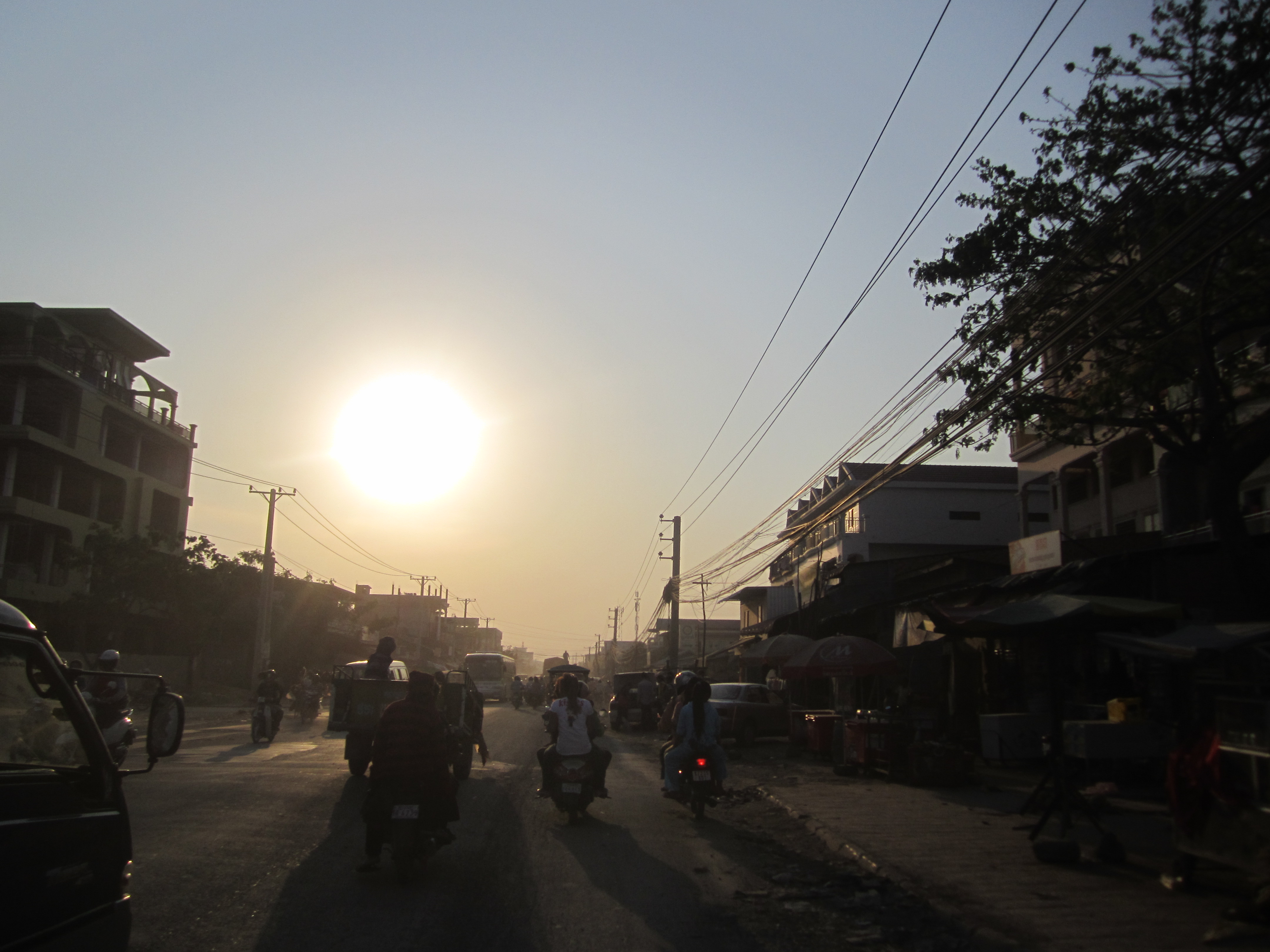
As far as accidents go, it was pretty uneventful. We were on a dusty highway outside of town—though “highway” isn’t quite the right word. It’s a big road with a gravel-and-dirt shoulder, filled with wheezing trucks and swerving motorbikes and minivans full of black-eyed workers heading home, the unlucky of whom were relegated to sitting on the roof. It’s one of the big roads outside of town, lined with garment factories and gas stations and bakeries and endless rows of roadside markets selling t-shirts and produce and weird smoldering meats, from beneath endless rows of beach umbrellas displaying names of cell phone companies.

It’s one of those roads that make you realize how big this city actually is, how little of it you actually know, living in the expat bubble of the inner-city. Which is why we’d headed out there—my friend’s company put him up in a housing division out there and he’d kept telling me I had to see it: “It’s totally different out there. Makes the riverside look fancy.”

That and we were chasing the dusk—wanted photos of smoldering sunsets, red as a wound behind a horizon of dust and exhaust, this particular breed of humanity all cast in silhouette. Everything’s more beautiful as a silhouette; anything can be beautiful as a silhouette.

So we were weaving and rolling through the bottlenecks and break-necks, me on the back snapping photos and trying not to slide in too close to the driver, but knowing that each time we narrowly missed another bike, I’d reflexively squeeze my legs. You’re never sure if that’s the kind of message you want to send, or if you want to send a message at all. Sometime you do.

So I was only half paying attention when an old man wobbled slowly on a motorbike in front of us. He moved out from the shoulder suddenly, and we couldn’t slow down in time. We probably wouldn’t have fallen over if it hadn’t been for all the dust—the same dust that was making the sunset so damn pretty.

We fell, I skidded and it was over before I realized it happened. It didn’t hurt, because most things don’t hurt till later, unless they’re really bad. We stood up, shook off the dust and I laughed as the blood blossomed from my knee.

People from the storefronts and markets came out, stood along the dirt that passed as a sidewalk, and stared. “White girl bleeding on the side of the highway,” I thought and laughed. I waved.

They smiled and waved back.

Blurry, but still...

We cruised back towards my friend’s apartment, stopped at a pharmacy that was really just a medicine cabinet in the front of a family’s living room. The woman tsked at me in a motherly way, stroked my shoulder and disappeared; a smiley guy I took to be her husband tenderly cleaned me up.

The wound foamed under the hydrogen peroxide, and the Betadine was drippy and the color of old blood, rusty blood, and it stung but in a clean way. The smiley guy cut up gauze and taped my wound shut as my friend looked sheepishly on and apologized.

“Don’t apologize, it’s not your fault,” I said. Then, with a smile, “But if I’d been driving, I’d probably be apologizing too.”

Smiley charged us $2 and my friend insisted on paying, which I didn’t argue about. Then we headed back into the city center, everything blacker than night behind my sunglasses, which I still wore to keep the dirt out of my contacts. But he was right—the city center seemed fancy after that, developed and paved and rich.

So now I’ve got this knee to attend to. Three days and thrice-daily cleanings, and it’s still raw in spots. I’m waiting for the scab to form, cringing each time I look at it, wincing each time I rinse it in disinfectants. I always hate tending to wounds. It’s the same with getting tattooed—it’s not the thing itself that bothers me, it’s the healing, the dealing with it. Which is a metaphor, of course.

But before I’d gotten back on the bike—while I stood on that dusty roadside dripping fresh blood down my leg and feeling the stares on my body like sticky insects—I’d looked out and noticed the sunset.

It was goddamn beautiful.

So I hobbled over and snapped a photo.

Because everything is beautiful at sunset.

The Only Omar I’ve Ever Known

So one of the great things about being an expat in Phnom Penh is all the extra time I have. It’s kind of unreal. Despite the fact I now have two jobs, a volunteer gig, a possible contract position in the works and try to freelance my ass off, I’ve still got buttloads of free time. Why did I never have any in the States? I dunno, but here I fill it with all sorts of productive activities, from sweeping my apartment every morning to kick boxing to spending entirely too much time on Facebook.

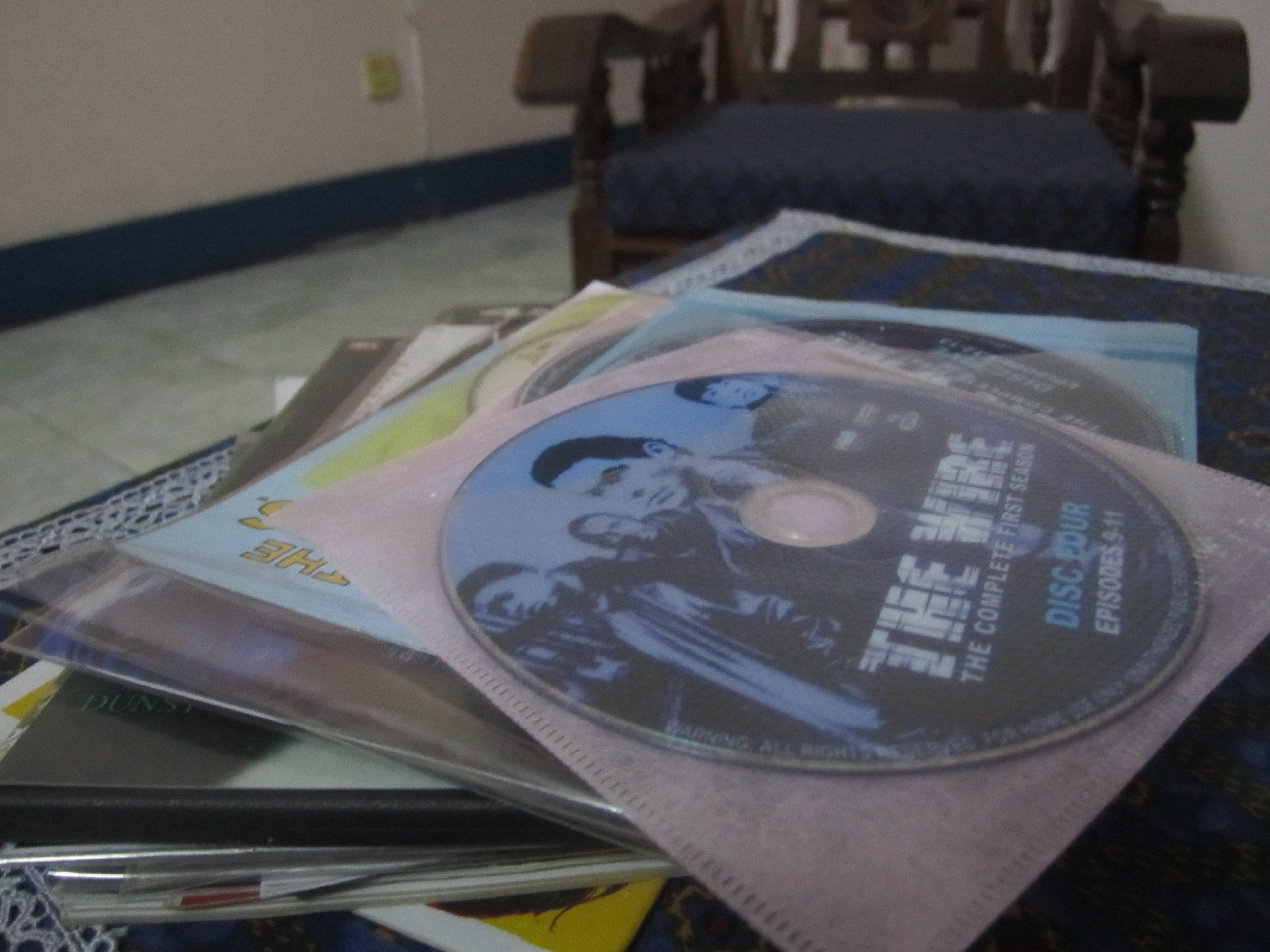
Then there’s the bootleg DVDs.

They’re everywhere, and they’re mad cheap. Usually $1.50 a pop.

It’s a dangerous combo.

Add to this the fact that I’ve got a friend who has a killer collection and is about to leave town. I’m urgently trying to convince him that customs agents will freak out if he tries to enter any Western country with a 300+ stash of plastic cases with fuzzy, Xeroxed liners, and that the best solution to this is to leave his collection in my safekeeping. Don’t know if it’ll work, but in the meantime, I’ve been sampling his goods.

And I’ve gotten into The Wire.

I was afraid of The Wire. I was afraid for the same reason I’m afraid of Words With Friends—do I really need another addictive timesuck?

Why, yes, yes I do.

So I’m working my way through Season One, curled up on my less-than-comfortable wooden bench in my kimono each night, eyes glued to the laptop screen adjusted juuuust so.

The world doesn’t need another commentary on the series, so I’ll just keep it to what’s relevant, which isn’t really relevant at all, just feels relevant tonight: my favorite character is Omar. For obvious reasons. But for less obvious reasons, it got me thinking tonight. As I had my nightly cigarette on the terrace (sorry Mom) and watched the stray motorbikes whiz by three stories below, listened to the neighbor’s dog barking, felt one of those rare cool breezes dancing around the edges of my kimono—it got to thinking about the only Omar I’ve ever known.

Omar James. I’ll use his real name, cause why the fuck not?—weird things happen online and I might even find him. We went to grade school together. He was in my class, all the way through, but I remember him most from sixth grade.

Omar was American, which sounds obvious, but half of my grade school was immigrant kids, so it actually kinda narrows it down. He wasn’t a Bad Kid, but he wasn’t a good kid either—that strange kind of inbetween place people float in as kids, before puberty, when all hell breaks loose—that time when everyone’s lives hangs before them, unformed and waiting, like one of those planetary birth charts I’ve never understood or been able to read.

I remember the DARE counselor, a dude named Officer Lee, saying on the first day: “There’s three kinds of kids. There’s the kids that’ll for sure get into drugs and the kids that for sure won’t. Then there’s the kids in the middle.” He’d paused here, for effect. “Those are the ones we’re trying to reach.”

I knew positively I was one of the kids who wouldn’t.

So I’ve been known to be wrong in my life.

But I remember thinking Omar was one of the kids in the middle. He had a real raspy, low voice, so the teachers always caught him when he was talking (“Your voice is like a red race car,” one teacher had told him. “People are always gonna notice it.”) I remember one term we were seated in the same group, warped old wooden desks facing each other, and I’d tried to whisper something to him out of turn—my version of taking a risk—and he’d gotten frustrated, making a pssshhh noise and said, “Man, I can’t hear you.”

I probably turned real red.

Irish blood makes you do that.

No one else in that class had Irish blood.

Omar had real dark skin and a burn from a flat-iron on his forearm. Lots of the black kids had them, and I remember wondering why—in the same way other kids asked if all little white girls were born with parts in their hair.

He had rough hands too; I remember that. They had little scars on them, callouses and patches of grayed skin, and they’d seemed to me like grown-up hands, man hands. I remember watching them, holding a pencil during tests. I remember watching that shiny burn too, the way the light seemed to gleam off it someway special.

He also had these little gray hairs all over his head. They curled around the rest of his hair, in a way that made them seem curlier, though probably they weren’t. He said he’d always had them, and I’d remember that, since second grade, he had. He said his grandpa had them too, and that that was who he’d gotten it from.

Omar also had a Starter jacket. That was a big deal back in the day. Cause they were expensive and fly. Kids in Oakland fought over Starter jackets, the way kids also fought over Air Jordans, and the kids who had them had a reputation for, you know, the kinds of things kids with fancy shit in poor cities have a reputation for. The Oakland School Board got frustrated and decided to ban the jackets at all schools. This was before the days of semi-mandatory uniforms in public schools, so the ban was also big deal. The school board meeting where it was discussed made the nightly news, and I remember thinking, “Not all kids with Starter jackets are thugs—Omar’s got one.”

No one, I should say, ever tried to fight Omar for his.

Which is maybe why The Wire Omar made me think of him.

But I really don’t know why the fuck I should remember any of this. Maybe it was the hair, the little gray hairs, and how they made me have a picture of his grandpa—some old dude as a little boy once, somewhere, hella long ago, with the same little gray hairs. And picturing that had made me picture Omar as an old man, the same way his rough hands did.

Neither one of us would be old now.

But still.

Then I left that school—we all left, graduated—and I went to a nicer public school up in the hills, followed by a string of other schools—the typical hustle for a decent education in Oakland—and I lost touch with most of those kids. I’ve found some through Facebook—Alekist, who went to Brown and works for a biotech company; Dartanyan, who used to do backflips off the stairs and has a record label now. (Okay, so, I found two kids.) But even before The Wire, even before Phnom Penh and expathood and this weird ass new life of mine that has made me nostalgic for random shit I can’t explain, I’d looked for Omar a few times—plugged his name into the search bar and got nothing.

Cause some people stick like that. Some images stick like that.

Like a race car in the red.

Going To The Bathroom Abroad: The Butt Hose Edition

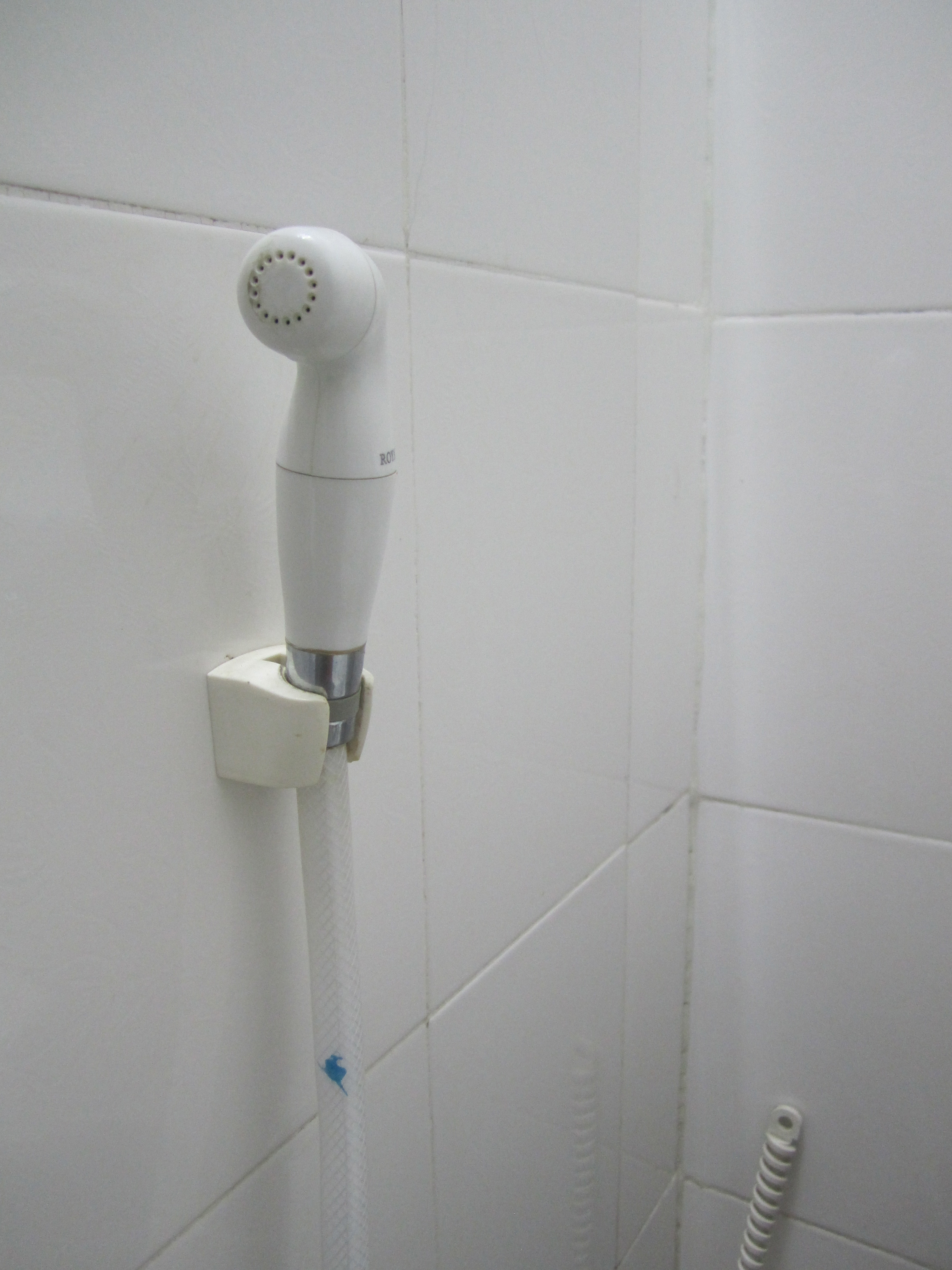
This is my bathroom. As you can see, it’s nothing special (aside from how clean it is). It’s actually nicer than my last bathroom back in the States, with its black mold and peeling linoleum. Because contrary to what some folks back home have envisioned, I’m actually not living in a straw hut. Nor am I not taking dumps crouched down over a squat toilet. Using the bathroom is a totally Western affair.

Except.

Look closer—what’s that thing snaking out from the wall and resting perkily in its holster?

Why, it’s a butt hose.

I don’t know if that’s what it’s actually called, but that’s what I call it. Maybe I haven’t been looking closely, but I haven’t seen butt hoses outside of Asia.

At first they confounded me. What the fuck were you supposed to do with that thing? I thought it might be for cleaning and admittedly used it as such once—got a real good angle on those hard-to-reach tiles behind the toilet. But that couldn’t really explain why I’d see the butt hoses around town, in fairly squalid bathrooms where toilets were either missing seats or were of the squat variety, and where toilet paper was a laughably far-fetched wish.

You know those little old ladies that sit outside bus station bathrooms in Latin America and charge you to enter? You know how they give you one painstaking square of toilet paper? I was thinking that Southeast Asia could really stand to learn from that jam. I mean, the pay-to-stand-on-a-scale hustle appears to be worldwide, so why not the charge-for-toilet-paper hustle?

Haha---these signs are reeeeal funny, until you go into a bathroom with muddy foot prints on the toilet seat

Cause they don’t use it.

Word?

Word.

Well, not everyone doesn’t use it. But from what I hear, the butt hose is the Southeast Asian answer to toilet paper. When you think about it, it makes a lot of sense: instead of smearing a dry piece of paper around there, you give the area a refreshing little spritz. It’s kind of genius, and far less intrusive and intimidating than a bidet, with its cranks and levers that strike fear and worries of cultural inadequacy into the hearts of Americans.

The butt hose takes up a lot less space too—just sits there innocuously against the wall, as if to say, “Use me if you’d like, madame.” It doesn’t stare at you from beside the toilet, in that way that makes you comfortable and unable to look away while you’re dropping one, wondering if you’re a less evolved human being because you can never figure out how to spell, much less use, that European contraption of ass-refinement. It’s a metaphor, really, when you think about it.

I’ve become a big fucking fan of the butt hose. Once it was explained to me, I began to work it in to my shit-taking repertoire—cautiously at first, perfecting my preferred angle and pressure. Now I’m a convert. A missionary, actually, since I felt the need to carry the good news to a friend over lunch yesterday:

“Dude, have you gotten into the butt hose?”

“The what?”

“You know, that hose you see in all the bathrooms?”

“Yeah, what’s up with that?”

[Insert semi-graphic demo and staring eyes from the neighboring tables.]

It’s really taken my dump-taking to a new level. But, because I’m so fucking international and can’t be confined to any one culture, I’ve taken to doubling up—using both the butt hose, then toilet paper to dry. It’s like a mini-shower for my nethers. And considering how much you sweat here, any extra freshening is a welcome affair.

So hello there, new friend. You’re looking fresh today. What’s that you say? Well, don’t mind if I do…

A Poem Walked Past My Balcony Last Night

Teenagers

walk down the median,
streetlamp light
laughing.

Boy pauses
reaches
to a branch.

He pulls it down
picks
one, two

mangoes off the tree.
Hands one
to each of the girls.

They keep walking
and disappear.

“The River That Empties Into The Ocean”: Glimpse Piece #2

Wax refugees from Khao Lan

So. Finally, finally, nearly a year after I originally landed on this continent, the second piece for my Glimpse project was published. You can check it out here.

The piece depicts my trip to the Thai border, where I searched for the remains for an old refugee camp my friends’ family passed through. If you’ve been following this blog for awhile, you’ll recognize part of the journey. What I didn’t write about at the time—because I knew I wanted to save it for this piece—was the strangely fortuitous meeting that occurred after I’d returned to Cambodia, made entirely possible by this blog. (Hey, I still may not have monetized this thing, but at least I’m getting something out of it!)

With the publication of this piece, I’ve officially completed the Glimpse Correspondent program. As such, I was asked to write a few words about my experience. What I basically told him was how incredibly valuable the program was to me. Getting the clips was nice, getting a stipend was nice, but what it really came down to was the editorial guidance. Sarah hashed through some insanely deep-level edits with me, giving me the kind of feedback you usually have to pay a lot of fucking money for.

I was gonna come out here and do the project regardless—I’d already booked my tickets when I’d heard my project was accepted—but it would have ended up being a much different project if it hadn’t been for all the support and guidance I received. I think the process pushed me to grow a lot, both creatively and personally. And I secretly kind of doubt I’d be back out here now if that hadn’t happened.

So read up! It’s mega long, so grab some coffee and get comfy. Then tell me what you think—and what you for real think, not what you polite think. [Insert smiley face]

Vaguely Familiar Dude Reports on Phnom Penh Nightlife

shitty flickr photo, not going all undercover yet...

The pub is dark and grimy and does not smell like meat.

I look up the bar and down the bar. I turn to a red-faced old dude clutching a glass of beer. “Hey, there’s not a roast here, is there?”

He shakes his head long and slow.

It’s Sunday and we’re feeling indulgent—indulgent enough to have just spent two hours at the FCC rooftop, drinking happy hour drinks and staring into the maze of foot traffic on the riverside below, and indulgent enough to top it off with a massive $9 plate of meat and potatoes and veggies and Yorkshire pudding, all drenched in gravy and butter.

There’s Sunday Roasts all over this city, and I’ve been waiting for the week when I was in both the company and the mood for one. Which is tonight—a friend in from Vietnam, with money to burn and time to kill. But I have to remember where the supposed best one is. The Something Pub on Street 17something. Which is not this place.

The old dude takes a deep breath, then unleashes the knowledge: a string of roasts and reviews, both popular and personal, as well as directions to the nearest ones. It’s as though he’s been waiting for someone to ask.

They say that the sexpats are some of the most knowledgeable folks around—for whatever you think of them, they’ve been here the longest and know the city, the culture, the language the best. Whether or not it’s true, this dude is obviously the Roast Master.

He speaks for a few consecutive minutes. He doesn’t make eye contact once.

Which leaves me to survey the scene. I don’t go out much here—there’s not much other than bars and the vibe gets mega-seedy. So I feel like a bit of a voyeur, peeking into the other side: pool tables and bad rock music and men slouched in the corners, along the bar, and thin women—impossibly thin women, with sharp faces and short skirts—moving around them like hungry insects.

I see a dude at the end of the bar. He looks vaguely familiar—some kind of ambiguous Latino, in a Neurosis shirt, pulled-up white socks and black Vans, long metal dreads bound together by another dread, tied on a knot. Not a style the expats rock here—an Oakland breed. I eye him.

When Roast Master finishes his litany, I nod and thank him.

He still doesn’t look up from his beer.

We walk past Vaguely Familiar Dude. “Hey,” I call out, over heads and between shoulders, “you from the Bay?”

Glassy pupils pin at me. “Yeah.”

I nod. “I’ve seen you around. You’re friends with Georgina and Adam.”

A slow, sloppy recognition spills over his face. “Hey! I’ve seen you!”

The truth is, I’ve been seeing him for years—at shows and parties, across crowded rooms, one of those people permanently on the periphery of your life, fixtures of vague features and forgotten names, “the extras in the movie of me,” a friend once called them.

“What brings you here?” I ask. “Just traveling around?”

He nods. “Yeah, man, shit, just traveling. I been in Thailand and Laos, I met this dude—” slaps another guy on the shoulder, who grins bashfully—“at the airport, and we’ve just been cruisin.” He launches into a haphazard travelogue, rattling off an orderless list of places; there’s a slurry undercurrent moving beneath his words, an intonation of long nights and jig-saw days.

It’s like he’s been waiting for someone to ask.

“So, where’s the party at?” he asks me when he’s done.

“Ha!” I let a wry laugh burst out of me. “I’m the last person to ask. I’m grandma in this town.” Really, I’m grandma in every town, but I let it seem like it’s just Phnom Penh.

“You been here a long time or something?”

I shrug. “Well, I live here.”

He gives me a funny look. “You don’t go out none?”

“Not really, it’s…” I trail off. “Well, we gotta grab this roast before it runs out,” I motioned to my friend.

“What’s a roast?”

“It’s a British thing.” I shrug again. “Meat and potatoes.”

“Oh, right on. Well, fuckin cool seeing you.”

“For sure,” I smile. We turn to leave.

I glance back down the bar. Roast Master is a little redder, but still hasn’t moved.

**

We’re walking down the riverside again the next day, plastic bags of produce peeking out of my tote bag and tickling the back of my arm. At one of the restaurants, I see Vaguely Familiar Dude and his friend sitting in a pair of big wicker chairs.

We laugh. “What’s up, what’s up!” I say.

They look dim and yellow and worse for the wear—two pm but my guess is that this is breakfast. “How was your night?”

Vaguely Familiar Dude shakes his head. “Man, what’s up with this city?”

I smile. “What do you mean?”

“It’s like,” he looks back and forth, doesn’t bother to lower his voice, “it’s kinda trippy. Everywhere we went was just gross, man. Like, we’d sit down and bam!—hella girls would be all over us.”

I let another wry laugh come out of me. I’m not sure where it comes from, or what it’s supposed to mean. “Yeah, that’s kinda the jam here.” I don’t bother to lower my voice either.

We’d missed the roast the night before; by the time we arrived at the other pub, they’d sold out and most of the seats were empty. We ordered shepherd’s pies and talked lowly to each other, a wiry guy with blurred tattoos rolling a joint at the bar. We declined when he offered a toke, our friendly smiles mirroring his.

“So, like, everywhere?” Vaguely Familiar Dude asks.

“Kinda.” I tell him about the one spot I like, where a grumpy old Taiwanese dude with arguably the best vinyl collection in the country sits in a corner, plays weird records and scowls at people. “But sometimes there’s girls there too,” I add.

Vaguely Familiar Dude shakes his head. “It’s kinda trippy, man,” he repeats.

I don’t know him. Not really. But I’ve seen him for years, in shitty warehouses in shitty neighborhoods in our shitty hometown, and he doesn’t seem like the type to get skeezed out by nothing.

It was weird to me at first too, I want to say; I wanted to puke whenever I’d see those crispy old sexpats with their arms around skinny waists. But I’ve gotten used to it. It’s not that I don’t see it, but that it’s sunk into the background, become part of the visual noise of the city. I avoid it, but you can’t avoid it, and it doesn’t creep me out anymore. I take their roast recommendations.

But I don’t tell Vaguely Familiar Dude any of this. I’m not sure why. I’m embarrassed, in a funny way—that I’ve let it become normal.

He takes a handful of fries, smears them in ketchup and mashes them in his mouth. “You want one?” he asks from between the mush.

I smile. “Nah, I’m cool.”


Lauren Quinn is a writer and traveler currently living in Hanoi. Lonely Girl Travels was a blog of her sola travels and expat living from 2009 to 2012. She resides elsewhere on the internet now.

Join 490 other subscribers

Buy This Sh#t

Categories