Standing on the ancient stone of Angkor Wat, watching the red fist of a sun rise, reach up through the horizon’s haze to ignite the sky, to silhouette that crumble of bygone glory, to light the ponds in the earth red too, to make them become a mirror between the lily pads—there, I had a vision:
What would happen if everyone put their cameras down?
Few things get me out of bed before 7am, and watching the sun rise at Angkor Wat is one of them. Yes, it’s touristy. But it’s one of the wonders of the world (depending on what list you consult; on the List of Me, it’s there), and getting there before the tour bus hordes, when the day was still cool, early, innocent and young—that sounded worth it.
I didn’t expect it to be so goddamn beautiful. I didn’t expect the sun to blaze like that, be red and burning like that, to glare against the expanse of ruin and palms.
I glimpsed it as I came through the gates. I gave it a quick glance and a gasp. As I scurried along the stone wall, rushing past Apsara carvings and other tourists, I reached in my bag. I pointed the camera, saw the landscape through the viewfinder, clicked. I did this before I even looked at the image myself, gave myself time to soak it in, breathe it in—to simple see it.
We moved down towards a pool of water, “a very good place for photos” our well-meaning guide assured us. Through the politely jostling throngs, we could see that, yes, it was a good photo op. So good, in fact, it was the same image on the postcards that little girls in sweatshirts and messy ponytails clutched, tugged at you—“Lady, you buy, 10 postcards, $1”—a voice too low and raspy to belong to a child.
I watched us all there, taking turns and swapping camera, posing with smiles, embraces: “Look at me, I was here.” It seemed more important to get the photo, the proof, the documentation, than it did to bear witness to the immense and startling beauty of it—to just be there.
What would happen, I wondered, if we all put our cameras down, just for thirty seconds, and stood and watched?
I suspected a silence would fall. I suspected some of us might start crying. I suspected something huge would wash over us, come up from inside us, that kind of humbling you feel in the presence of the world’s greatness, that particular pang in your heart when you see something so beautiful it overwhelms you—a feeling you think is private but that really might be communal, like a great inkwell a monk tattoos from, writing our particular fates with shared blackness.
But that’s just a guess. Really, I wouldn’t be able to know, won’t ever know. We all kept clicking at the blaze of a red sun, in the shadow of Angkor Wat.
It’s been six weeks in Phnom Penh. That’s the longest I’ve sat still anywhere—the longest I’ve spent consecutively in any city other than Oakland.
I’m embarrassed to admit that; I feel like I should have lived abroad, should have studied abroad, should have spent a summer somewhere, should have should have should have. But the truth is, I’m still a relative newcomer to the travel game, and for the first few years I was stuck in the going-going-going of it all: ticking off lists, counting countries and cramming in as many destinations as possible. It seemed like a waste of time to stay anywhere any longer than necessary.
Sure, I’d entertained elaborate fantasies about moving abroad. But really, if I couldn’t sit still in another city for more than 10 days, how could I really know if I could be happy, could have a life, abroad? Or, hell, even out of Oakland?
Part of the reason I got an apartment in Phnom Penh is that I wanted to feel like I lived there, that I wasn’t just passing through. I wanted a little glimpse into what that life would be like. I wanted keys; I wanted to shop for toilet paper; I wanted to “Sua s’dei” the neighbors and have a cafe where they knew my order. I wanted to feel little roots sprouting—the beginnings of being grounded, like the wind could blow and I wouldn’t fall over, be blown over with it.
When my bus arrived last week, bringing me back from my three-day visa run/refugee camp search, I hustled down the steps. I booked it past the cluster of tuk-tuk drivers, crossed the street without looking (the Cambodian way), dove between the tents of the night market, walked directly to my favorite food stall, kicked off my shoes and slurped down a Khmer soup under the night’s haze, the warm breeze from the river. I felt like I’d come home.
So I was expecting to be sad to leave. I was expecting to go around doing my silent rounds of “last times” with twinges of melancholy, that little lonely longing that you can almost fall in love with, more than the thing itself.
But it wasn’t as bittersweet as I’d expected.
Sometimes it comes to this: Nescafe from a plastic mug. And plastic flowers. Classy as shit.
Saying good-bye to the people was sad. I’d made some rad friends, had gotten close to a few cool girls. People tend to be on a three- to six-month rotation in Phnom Penh, and in a few months, almost everyone I know here will have moved on. And it was definitely sad to leave my apartment, with its metal table and one chair, its thin mattress and fuzzy TV, the plastic kitchenware I’d purchased at the market down the street—where I’d go to eat soup and the women would squat down and stare at me, giggling. I’d giggle back, and I’ll miss that too.
But still, it wasn’t as bittersweet as I’d expected.
I’ve taken to comparing cities to people. Boys, to be specific. Because cities have personalities the same way people do, and you have relationships with cities the same way you (I) have relationships to boys with (well, no, they’re actually much healthier).
So Rome is a really sophisticated, well-groomed and worldly guy that I like to keep track of, that I like to get lunch with from time to time, and talk about art and culture and history, but who I could never actually be with—we’re just too different. Tirana is the fun one, the one I met one crazy night at a crazy dance party, who I connected with under the lights—the one I felt like was made for me, as though anyone could ever really be made for anyone else, as though you could ever really know anyone after a week, or a month or even a year, years.
Buenos Aires is the one who got away, the eyes exchanged between subway cars, or maybe the one whose number you got and lost and still catch yourself thinking of, years later, looking for some scribbled scrap of paper in old jeans pockets without even realizing it. San Francisco is the neighbor boy you grew up with, who you know is really attractive and cool and who you really get along with, but you just couldn’t ever date.
And Phnom Penh?
Phnom Penh’s not terribly handsome or debonair, not the stuff of little-girl dress-up fantasies. He’s not super cultured and he’s got some obvious flaws. He’s a little beat-up; he’s been through shit. And there are things about him that drive you nuts. If you were to write a list of the perfect mate, there’s a lot of things Phnom Penh wouldn’t have. But the big ones, the ones that are really important and that really fucking count, when you’re up against the wall and the wind is blowing and you need something firm, some kind of roots to hold you down—he’s got them.
He fits. He’s not perfect, and neither are you.
And so it wasn’t so bittersweet to leave him. The same as when you leave for a trip and you just know the person you’re leaving behind, that you’re coming back to eventually, isn’t going to cheat on you or be shady. You don’t even have to think about it, worry about it. It doesn’t occur to you to worry; you’ve just got that confidence, you know? That you’ve got them and they’ve got you, whether you like it or not—like you were picked for each other, matched to each other, though you’re not sure by who.
The three little girls followed us like flies. They circled as we walked through the dirt and dry grass, holding out scarves for us to buy.
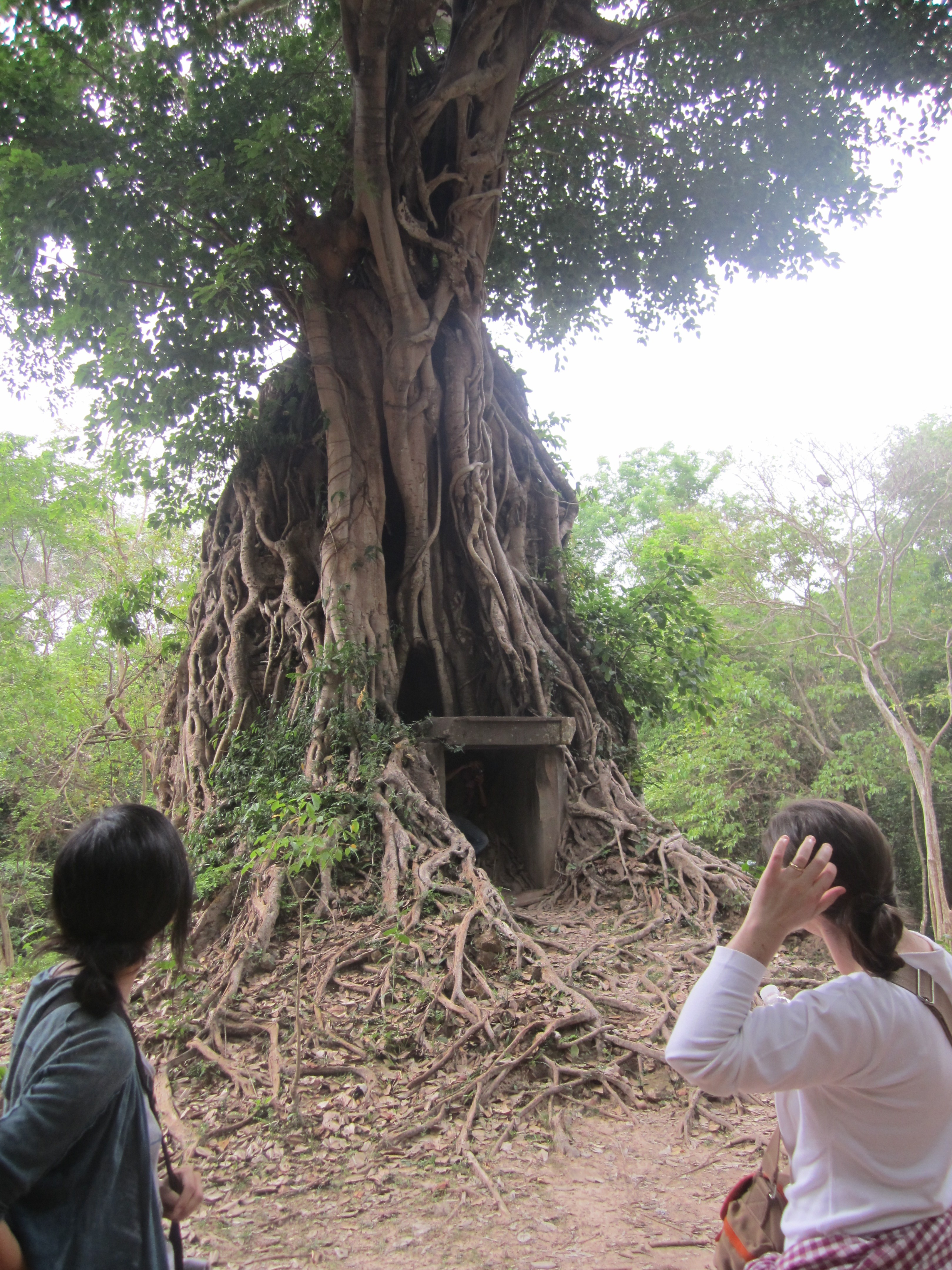
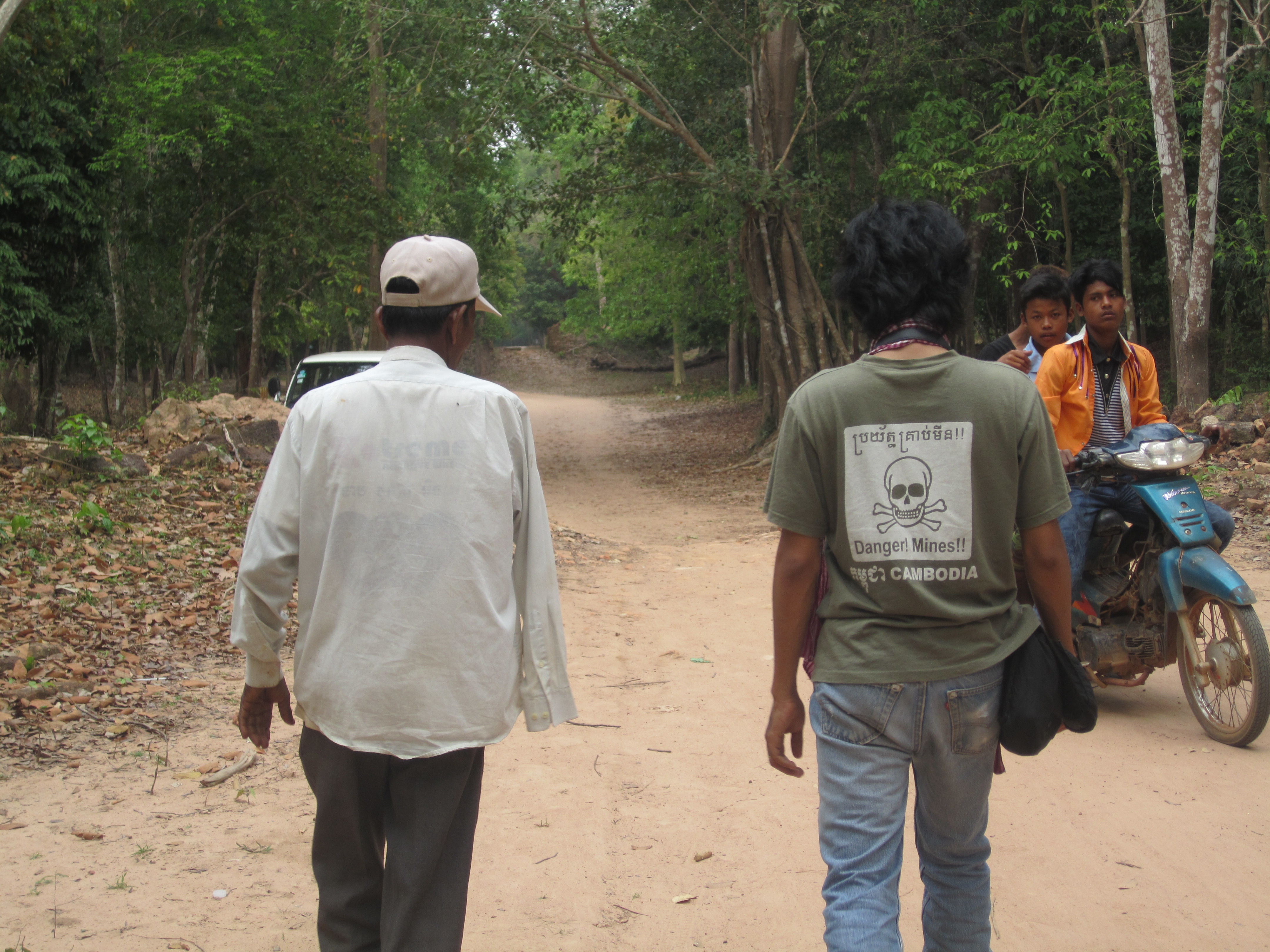
We approached the rubble of temples, bricks strangled by a varicose of vines. Beside where we stood, busted stone sat in a pile. One of the girls pointed. “American. B-52.”
It was my first trip out to the provinces. That’s what expats call the rest of country, everything that’s not Phnom Penh, and it’s a fairly accurate distinction: it’s like there’s two Cambodias, not just the surface and the underbelly that I wrote about before, but the urban and rural.
The division goes a long way back. Before the Khmer Rouge, during the Lon Nol regime and the American bombings, the countryside suffered greatly—some million people are estimated to have died—while Phnom Penh remained a relative island of safety. When the Khmer Rouge took over, they targeted urbanites, the so-called “New People.” A mutual distrust between city- and country-dwellers lingers.
Still today, people in the countryside tend to be darker skin, pure Khmer, and largely uneducated, often living without electricity and running water. And while Phnom Penh is rapidly developing, construction cranes and billboards and the gleaming new riverside, the provinces remain fairly the same: dirt roads, thatch-roofed houses on stilts, naked children and water buffalo and chickens in the road. And a lot more of the scars of war.
We’d headed out to the Kompong Thom province, 170 km along the “highway” to Siem Reap. We were going to look at two things: the Sambor Prei Kuk pre-Angkorian temples, and bomb ponds. We found both, beside each other.
I’d contacted Rattana Vandy about his exhibit Bomb Ponds, wanting to learn more. Although he lives in Paris now, he just so happened to be back in Phnom Penh, and invited me to come along with his wife and friend on an adventure to the countryside.
The drive was long, filled with stops for cashews and pomelo and tarantulas (which are surprisingly delicious). Three hours on the road and we arrived at the temple site. It was nearly empty, aside from a straggle of locals and the few huts they’d set up, selling bottles of water and chips. The little girls were on us; even after it was obvious we weren’t going to buy anything, they followed us, poking and playing with each other. There probably wasn’t much else to do.
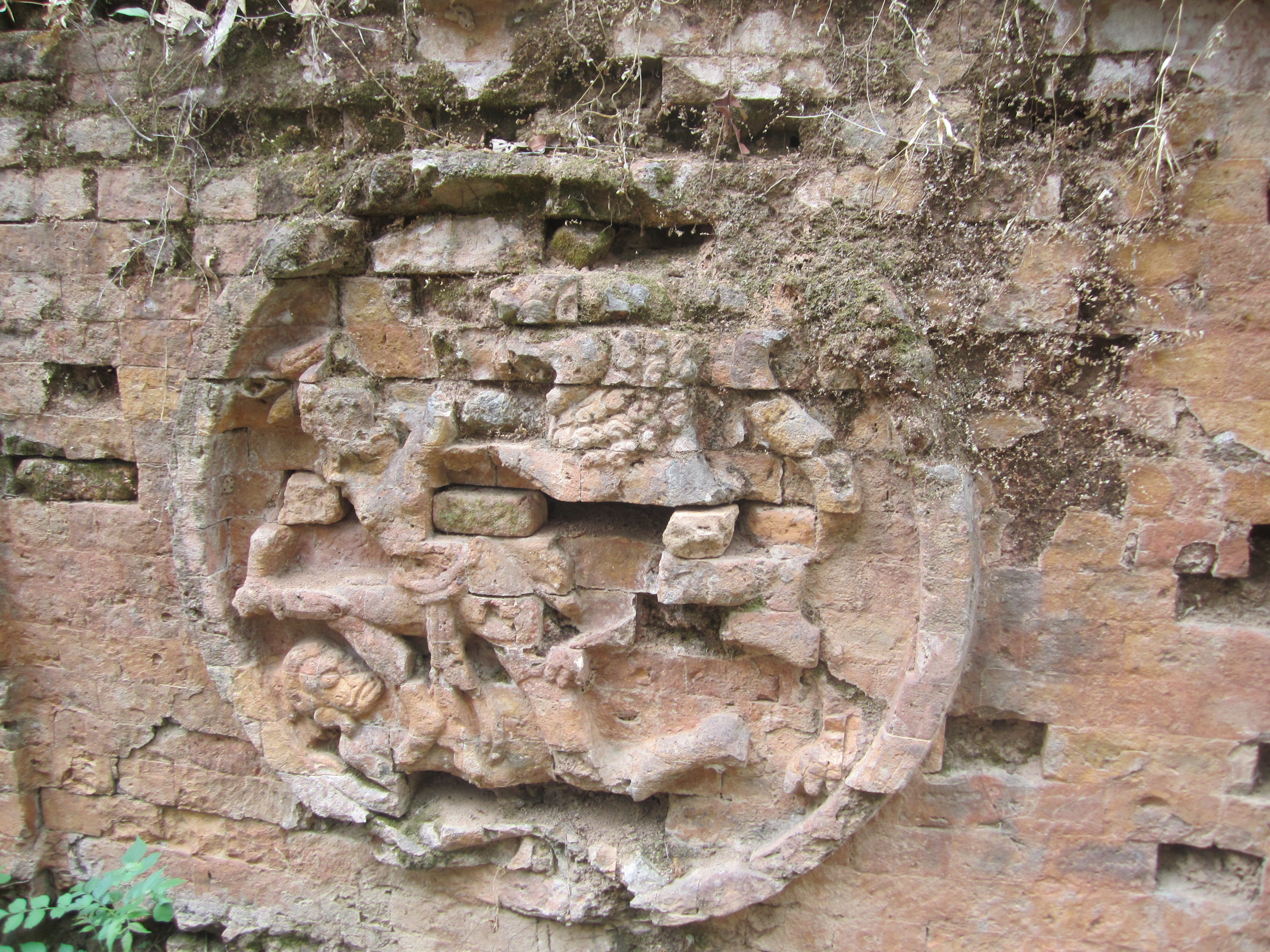
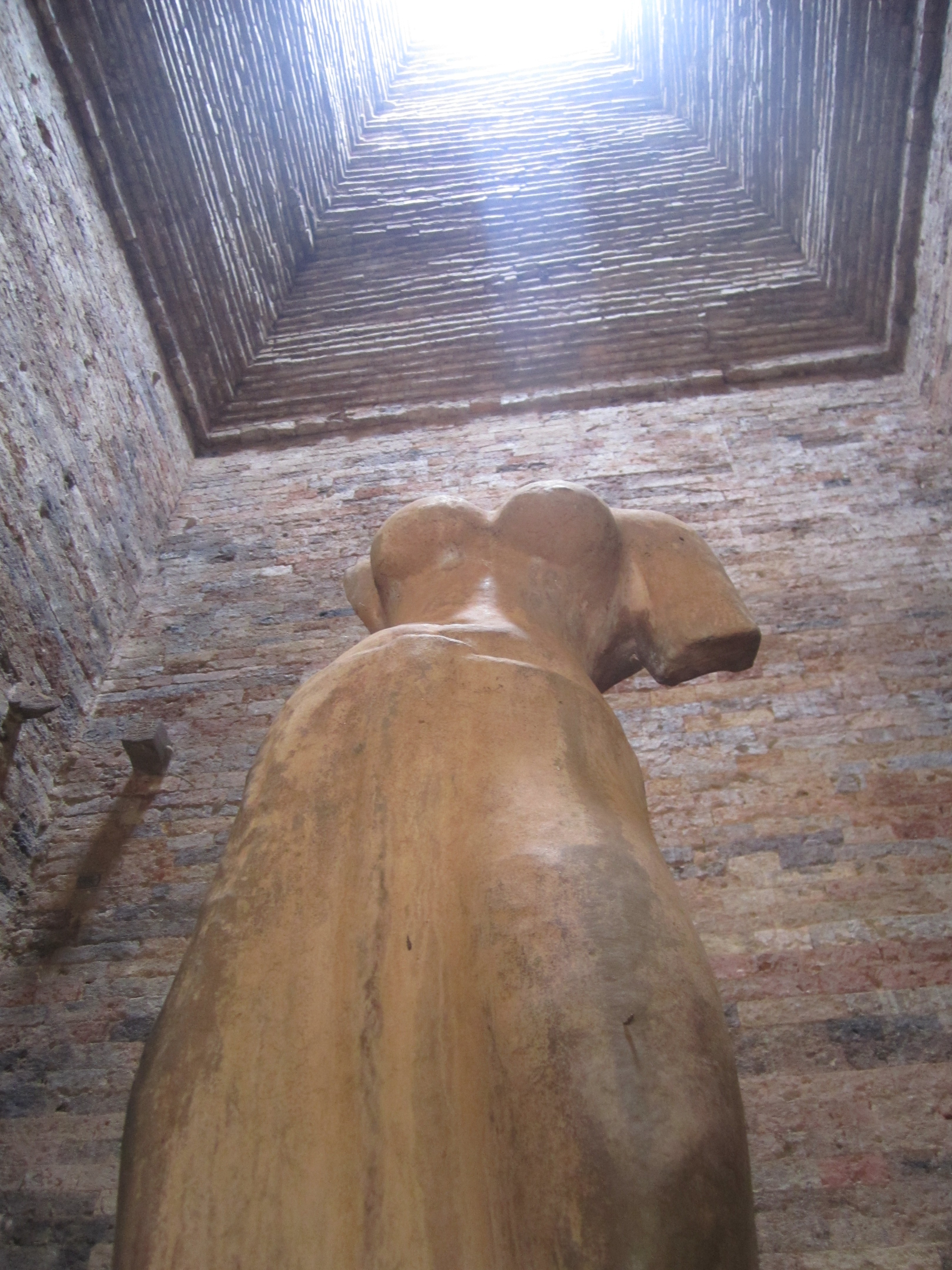
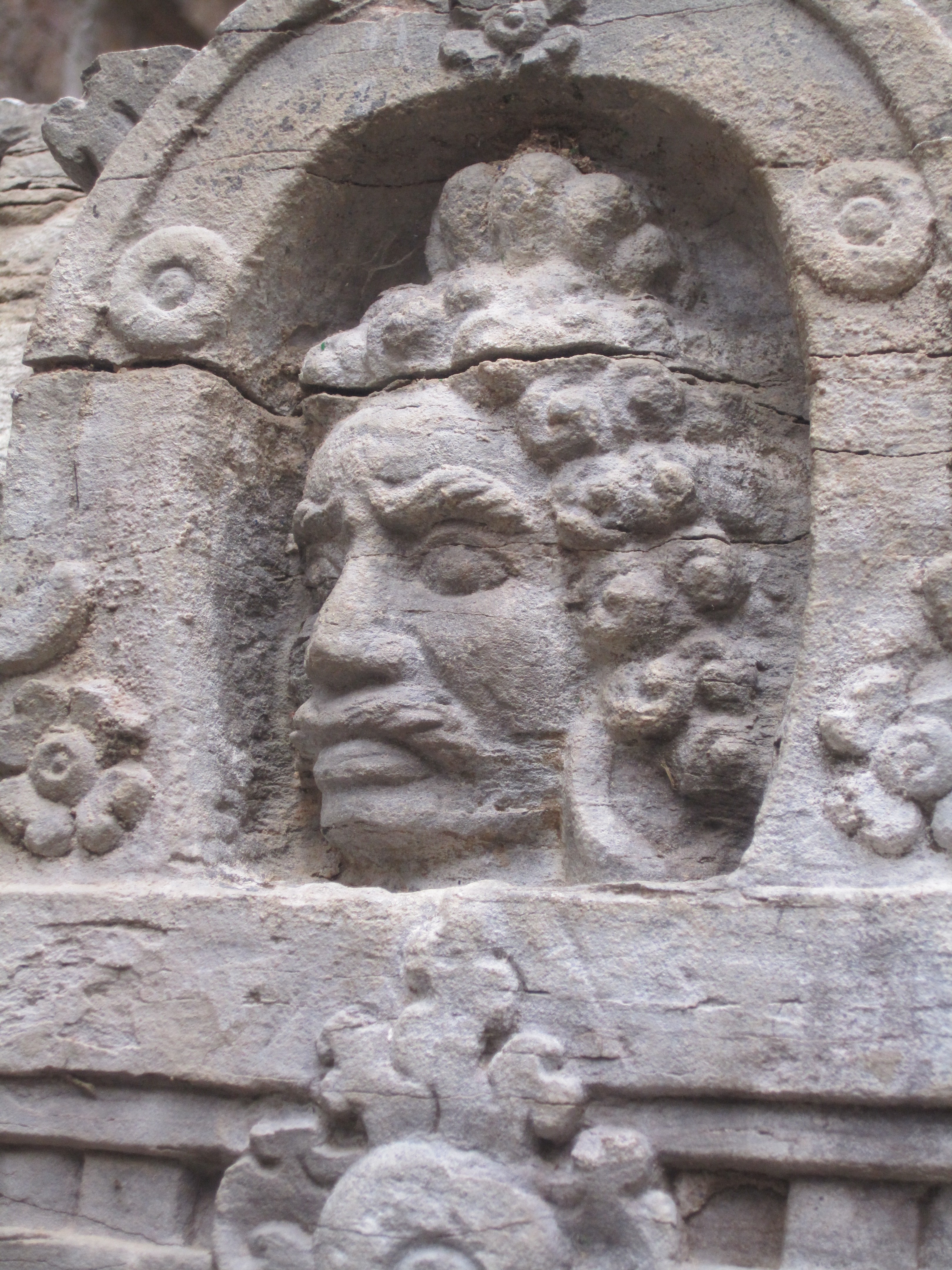
The temples were scattered around the shady dirt grounds. They’re pre-Angkorian, which means they were built between the 5th and 7th centuries, constructed of brick, with carvings in Sanskrit, odes to Hinduism rather than Buddhism. I hadn’t seen any temples yet, so I was easily impressed by the age, by the trees growing up and along them, like the vines were strangling the remains, trying to pull them back down into the earth.
There’d once been some 200 temples at the site; only 40ish remained. I thought of the incredible luck that any of them had survived: the years, the monsoons, the looting, the gold diggings—and the bombings.
Photographing a bomb pond/crater
Rattana had taught us how to spot bomb ponds. Unlike natural ditches, they’re perfectly circular. Because of the linear bomb-dropping pattern, they usually occur in a row, in certain intervals; you can count them out: “one, two, three…” The big ones are along the Vietnam border; the smaller ones, like these, were dropped from fighter jets and can be found all over the country. During the rainy season, they fill with water that even still, after 30+ years, has a lingering toxicity that makes it undrinkable. As it’s the end of the dry season, the bomb ponds now are just craters, sunken and waiting. They reminded me of pockmarks, the skin of a hard life—I thought back to Thailand, to its green, its rich-kid skin.
A local man lingered around us, like the little girls but with less exuberance. He began chatting with Rattana in Khmer, and wound up being our guide. He was knowledgeable, walked slowly, chiseled cheeks and a lean smile, salt-and-pepper hair swept into a comb-over, though he wasn’t balding. The lines around his eyes and mouth were thin, precise, deep and uncountable; they framed his mouth when he smiled, so that they seemed like smile lines.
He was missing an arm. There was a nub somewhere inside his worn shirt, and he tucked things under it: his cap, his cigarettes. Sometimes when he walked, a slow and pensive walk, he held onto the empty sleeve as though he were clasping his hands. There was a tenderness to the gesture so palpable you wondered if it was his phantom limb he was holding—a dead hand, ghost hand, from another life that he was still clinging to, intertwined with, in the moments when no one was looking.
He pointed out carvings and statues and explained their meaning, which then went through rounds of French and English translations. At one point, as we walked between temples, he pointed to a crater in the earth with his one arm. “American,” he said. “B-52.”
How do you be American in this? “I wasn’t born yet” doesn’t seem good enough. “My parents were against the war” doesn’t either. Because these may be ruins, but it’s still happening, in other places; it’s still happening in this place too, the echo of it. You know, intellectually, that this echo lasts a long time, but knowing it and seeing it are two different things: You can hear something a thousand times and not know it, yet if you see it with your eyes just once, you know. It’s a Khmer proverb, and it seems to be written for this place, the experience of being in this place.
I thought, briefly, of bombs falling from the sky like small black parcels; I tried to imagine the blast and the sound, the rumble and heat. I couldn’t, not really—just project what I’d seen on old newsreels, aerial footage of impersonal explosions, reverse fireworks against dense green. I thought of how much was lost—lives and limbs and ancient temples, vacant of their gods—and how much remained, that any of it remained, even as scars, on the earth and in the bodies. I thought of what still stood, what still walked, and wondered how to be American amidst all this.
“I like how cheesy it is, you know?” Mathilde said this morning, ashing her anorexic cigarette and looking across the street, at the teenagers hanging out at the Best Friend Cafe. Fake acid-wash skinny jeans, emo sideswiped hair-dos, bedazzled trucker hats positioned atop boys’ heads in a perch reminiscent of Abe Lincoln—the styles donned so earnestly by Cambodian youth would be only be seen on the most ironic of Western hipsters. And even then…
“It’s not so serious as in Europe,” she continued. “We would think this was so cheesy, but why not? If they like it, if they think it looks good, why not?”
One of the things I love most about Cambodian fashion—and it isn’t the stripper shoes or cutesy pajama prints or polka-dot pants—is the utter sincerity with which ridiculous clothing is worn. Ridiculous to Western eyes, I should say. And tonight this was exemplified by the t-shirts for sale at Phnom Penh’s Night Market.
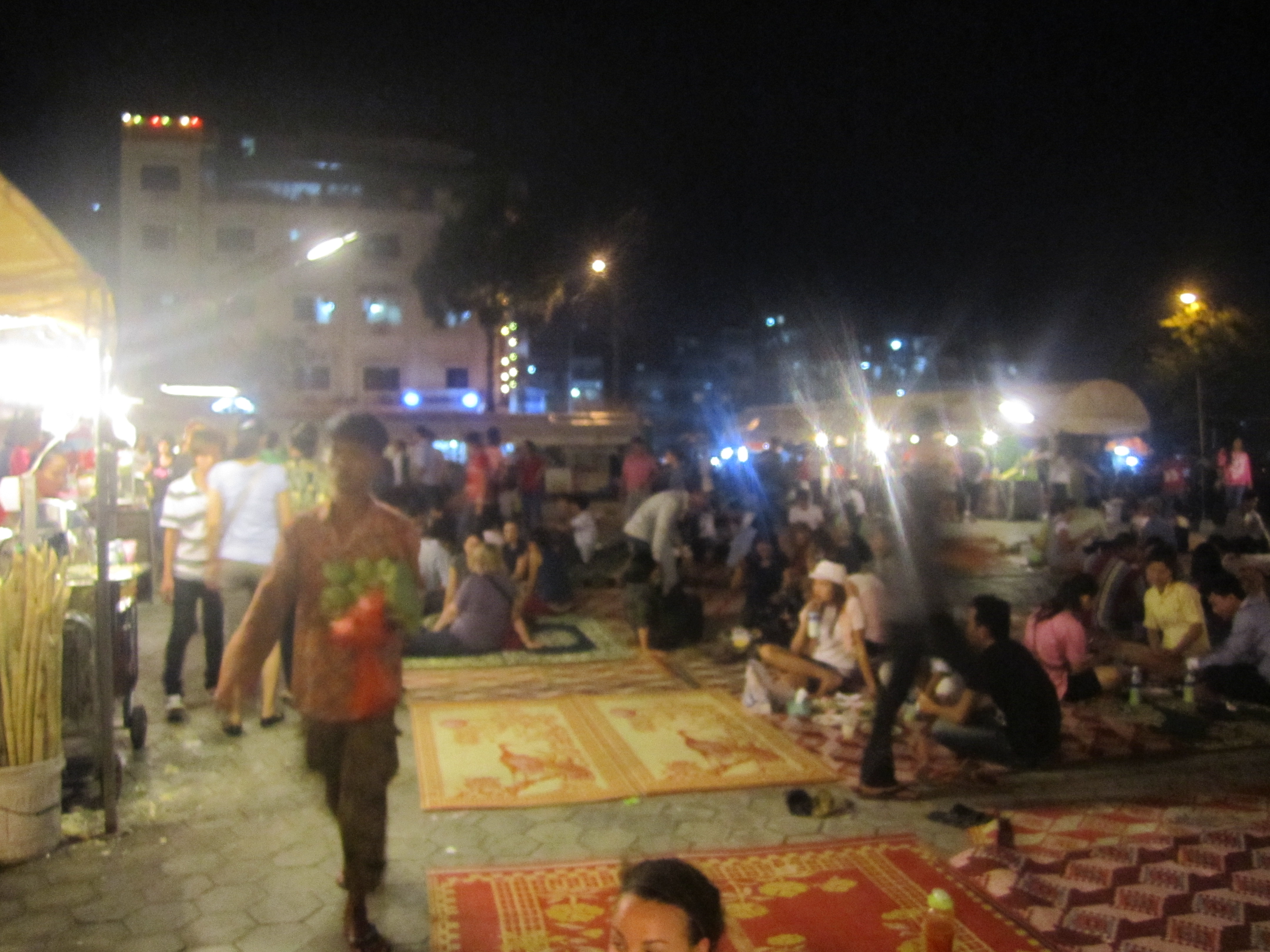
On Friday, Saturday and Sunday nights, along the riverside, tents are erected and a fair-style stage put up; vendors set up booths, teenagers with mediocre voices and sleep-walk-y dance moves perform on stage, mobile phone companies set up opposing stands with megaphones blasting promotions at one another, food stalls sell skewers of myserious deep-fried meat products, and diners take off their shoes and sit on straw mats, eating off thin wooden sticks. It’s nice. It’s a good mix of foreigners and Khmers, the riverside breeze is sweet, and until the mosquitoes drive you away, it’s pretty fucking luxurious to sit out and enjoy the night.
So we’ve been making a habit of grabbing some food and sitting out under the stars—or what would be the stars, might be the stars, behind the haze of city lights and smog. You can’t really be sure anymore. You don’t really go there to buy things—some tourist trinkets, fake floral arrangements (okay, I bought one of those for my apartment), and clothing. Clothing for local teenagers, I should say.
Tonight I took to photographing some of the t-shirts I felt best exemplified the Cambodian fashion spirit within the particular sub-category of Putting English Words On A Shirt Immediately Makes It Cool.
Rule #1: It doesn’t really matter if what’s on a shirt makes sense or not—as long as there are English letters, you’re half-way there.
Rule #2: It really doesn’t matter.
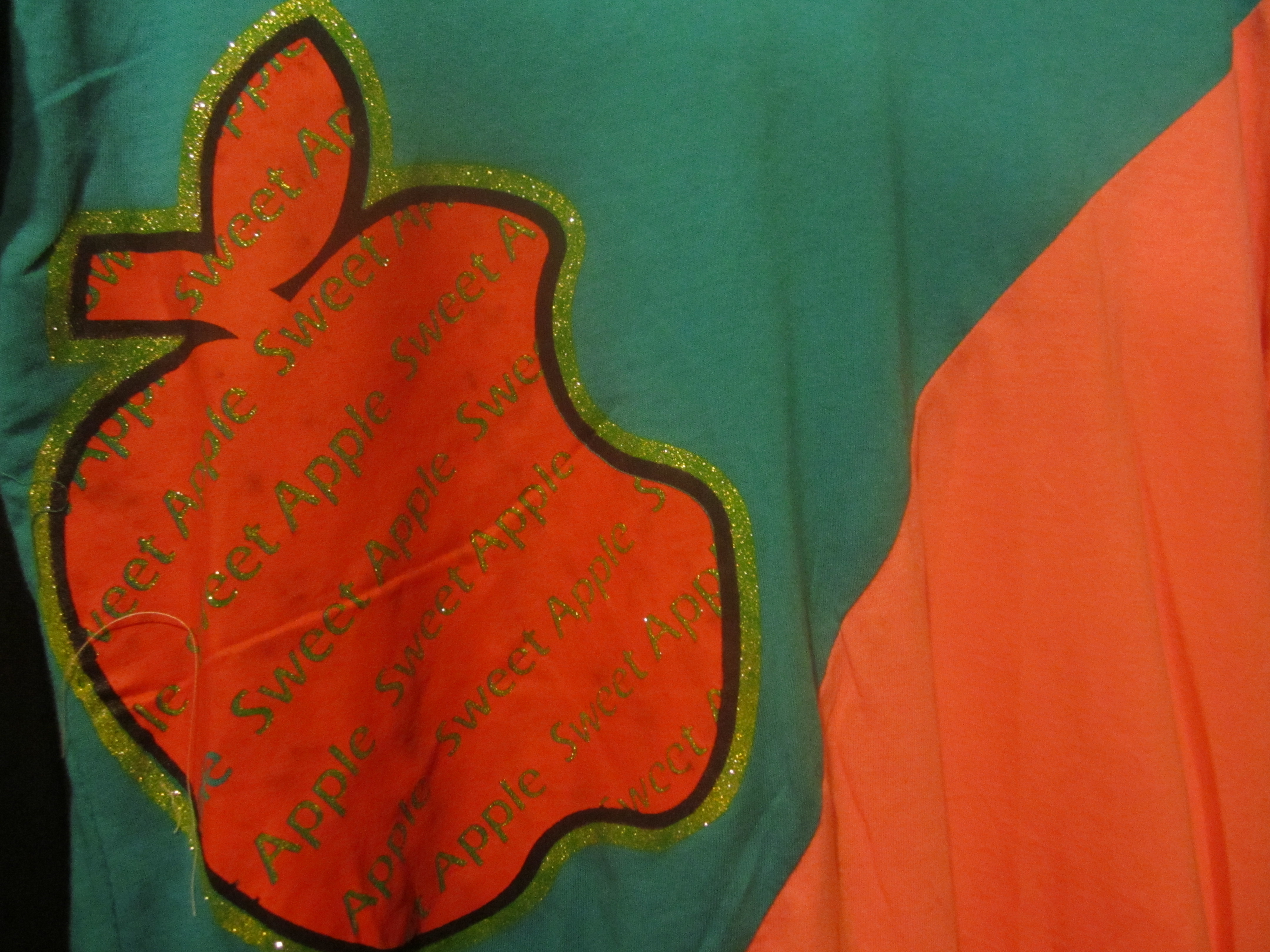
Rule #3: Product placement is a key component of English-language t-shirt fashion. It doesn’t matter if it’s the actual logo of a product, as long as it refers a Western, and preferably American, product.
Hey Apple marketing masterminds: you should really think about doing a Cambodian edition of those PC vs Apple guys ads. Do you see any PC t-shirts out here? I don’t think so…
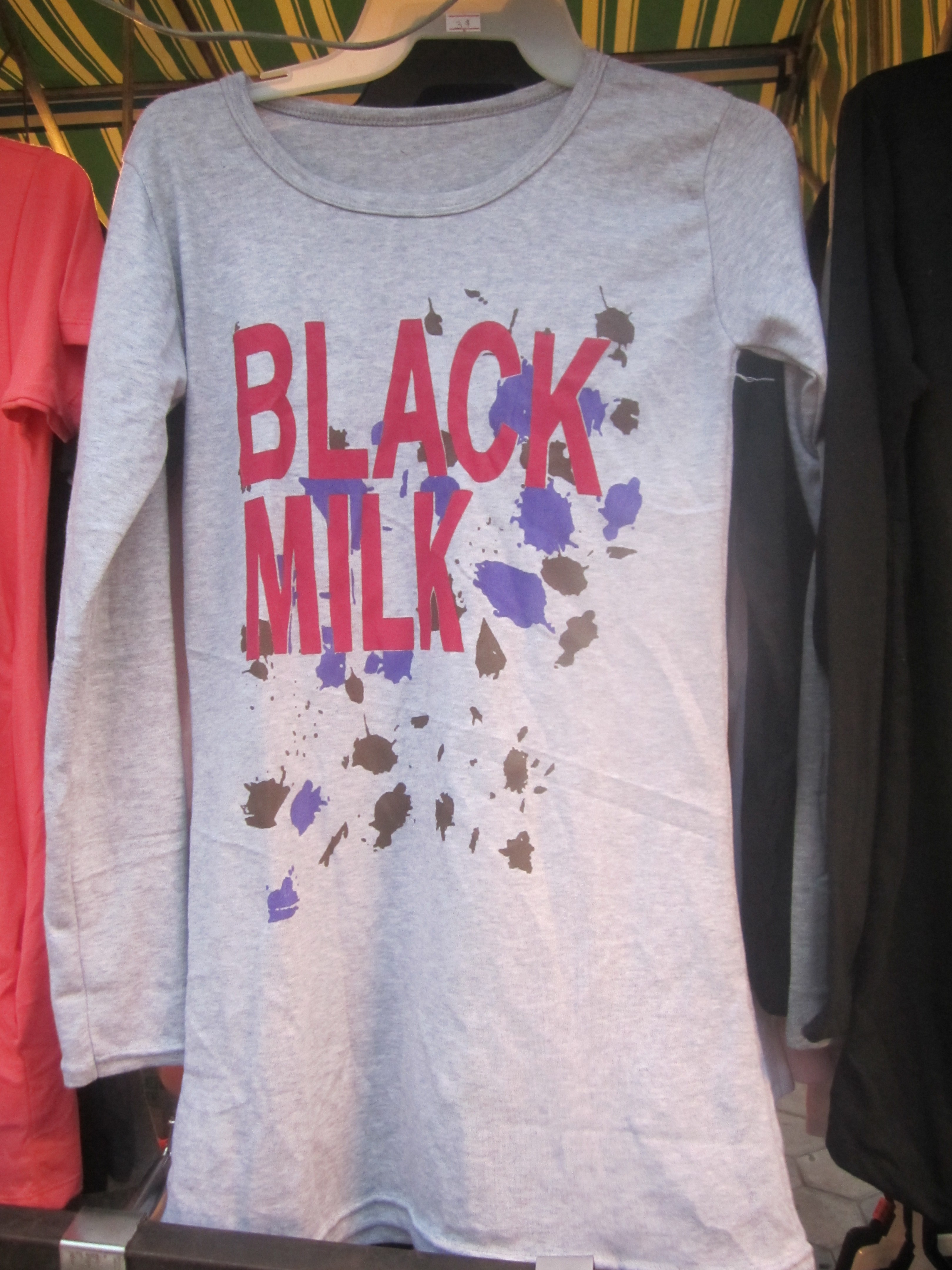
Rule (?) #4: It also doesn’t seem to matter if the senseless phrases evoke repulsive imagery of, say, spoiled food products.
“Punk Rock Tonight Love Me”: I almost bought this one. It was too small.
“Power Over Pimples”: Fuck yeah! As someone who endured 12 years of acne, I wanted to high-five this t-shirt and jump joyously in the air like… the people on this t-shirt. The text was also English, singing the praises of an acne-fighting cleansing solution.
So, um, in a country where a shitton of kids get strung out on glue sniffing and paint huffing, I didn’t know what to make of this. Was it supposed to be funny? One thing’s for sure: I don’t think the affected demographic is perusing for new shirts at the Night Market though…
Rule #5: Content Over Accuracy
“Joy, Look For It Evert Day”: This shirt says it all. There’s a certain sweetness to it all, what would be convenient to call an innocence, but I think it’s something other than that, less simple or more simple or in any case different.
“Cambodia’s not a post-modern culture,” someone was explaining to me. “So there’s not a lot of irony. There’s a playfulness for sure—but more of a sincerity to the work.”
She was talking about contemporary art, but I thought about her comment looking at the shirts tonight. And I think it’s true for the fashion as well. And I agree with Mathilde—I like it. Coming from a world of ironic everything—ironic moustaches, ironic wolf-howling-at-the-moon shirts, ironic gangsta rap listening and ghetto blasting, ironic malt liquor drinking and crack smoking (yes, really)—it’s pretty fucking refreshing to enter a world of sweetness and anti-irony. It’s not any less self-conscious, it’s just self-conscious in a different way. It makes you feel like we’ve missed something in the Western world, that we’ve lost something, gotten away from something, something I can’t quite name but that makes me horribly sad, in the smallest way, heavy like a pebble.
But I’m Western. And I can’t switch worlds, switch roles, ease myself into a different way of thinking. The t-shirts are, to me, ironic.
So about once a day here in Phnom Penh I have a massive WTF moment. I’ve been catalouging them: a boy stabbing birds, Western beggars, my guesthouse posting a sign about not offering “the sex services,” and pretty much any occasion I open the Phnom Penh Post. Strange things, bizarre things that my Western brain can’t compartmentalize—where all there is to do is shrug, shake your head and say “What the fuck…”
Today’s WTF moment came as I was walking home. It was a mellow day, filled with writing and street food, and I was retiring early, walking down a dusty road lined with corrugated metal fences, behind which the humming of machinery had ceased for the day. Men still wearing their hardhats bicycled past; teenagers in school uniforms clustered at the street corners, eating grilled meats from street stalls.
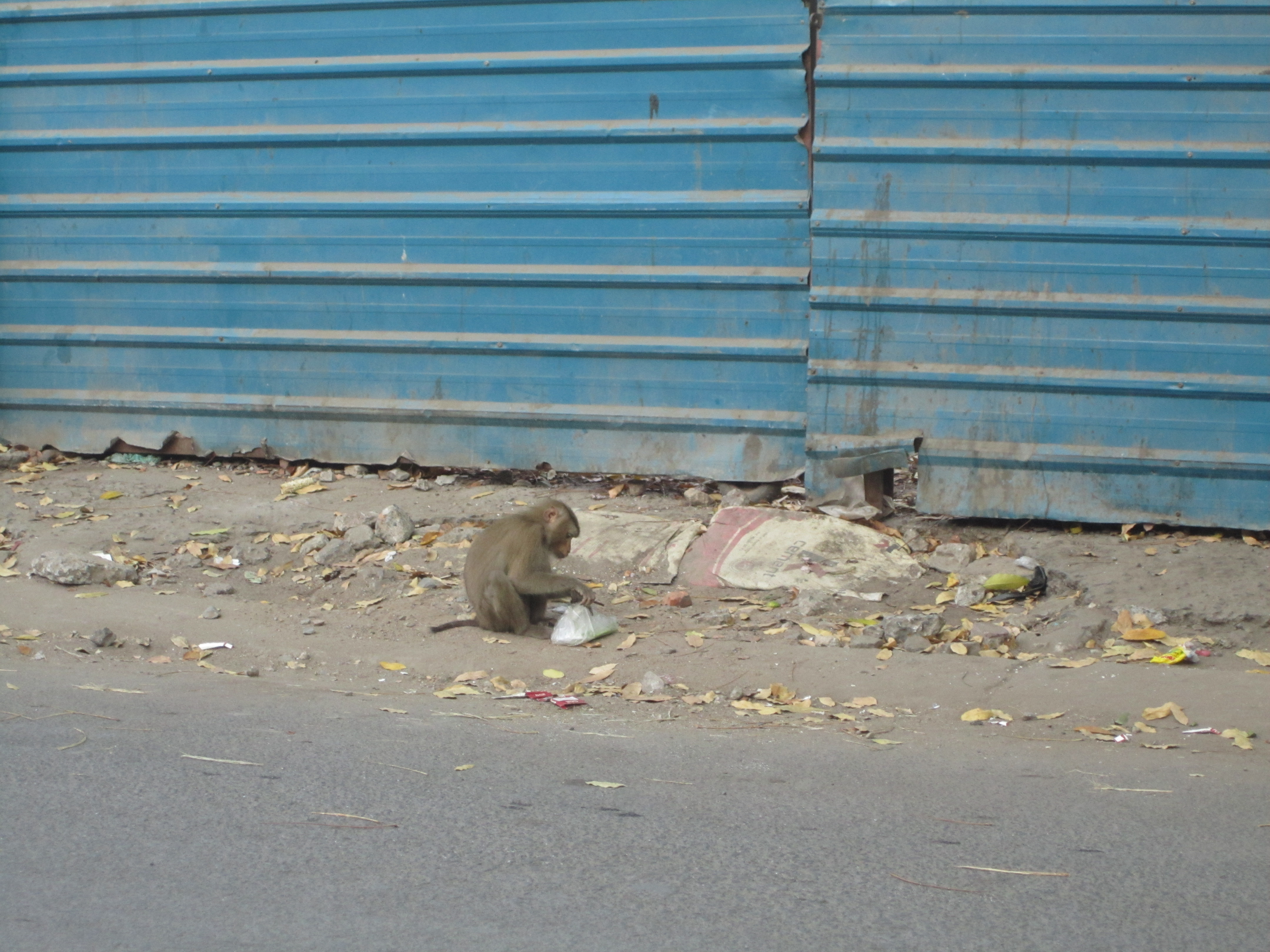
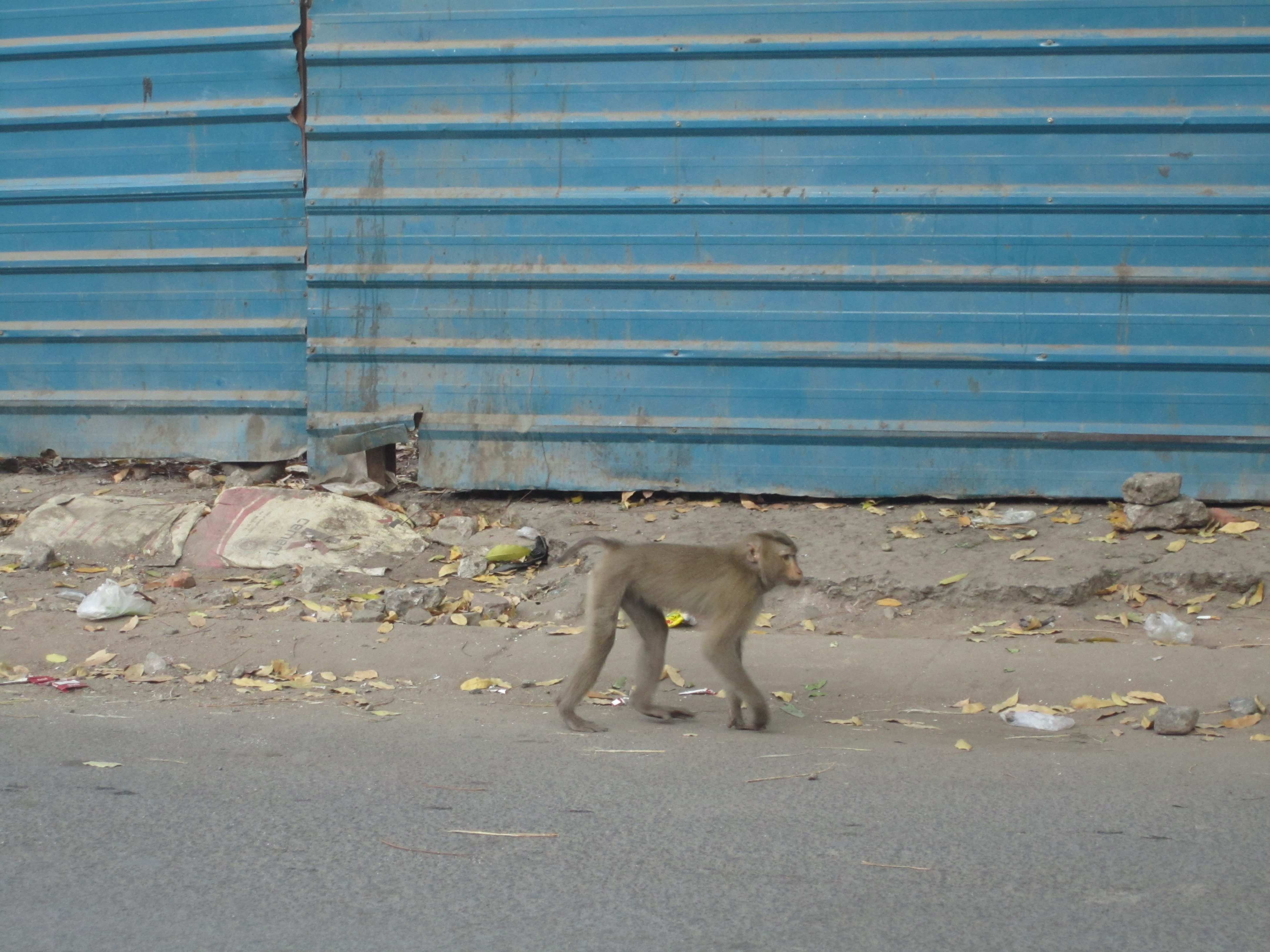
Then I saw this fellow:
Now, I’m familiar with street dogs and street cats and rats and mice and raccoons and squirrels—but WTF?! A street monkey? Phnom Penh isn’t the fucking jungle; it’s a city.
Where did the little guy comes from? Why wasn’t he in a zoo? Why was he just chilling there, riffling through a bag, trying to fish out a little food, sticking his red ass in the air as he repositioned? Why was no one doing anything? Why were they all going about their business like it was no big deal, perfectly normal for a hairy primate cousin to be out and about on a humid late afternoon?
I stood and watched him. I took a picture. A security guard down the road looked at me curiously—What’s this crazy white girl taking a picture of a monkey for?
The monkey tired of the plastic bag, threw it aside. He stretched his limbs and turned, looking into the traffic. He began to cross the street slowly, the same way I do, sensing out the rhythm of the road. He knew what he was doing. He was better at crossing the street than most tourists. The motobikes and tuk-tuks and cars slowed and swerved seamlessly around him—just another monkey cruising across the street.
Then he spotted me.
I still had my camera in my hands; maybe he was offended that I was taking pictures, objectifying him like an animal in a zoo. He gave me a real menacing look, bared his teeth slightly. He walked towards me.
Here I should clarify that I am 100% a city kid. I used to be afraid to swim in water I couldn’t see the bottom of. I’m easily impressed by the appearance of any stars whatsoever. Wildlife freaks me out about as much as uber urbanity freaks other people out. And everything is wildlife: from the geckos on the wall to the squeaks of bats. If it’s not a cat or dog, it’s probably got rabies and wants to eat you.
I thought of Greg, who I met bicycling breathlessly down a dirt road in Southern Italy. Greg was straight outta Queens, his speech peppered with more “yo”s than my own “hella”s. He’d just run into a herd of sheep in the road. He’d freaked—what were they doing? (“Probably grazing,” I offered.) Wildlife, fuck that. He hadn’t wasted any time in pedaling the other direction, and I immediately understood his panic.
And so the gangsta street monkey swaggered towards me. I moved slowly (“keep it cool, don’t ask scared, he can smell your fear”), stepping carefully, one foot at a time, in the opposite direction. When he disappeared between two parked cars, I walked briskly away, shaking my head and thinking, “What the fuck, what the fuck, what the fuck.”
You’re apt to hear this from other Westerners as you travel throughout Southeast Asia; you arrive in Phnom Penh and you’re apt to agree. A friendly, welcoming, almost shy demeanor, so vastly different from the brashness of their Vietnamese neighbors—it’s entracing, in a way, and a part of you falls in love with it, with the endlessly smiling faces, the hands pressed together and the small bow, say, when you pay your tab at a restaurant.
“How could they have possibly killed each other?” you hear people ask. “It’s amazing to think the Khmer Rouge could have occurred in a place like this, where the people are just so nice.” And as you graze the surface—stroll along the riverside, say, or stop for a coffee at a shady little street stall—it’s easy to wonder the same thing.
But you stay here a little while and you begin to see things—shadows that move like stray dogs, so that you think they’re stray dogs, until you look closer and realize: no, no, that’s something else. And it’s like there’s two Cambodias—the one you see on the surface, during daylight hours, and the other, some strange Other, of darkness and violence and short skirts sitting outside neon nightclubs, and weird, weird shit you couldn’t possibly ever understand.
“It’s out there,” Rachel said, nodding. “And all you need to do is scratch the surface—” she flicked her finger in the air “—and you see it.”
Flipping through the two English-language newspapers, you catch glimpses, between the black newsprint that smudges onto your fingertips in the heat. Western pedafiles, human traffikers, drug busts. You read a story about a local military captain being punished for using his gun “anarchically”, shooting it recklessly into a crowd of people. Because no one died, he doesn’t face any criminal charges. Instead, his head is shaved and he’s forced to go a military detention center, what sounds like a work camp, where he scrubs toilets and collects rubbish. He’ll be forced to work until “his attitude changes, then he’ll be set free.”
You read another article, about the murder/rape of a 25-year-old girl in a village in the Cham province. She’d been scratched, maimed, her vagina set ablaze. And yet it’s what the article mentions in passing, without further explaination, as though it were a given, that you find most disturbing. “Even in a time when every week brings fresh news of a horrific assault on a woman or child, the brutality of Lim Kim’s death stands out.” It’s determined that the attacker must be married, because otherwise he would have just married the victim after raping her and wouldn’t have had to kill her. “Something made him unable to be responsible for his actions,” the local police had determined. The reporter had gone on to interview villagers; they reported being “scared of the ghost of the body, but most of all the attacker”—as though it were perfectly normal to be scared of the murderer girl’s ghost, but not of an attacker.
Tim’s telling you the lead-in to some story, some hapless night. It took place at the first Western nightclub in Phnom Penh, where prostitution isn’t the worst of the city’s nightclubs, but certainly still present. “It’s called Heart of Darkness—”
“Wait,” you stop him. “Are you fucking serious? The first Western nightclub in the city is called ‘Heart of Darkness’?”
He nods and you laugh, because what is there else to do in the face of such a blatant metaphor—if you wrote in a book, you say, it’d be over-the-top symbolism. But here it is, in real life, staring you in the face, and there’s nothing to do but shake your head and laugh.
“You should always take a taxi at night,” Patricia tells you at the club, giving you the number of a taxi service. “The police clock off at 9. So sometimes, the moto or tuk-tuk driver will call a friend, and there’ll be someone waiting at your apartment with a gun to rob you. The taxi costs more, but it’s better.”
You program the taxi number into your phone.
You’re having dinner with Susan and she mentions in passing that the number of mob killings are down. “Mob killings?” you ask. “Oh, yes,” and she tells you about the phenomenon of mobs of people spontaneously beating and stoning accused theives to death. “It was really bad seven or so years ago, several a month. They came under pressure from the UN to get a handle on it. It’s pretty rare in Phnom Penh now, but it still happens in the provinces.”
“A girl was double raped earlier this week,” Tom tells you, “and her attackers only had to pay a $125 restitution. The case didn’t even go to court.”
“We’ve secured scholarships for several kids to go back to school,” Romi tells you when you visit Tiny Toones.
“Are the school fees very high?” you ask.
“No,” she sighs, “it’s the bribes that really add up.”
“Bribes?”
“Yes, the teacher bribes. They don’t always call it that, but it’s like this: the teacher photocopies a lesson. They say, ‘I paid for this photocopy, so you must pay me.’ If you don’t, you don’t get the lesson, you can’t take the test, you can’t pass the class. So it’s like this. But,” she shurgs and looks out at the shaded lot of squealing children, “this is Cambodia, and this is how it is.”
You nod. You’ve given up trying to wrap your head around it, trying to fit it into some compartment of Western understanding.
But it doesn’t feel bipolar; it doesn’t feel like a contradiction, or like it’s at odds with itself. You feel, on an intuitive, unnameable level, that it’s two sides of the same coin—that it’s born from the same place, the beauty and grace and warmth, and the violence and corruption and darkness—born from the same mystery down there at the center, and not so far from the surface.
You think of Elliott Smith. Which is embarrassing and ridiculous, but you think of him anyway—of the beautiful ballads, the immense tenderness, the way you cried across the Atlantic when his song came on your iPod and the news of the death was fresh, an another lifetime that’s not so long ago sometimes, not as far as you’d like to think. And you think of people asking, “Man, how could he write such beautiful songs and fucking stab himself in the chest?”
And you’d always thought, “That’s how.” And you think of it now, though you’re not sure why, though it’s not at all the same thing—though you laugh at your silly, silly gut for telling you it is.
“Tuk-tuk la-dee?” “La-dee, moto-bike!” “Where you go?” “La-dee, la-dee—you need moto-bike!”
This is the chorus you hear, endlessly, walking through central Phnom Penh. It’s like birds chattering, only more jarring, less song-like. It comes accompanied with a raised arm, two fingers extended—more of a summons than an offering of service.
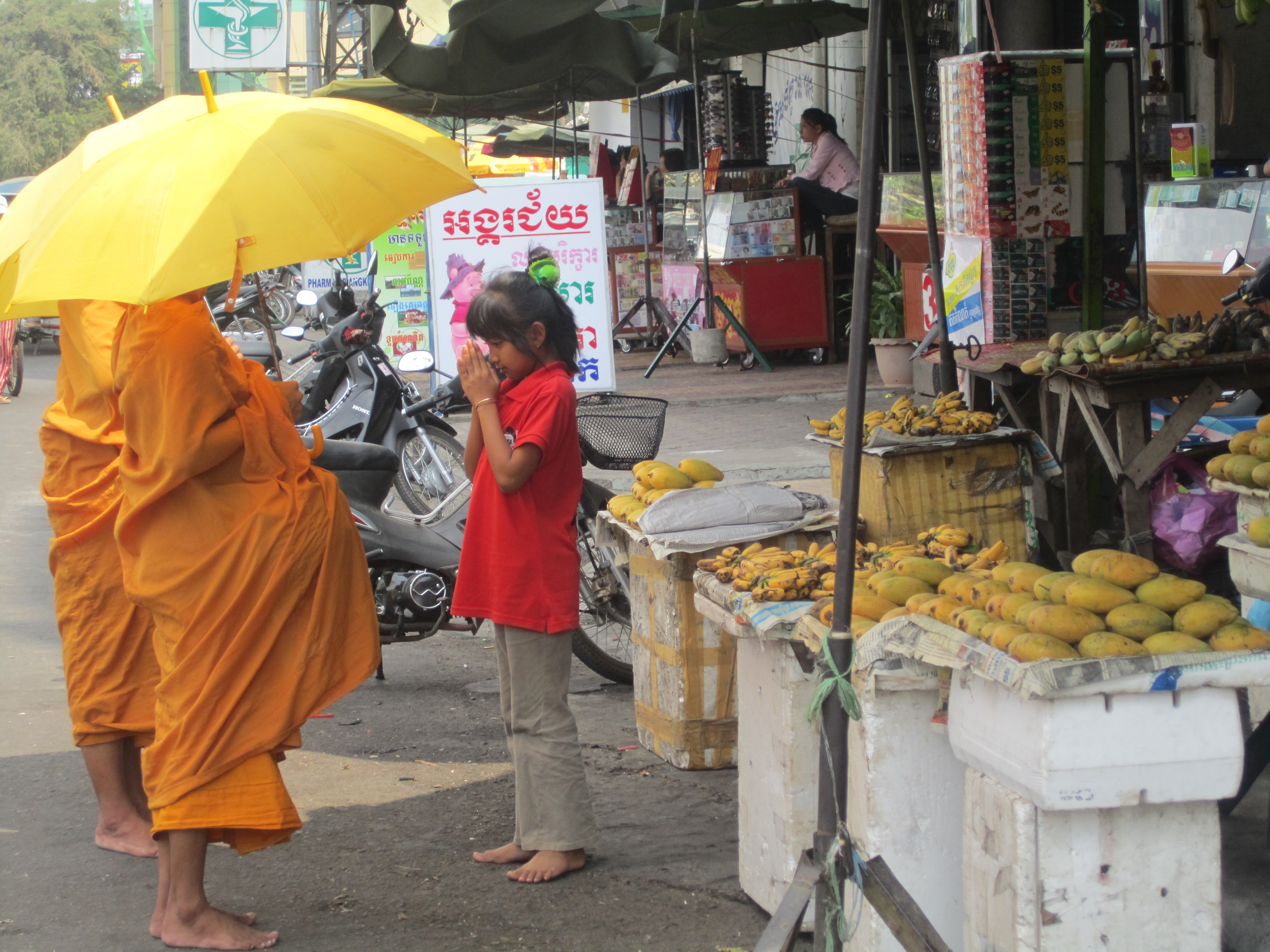
By the touristy riverside, the touts can be pushy, but for the most part they’re just guys trying to make an honest(ish) buck. At first I tried to respond to all of them—Lisa ran a tuk-tuk company in Phnom Penh, given as part of her dowry, before the Khmer Rouge—so I feel a special responsibility to be respectful. I smiled politely and said “no” or “ot te.”
Eventually it got to be too much to respond to each other them, perched on their bikes at every street corner, crying out to you when you’re half-way down the block. I began to just shake my head, and soon stopped making eye contact. I started feeling like a bobble-head toy, my neck hurting from the constant swinging. Now I barely respond at all.
But I suppose that’s not so unusual, the constant barrage—being a Westerner in a city like Phnom Penh, where you stand out, gleaming of privilege and sweat and thin layer of sun screen. You take it in stride, a small price to pay for the relative welcoming warmness of the Cambodian people.
But here’s what is so unusual: most of these tuk-tuk and motorbike drivers have no idea how to navigate the city. A city, I should add, that’s laid out in a neat grid. And not just a grid, a numbered grid, where even numbered streets intersect the odd.
It is perhaps the easiest city I’ve ever learned. And I don’t make my living by driving its streets. So what, what, what is going on here?
It took me a few days to clue into it. I did a lot of walking at first, and when I did finally take a motorbike, chalked the confusion up to language barriers and my hotel’s offbeat location.
On Friday night, I was headed from a party back to my hotel. “Street 141 at 232,” I told the driver. The glassy gleam of incomprehension stared back at me, followed by a vague nod. This did not produce a feeling of confidence in me.
Must not know his English numbers yet, I thought and whipped out a piece of paper. I wrote the street numbers as largely and legibily as I could. I showed him. He nodded a little more vigoriously; we negotiated the price and I hopped on.
We slid down the wide Norodom Boulevard, nearly empty of its honking, and I felt the breeze of the night on my arms, my legs. I closed my eyes and let it kiss me.
I’d been in the city four days by that point—so I knew when we were making a wrong turn.
“Um, no,” I said and pointed back to Norodom. He shot me a confused glance. I pointed to the street sign. “This is only 156. We go to 232.” I waved my hand down the road.
A series of slow circlings and U-Turns ensued, me growing ever crankier on the back of the bike. It devolved to me leading the motorbike driver street-by-street back to the hotel.
He must be new at this, I thought as I finally hopped off.
But the phenomenon repeated itself: the glassy look, the vague nods, the wrong turns and aimless meandering. Another characteristic element to the typical un-joy-ride, I soon discovered, comes when you stop every couple blocks for the driver to discuss with other drivers the intended destination of the passenger, locked in some sort of secret code no one is able to decipher. Lots of pointing and shrugging ensues. This is apt to repeat two-to-four times before one finally arrives.
At first, I blamed it on my own inability to say Khmer numbers, and took to only writing locations, following it up with a big, you-get-it? grin.
The answer you always get is “okay, okay.” The ride you get is not always “okay, okay.”
I was utterly confused and out of ideas. Maybe they were guys from the countryside, who’d only just come to Phnom Penh. Maybe they didn’t know the city that well yet—but come on, how long does it take to learn a city? A numbered grid of a city at that?
No, no, there was something more going on here—some kind of deeper divide than just language or location familiarity. There was so kind of vast cultural chasm, a disconnect.
“Oh no, no, no,” Mathilde told me. “They don’t know street names, only landmarks. It’s better to say ‘near to Independence Monument,’ or ‘Royal Palace.’ These they know. But sometimes even then…”
I’ve worked that into my repertoire, a long, drawn-out process in which I use every means I can fathom to communicate my destination. “Sihanouk, near Independence Monument,” I told the driver yesterday.
We got closer this time, but just before the up-lit monument—positioned handsomely at the crossroads of two main thoroughfares and surrounded by the massive honking roundabout—we took a turn down a random sidestreet. I sighed. We U-Turned.
I reported my failure back to Mathilde. “They will always say ‘okay,’ even if they don’t know.”
“So, how do they work? How do they live and get around a city they don’t know at all?”
She shrugged, and I guess that’s all you can do. Because they must know it—there must be some way they know it, some entirely different way of interacting with a city and a landscape that doesn’t even occur to me, that I can’t even fathom—as foreign as another language, as mysterious as an alien scribble, written all over this city in a way I can’t read, can’t decipher—in a way that I can’t even see.
Perhaps I’ll figure out the mystery. But for now I’ll keep circling, keep ambling, keep pointing to a destination I can’t communicate, hidden somewhere in the gap between cultures—foreign, mystified and helmetless on the back of a Phnom Penh motorbike.
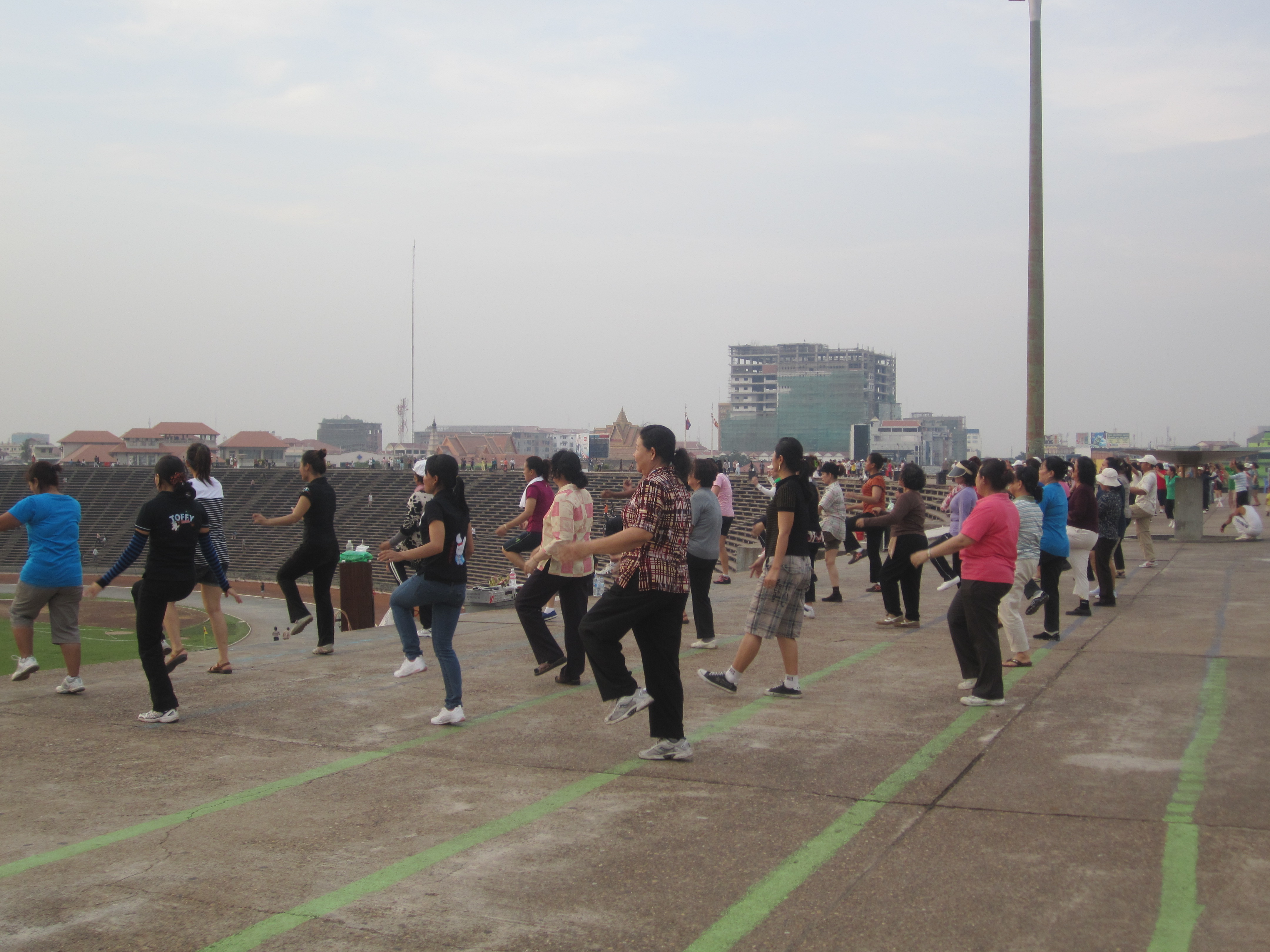
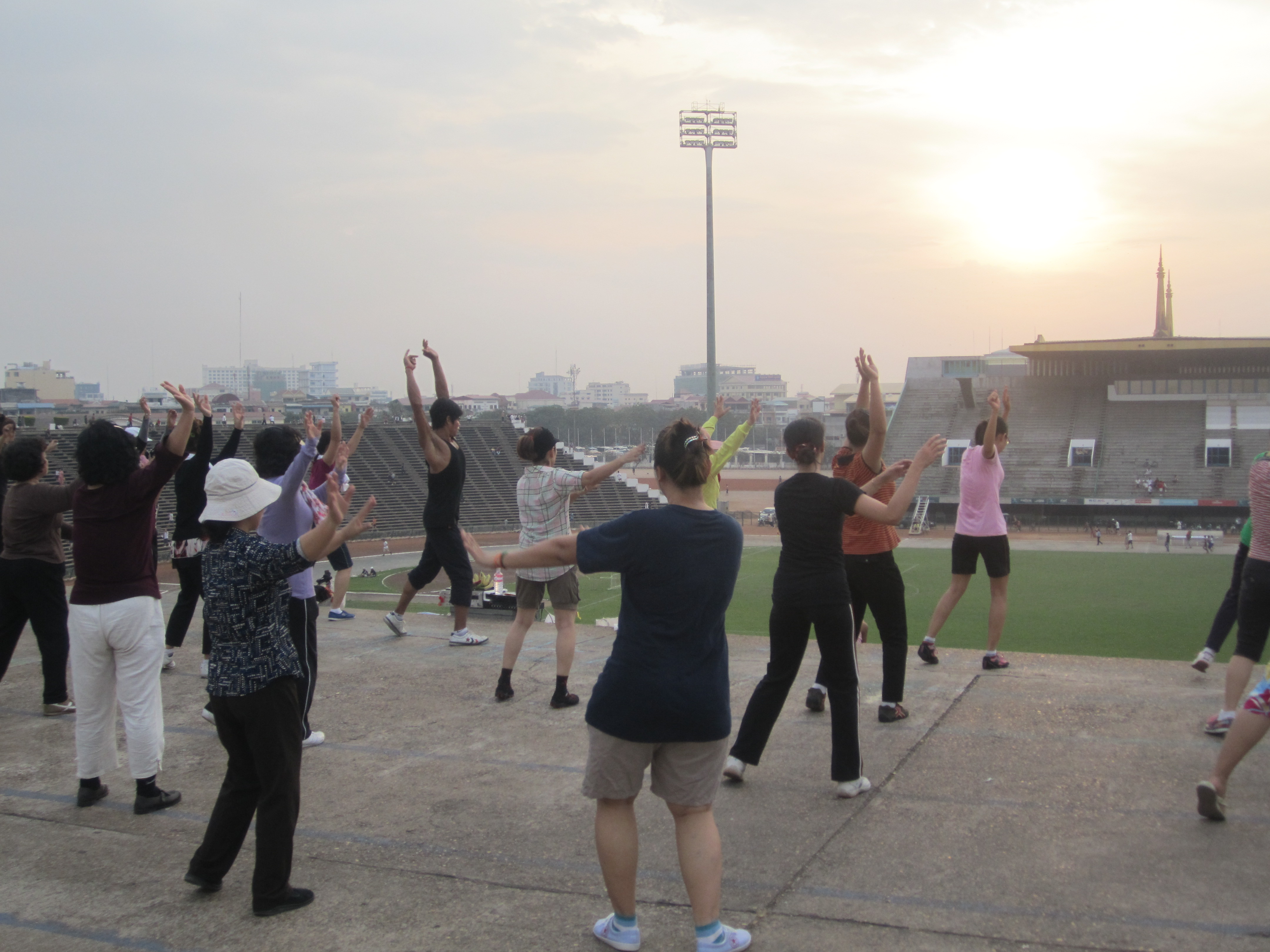
It’s dusk at the Olympic Stadium, and it feels like a festival. Vendors have set up stalls selling snack foods, beverages, trinkets. People in sweat clothes swarm. Cliche club dance music beats out of stereosystems and, lined up along the cement ring of the stadium’s top tier, little old ladies dance.
It’s called Aerobic Dancing, and it’s about the goddamn most endearing thing I’ve ever seen.
I saw it my first night in Phnom Penh, along the riverside. A few sets of stereospeakers had been set up, and young men were leading groups in dance moves. I thought it was something for tourists, some sort of street performance. I looked for baskets of money and didn’t see any. Then I scanned the expressions of the dancers’ faces, and they were all totally in earnest, concentrated of getting the moves right. Now this, I thought, is something different.
It was recommended to me later that I go to the city’s Olympic Stadium at dawn (um, no) or dusk (um, yes!) to see some real aerobic dancing. Well, you didn’t have to tell me twice.
It’s bustling leading up the steep slope of the stadium’s entrance. People swing their arms and legs, warming up. Children run around. I get to the top, and it’s a buzzing beehive of fitness. People run the stairs. Down at the bottom, a crew of joggers circle the dirt track. But the overwhelming majority of people at the stadium are late-middle-aged women. And they are there to dance.
Now, I’m quite familiar with old ladies doing Tai Chi in the parks at dawn. And I’m even used to random young Western dude who thanks to Ghost Dog has aspirations of becoming an urban samurai and practices along. But this is something entirely different.
About a dozen different stations are set up along the stadium’s ring, where a cool dusk breeze passes. Their music and moves are all slight variations of each other: twists and kicks and stretches and arm raises, a little fancy footwork from time to time. The people in the front rows sweat, focus intently. Most of the others vaguely step along, moving this way and that, sometimes getting the moves right, sometimes not. It doesn’t really seem to be about that.
The leaders of all of these groups are young men, teenagers in some cases. Hair swept across the face, pink shirts, dedazzled jean pockets: they are boys that by American standards would be categorically, 100% flaming gay. But they’re doing their thing here. And a crew of older ladies are doing it with them.
I sit and watch for awhile: the various sets of raised arms, the shakes and twists, the echoes of club music. Before the Khmer Rouge, dance was one of the most important art forms in the culture. Most of the country’s dancers, along with other artists, were killed.
Well, this might not be a revival of a lost traditional art form, but it might be an evolution of that. It might be a new manifestation of a cultural predisposition to dance. Or it could just be exercise, set to a melting sky and sweet as fucking hell.
That’s all I kept thinking last night, as I stood sweating and stomach-sore in the crowd. I’d dragged myself out to a show, what was described to me as an all-girl indie rock band that sang in Khmer. Killer. No traveler’s flu would make me miss this.
It was a funny mix—local men in dress shirts and slacks, women in those super foofy sparkly dresses; kids, some just in the crowd, others wearing matching shirts for some organization I couldn’t quite make out.
And there were your typical expats—Western, mostly white. Some of them were extremely well-groomed, reeking of cologne and hair spray and kissing their friends on both cheeks. Some of them wore that aren’t-I-so-cool-for-being-here look. Some tried to dance along or move to the beat, and it was sad and cute in the way it’s always sad and cute. And others just seemed to be there, watching, enjoying the show, because that’s what there was to do that night.
But the kids putting on the show—the kids on stage and holding the cameras and checking the sound—they were not your normal expats.
Your typical expat does not drop their “to be” verb (“She crazy”), doesn’t say “y’all” or “aight.” They don’t wear baggy jeans and puffy sneakers. They don’t start NGOs called Tiny Toones or hip-hop groups called Klap Ya Handz, written in Godfather font. They don’t breakdance or freestyle or bust—and they don’t do it in the language native to their new homes.
I’d heard about the show from Bel, a girl I’d found on Couchsurfing. We had plans to meet up for coffee and even though my stomach was already getting wonky, something told me not to flake.
She was a cool girl and we talked for awhile. Her boyfriend was a Khmer-American who’d moved back to Cambodia, with no intention of ever leaving again. “He’s the most patriotic Khmer you’ll ever meet,” she said, and later he showed me the tattoo of a famous Wat across his back.
“There’s a lot of foreign-born Khmers moving back,” Bel told me. “Lots of artists and young people. And they’re really motivated to do something here.”
I wanted to see this; I wanted to glimpse what this was. Sure, I knew of people going back to their parents’ countries for a visit, but to live? To give up everything they know to fight for something better in a country they hadn’t grown up in? This was something different.
And it was. The show place was buried deep inside the maze of a mall, shuttered shops and a blinking arcade, bowling alley and bumper cars. I got there earlyish, paid a $10 cover—normal for the US, but exorbitant for here.
On stage was a DJ, two turntables and a MacBook glowing. Two artists were on stage, doing ad hoc graffiti art on a make-shift wall. “Empire State of Mind” came on. It was like being at any hip-hop show at home—except a hell of a lot hotter.
The first act was a hip-hop group called Klap Ya Handz. They spoke in a working-class English, like kids that grow up in Oakland. But in the songs, they flowed in Khmer. For one song, they brought out traditional Khmer drummers that were, well, bad-ass. During another song, the lead girl did what she later called “Khmer hands,” a hip-hop take-off on the hand movements of traditional Khmer dancers.
Cambodia lost a whole generation of artists during the Khmer Rouge. Traditional dance was virtually erased and, after Pol Pot, there wasn’t anyone left to pass it on. I’d read accounts of the few survivors left trying to teach the next generation, and it being hard—they were more interested, as teenagers usually are, in contemporary things. Like hip-hop.
The headliner was Laura Mam and the Like Me’s. They’re a bluesy, all-girl rock band from San Jose, California (local love). They’re Khmer-American and sing in Khmer. The crowd obviously loved them, singing along and snapping photos and waving their arms. I was told that they came to play in Cambodia relatively often. Either way, they showed the same kind of passionate pride in their Khmer culture that the kids in Klap Ya Handz did.
They played a song called “Diaspora”: “for all the refugees living in diaspora around the world—and missing Cambodia.” The crowd went crazy.
No, this wasn’t your normal expat scene.
Your typical expat is someone of relative priviledge; they have, say, a university degree and the social mobility to pick up and move around the world. Maybe they studied abroad, or spent time backpacking around. In any event, it occurred to them to leave their home countries in the first place and they had the means, however meager, to do it. The ones I encounter are largely middle-class; the uber wealthy ones exist on another plane, and I only see them in passing—the immaculate girls on the streets of Hong Kong.
These kids were categorically Not That. They’re the kind of kids, in the kind of scene, that I miss when I leave the US; when I think about moving abroad, I think, “Man, there’s so much shit I’d be missing” and this is part of what I mean.
And they bring their Americanness—their very, very Americanness—back here. But they’re making something new with it; there’s that frenetic energy, that spark you feel when cultures collide and you see people that are so intensely passionate about what they’re doing, you can’t help but feel it too.
Of course, not all of them are coming back by choice. The US opted to deport foreign-born convicts, regardless of whether they’d served their time, and nearly 200 people who were, for all intents and purposes, American were sent “back” to Cambodia. They brought their culture, a street culture, and they brought their art. And they’re doing shit; they’re bringing this to the kids of Cambodia, the next generation (ie: Tiny Toones).
So basically, watch the fuck out for these kids.
There was a shirt I kept seeing in the crowd, tons of kids wearing it. Its design was a take-off on the Star Wars logo, and it read: “The Khmer Empire Strikes Back.”
This was my first glimpse into this, my looking-through-the-peep-hole into this. I fully intend on investigating this more during my time here. But last night, sickness was calling, and I had to head back to the hotel.
A sun-pressed afternoon and I’m walking through the dim cool rooms of the Tuol Slen Genocide Museum. The crumbling cells, the tangled barbed wire, the blood stains on the floor—none of it seems real. A bird flitted through the room of brick cells during our tour; a child was giggling and running on the grass. Tourists snapped photos.
I didn’t feel anything I was supposed to, or thought I was supposed to. The rooms and rooms lined with photos on cheap display boards, gleaming plexi-glass—young faces, beautiful faces, virtually all with same expression. I can’t quite name it; it isn’t anger or fear or anything like that. Maybe it’s a lack of fear, a numbness, a well-isn’t-this-it, isn’t-this-the-end-of-it. I looked at them and they didn’t look dead, didn’t look like people tortured and starved and tossed off into a mass graves just a couple meters away. They looked real and their expressions, in the face of death, looked real too.
I’m waiting to catch my tour guide. He’d shared his own experiences during the tour—life in the camps, his family members that had died—and I want to ask him questions. How does he do it? How does he walk through here everyday and talk about it, tell his story to masses of Western tourists, panting and sleeveless?
“Everyone in my generation is traumatized,” he’d said, pointing to his head with both fingers, making a very small looping motion. “We all have the trauma.” How does he do it, how does he talk about it?
[“I don’t want to, I don’t want to take this job. But I needed to work,” he told me later, a bench in the shade. He’d gone to Germany last summer to study at a Holocaust museum. “That’s what this was, a second Holocaust,” and he showed me a page in the book he held, where amidst the Khmer lettering, more like art than language, a lone English word stood in parentheses: “Holocaust.”]
I’m waiting and rewalking through the first rooms, torture rooms. In each one is a ragged metal bed frame, rusted tools of torture, a photo on the wall of a body, bloody and dead and tied to the bed. There are blood stains on the floor and they look more like dirt, so that you could almost think that they were dirt and not someone’s blood, and again I don’t feel anything.
Three tourists—male, late 20s. Not American or European, some kind of Asian, I think. They’re laughing. There’s big signs that ask you not to laugh—a smiling man with a red slash across his face—and they’re laughing.
One of them picks up a torture tool. He swings it at the other in slow motion; he makes a comical grimace and their friend snaps a photo. They gather around the viewfinder and laugh.
I watch them, and it’s now that I feel something. It isn’t anger or rage, which would make more sense, I think—not even the how-dare-yous. It’s just a sadness—a deep, wordless sadness.
“That’s really fucked up and disrespectful,” I say. I don’t know if they speak English, but it doesn’t really matter.
And it’s at that point that I feel tears welling up—that I finally feel what I think I’m supposed to feel at a place like this. And I curse myself for having put on eye makeup that morning, and I curse myself for crying for something I don’t think I have a right to cry for, for crying here, in the middle of the museum. I curse myself for letting someone else’s ignorance bother me, and I curse myself for having said something when it’s not my job or my place—when it won’t change anything, not their disrespect and certainly not my sadness.
They stare at me. They have no expression, and maybe it’s their own kind of numbness. “That’s really hurtful,” I add, and walk away.
Lauren Quinn is a writer and traveler currently living in Hanoi. Lonely Girl Travels was a blog of her sola travels and expat living from 2009 to 2012. She resides elsewhere on the internet now.
 I had a vision.

















 Lonely Girl Travels
Recent Comments