Posts Tagged 'blogsherpa'


Learning to Ride On a Motorbike in Hanoi

Hanoi is a bipolar child with a strict bedtime.

Clinging hands behind me to the metal rack, I try to suppress the involuntary flinching—a circumstantial case of Tourette’s. It’s Saturday morning, and my first ride aback a motorbike through the frenetic traffic of Hanoi.

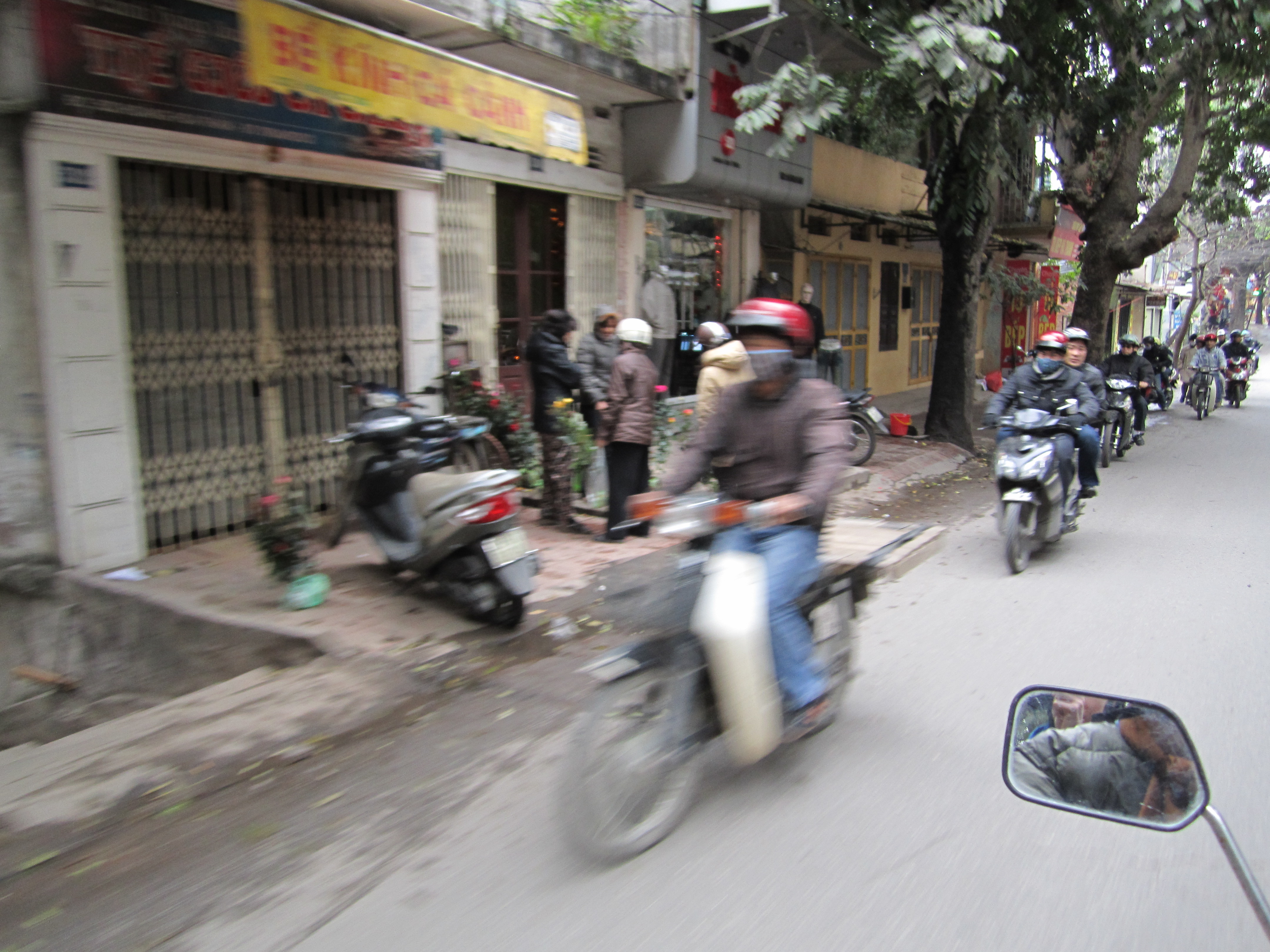
If you want to see the word “clusterfuck” defined, acted out in an exquisite charade, snap on a spare helmet, straddle the seat of your friend’s motorbike and take a ride through the streets of Hanoi. Feel the blanket of exhaust haze whip up around you; feel your legs naked to the risk of a thousand near collisions; feel the breeze of your own mortality and the queasy cocktail of sweetened coffee, cigarettes and exhaust churn in your stomach.

See towers of Tet trees and blossom branches balanced aback bikes; see jugs of water and housewares, bundles of mysterious somethings tied on in impossible precariousness. See families of four smooshed onto a single bike; see the eyes of children placidly blinking in the madness. See drivers texting, pulling out without looking, barely slowly, pedestrians stepping out into the chaos of it all—women walking with baskets balanced on a piece of wood across their shoulders, liked Lady Justice, except it’s their mouths that are masked; their eyes remain wide open.
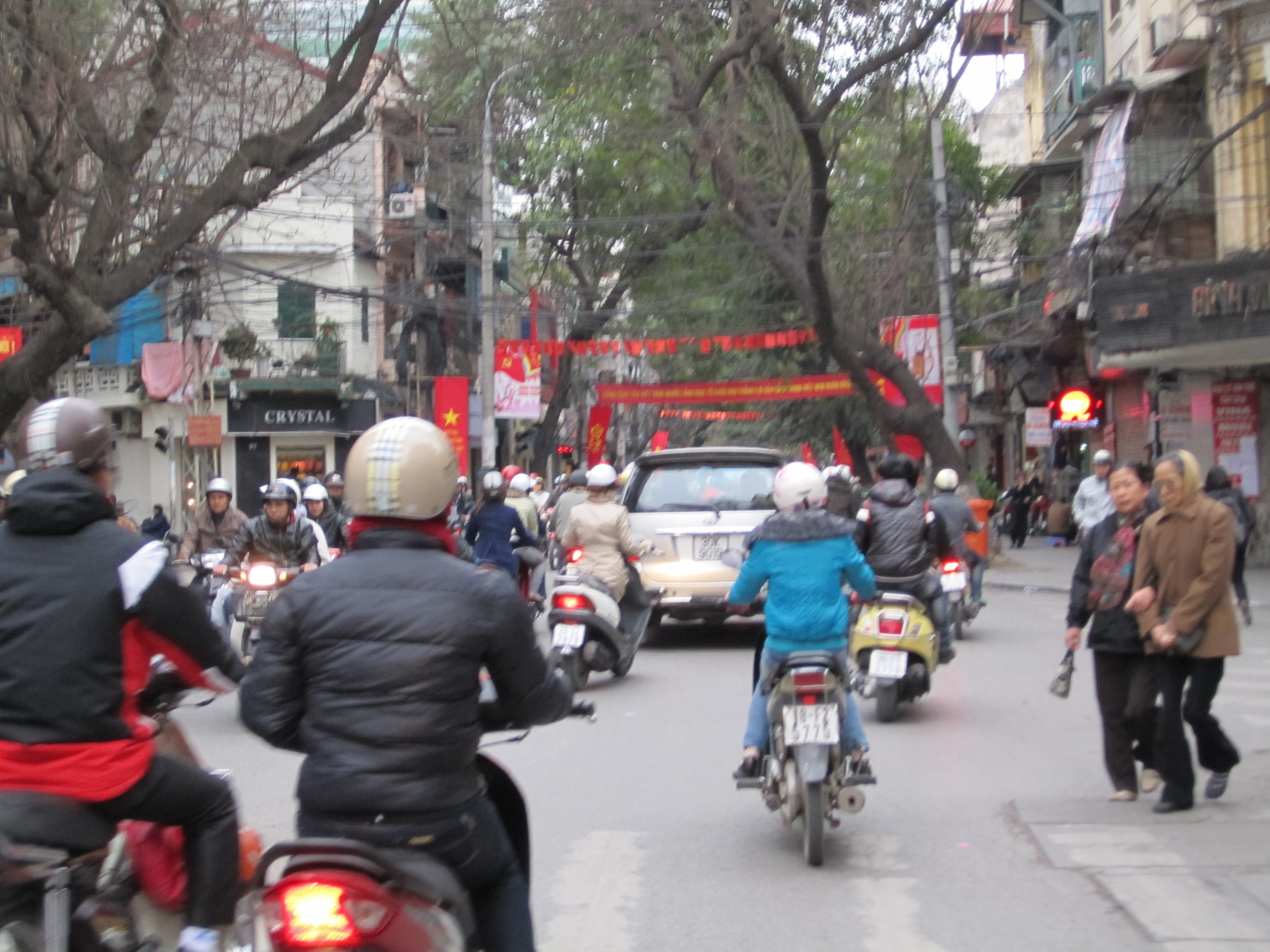
Hear the horns beep and squawk like a million hungry birds—seven million, to be exact, and every damn one of em has a motorbike and is riding their motorbike, lanes just vague suggestions, right-of-way a nonexistent notion.

See this all this because you’re in this, suddenly a part of this: a passenger in the strange dance that feels more like a riot or a mosh pit—but no, no, must be a dance because you keep skirting disaster, skirting death, and you keep wanting to clamp your eyes shut but can’t, can’t.

Riding aback a motorbike through Hanoi isn’t exactly a near-death experience. It feels more like being on an airplane with really bad turbulence: you trust the pilot but not the skies. You know you’re not actually going to die, but you really can’t wait for the whole damn thing to be over. You get off feeling like you’ve just stepped off a rickety old rollercoaster that’s safety permits are supremely suspect.

“The sidewalks in Hanoi aren’t really for walking,” Jacob throws over his shoulder. “They’re more for commerce. If you want to walk, you’ve pretty much gotta do it in the street.”

It’s not a walking town, he says, and it’s true—at times I don’t see a single pedestrian, just a weaving, wheezing sea of traffic. How do you get to know a place without walking it? How do you get a feel for feel for a place without your feet on its streets?

It gets easier. I tell myself to trust, to put faith in the fact no one seems to be crashing. It begins to feel like we’re moving along this barely perceptible tightrope that weaves in and out of other people’s tightropes, maybe like telephone wires—like our own personal orbit, the miracle of chance that we don’t collide, such a miracle that it can’t be chance at all, but driven by some other force I can only suspect, can feel at times in the smoggy breeze, but can’t come close to naming.

Nighttime is different. It’s as though someone flips a giant switch. By 11, the streets have cleared, suddenly swept of everything but a faint whisper, the asthmatic glow of the headlight. The streets seem smaller in the dark, emptied of their madness—they don’t seem like the same streets at all, but an entirely different place, a different city. An incredible stillness settles over the buildings, the pavement, the wires stretching and branches drooping and the shapes of shadows in the dim drizzle—as if none of it were real, all the daylight mania just a waking dream, a reverse nightmare.
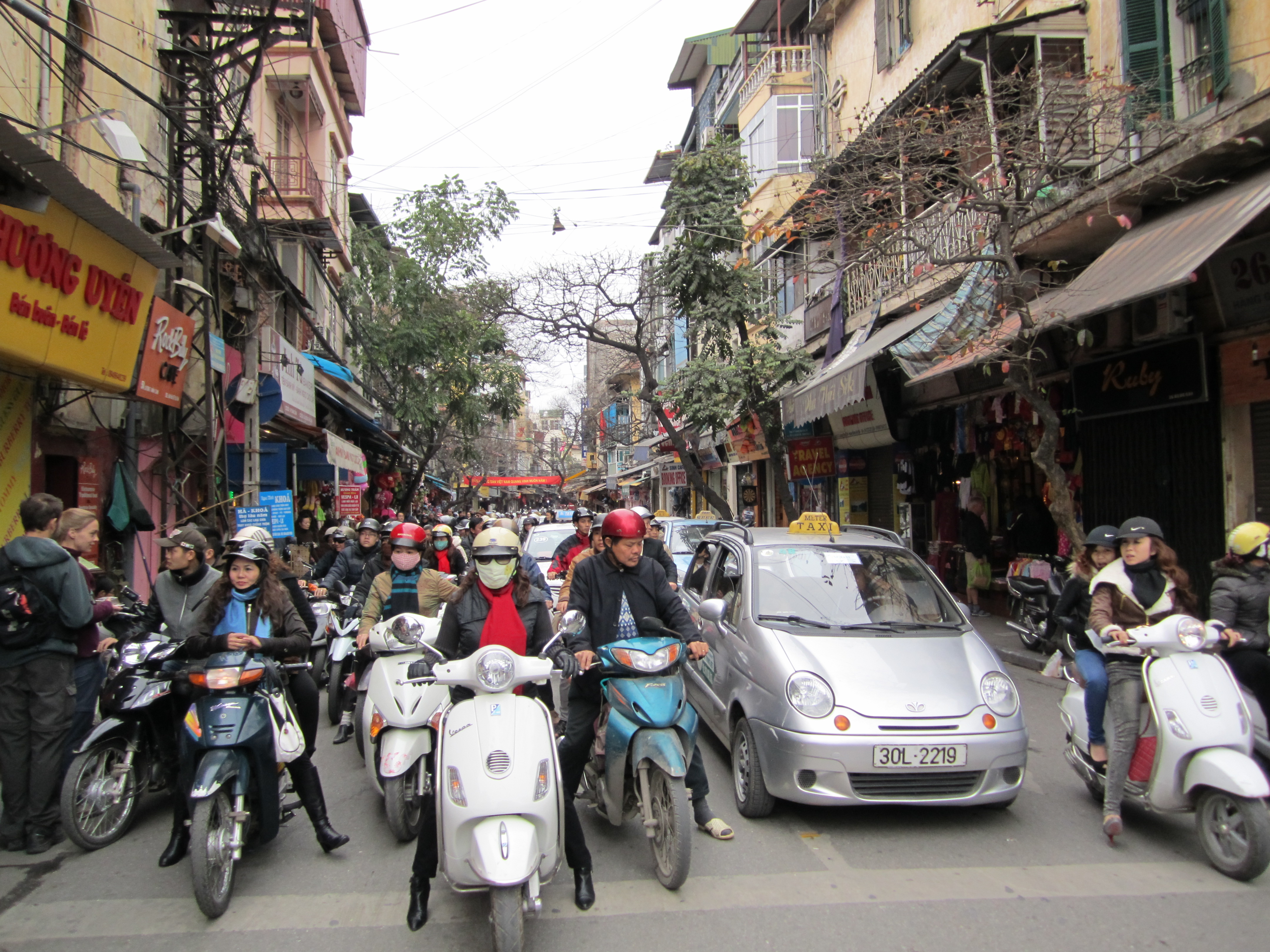
By Sunday I’m able to hang on with only one hand and snap photos with the other. I’m comfortable enough to carry on a conversation as we drive. Jacob points out landmarks and tell little stories; I tell him how my parents were revolutionaries when they were young, how the met in a Communist meeting. He quizzes me Vietnamese numbers, phrases; we laugh about the universal asshole-ness of SUV drivers. We weave through the manic chaos of daytime, and I tell him Hanoi feels like a bipolar city.

Rain comes that night, along with a cold wind; we move more slowly through the vacant streets. I blink against the lashings of wet and my hands turn frigid. Slowly, I loosen my grip on the metal grating, and place both my hands in my pockets.

I’ve learned how to trust the gods of traffic and chaos. I’ve learned how to ride a motorbike in Hanoi.

11 Dazed Hours in Hong Kong

If ever there was a place to wander around in a jet-lagged, head-cold haze with nothing more than a tourist bureau map, Hong Kong is it.

The 11-hour lay-over is actually what made me choose this flight to Hanoi (aside from the fact that it was the cheapest). I love long layovers; it’s like a two-for, a bonus. You get to extend the half-here-ness of transit onto a place—walk through its streets like it were a video game, or bumpy camcorder images from someone else’s vacation, or someone else’s dream, exuding a kind of impermenance that makes you impervious, imperceptible, a kind of illusion, a walking ghost in a half-here city.

Or it could just be the jet-lag talking.

Either way, Hong Kong is a trippy city to spend 11 hours sleepwalking through. Everything is clean, clear and predetermined: signs telling you where to go, signs reminding you to hold the handrailings, signs designating exactly where you should walk and where you should stand and which direction you should look for traffic and when you should be mindful of bicyclists.

It’s a subdued city, a city on Vicodin. Everyone talks in a low, pleasant voice; they smile slightly when they exchange words with you. Skyscrapers rise up to be swallowed in a white fog. Municipal workers sweep sidewalks, trim hedges, wear blue face masks and walk with their hands clasped behind their backs, or piously under their bellies. People walk with the self-possessed composure of business people on their lunch breaks. Shoes click, crosswalk signs hum, the gentle clatter of endless construction (what more could they be building?) echoes. Nothing is loud or jarring or overwhelming. Yes, it’s crowded, but there’s an order to everything—an organized insanity, a colonized chaos.

You could almost begin to suspect that you were in some George-Orwell-esque alternate reality, where everything seems real, resembles real, but really isn’t—just some placated approximation of a real place. Rolex, Prada, Couch, Ralph Lauren, Espirit, Starbucks, 711, Pret A Manger, Citibank, Geox—buildings that stack as neatly as Leggos and fish markets that don’t reek of fish, don’t reek of anything. The thinnest layer of soot covers the awnings, as if to remind you that it’s real—the slightest twinge of exhaust tickles your nose.

It doesn’t feel theme-parky or like a tourist charade, but rather like the city has in fact become this—a large, outdoor office park.

None of which is to say I didn’t enjoy my time wandering around Hong Kong—just that it felt more like one of the alternative realities from Inception than a real place. Which could have been the cocktail of jet lag and DayQuil and caffiene and bad airplane food swimming around inside me. It could have been the pork dumplings and Ramen noodles that tasted like childhood.

Vietnam, Look For Me Cause Here I Come: How to Get A Visa

Yes, travel is exotic and life-altering and profoundly moving. Yes, you encounter new environments, new people, new customs, and in that way, also encounter some new piece of yourself. Yes, you become more cultured, more able to pepper cocktail conversations with ledes like, “Well, when I was learning tango in Buenos Aires…,” and “There’s really no comparison to actual Italian gelato…”

But there’s also the nitty-gritty, the laborious and unglamorous, the tedium of trip planning. It’s not fun, there’s no scene cred, and no one likes to talk about it.

So, with twelve days left until my departure to Southeast Asia, I’m taking a pause in the string of earth-shattering lyrical narratives to discuss the oh-so boring details necessary to Vietnam travel: visas.

The first step to any obligatory activity, whether it’s commuting or house cleaning, is to get yourself a killer soundtrack to lessen the annoyance. For this, I suggest listening to Abner Jay on repeat.

Having to obtain a visa before visiting a country is a strange and confusing process to those of us native to countries of privilege. As an American, you’re more or less used to waltzing up to a customs window, flashing a smile that gleams of tourist dollars, and getting your stamp. Some countries, like Chile and Brazil, charge you of reciprocal entry fee, a kind of fuck-you I can appreciate. But needing to arrange a visa prior to arrival? What kind of criminal do you think I am?

Once you get over the indignity that the majority of the world’s other citizens are subjected to, you’ll need to actually procure the said visa. Here’s what I learned, thanks to research and Thorn Tree, one of my all-time favorite travel resources.

There are no “visas on arrival” for Vietnam.

Other countries in Southeast Asia, yes. Vietnam, no. It’s pretty simple.

There are different types of visas.

For your basic Vietnam tourist visa, there’s a few options. You can go for a one- or three-month visa; you can also opt for single- or multiple-entry. There are no longer six-month tourist or business visas. This means that, if like me, you’re planning on cruising in and out of Vietnam for a period longer than three months, you’ll need to get a visa extension while you’re there. That’s a beast I’ll tackle when the time comes…

Visa costs aren’t fixed.

Figuring out exactly how much a Vietnam visa will cost is an adventure in obscurity. The Embassy and Consulate websites conveniently don’t tell you how much visas cost. Through poking around, I discovered that if you go directly through official channels—that is, the Embassy or Consulate—you can expect to pay anything from $70 for a one-month single-entry, to $150 for a three-month multiple-entry.

There are several companies (like this one) that facilitate visas, and their prices are far from fixed. Discounts apply for groups; the larger the group, the deeper the discount. Prices for these service range from a $20-$50 discount from official prices.

Going through the Embassy or Consulate is expensive, time-consuming and worrisome.

In most situations like this, I’m skeptical of companies with cheesy websites that offer deeply discounted prices on official services. So I’d decided to stick with getting a visa from the Consulate. But this meant handing over my passport. I’d either have to mail my passport to the Embassy and wait for it to be returned (hello anxiety), or get up early one morning and head out to the Vietnam Consulate in San Francisco. Here, I was told I’d need to give them my passport for processing, which would take around 5 days, and then come pick it up again. It sounded like a pain, but preferable to mailing my most sacred of travel possessions.

The night before I was to roust myself and cram onto the train with all the suit-and-ties, I discovered that…

There’s a way around all this. Kind of.

So, you can actually negate the visa process, in a way. You can get what’s called a Visa Approval Letter, an official document that allows you to get what is essentially a visa on arrival. The pluses are that it’s much cheaper, your passport doesn’t have to leave your possession, and you can do it from your computer. The two big catches are that you need to be arriving into one of the international airports (Hanoi, Da Nang, and Ho Chi Minh), and you need to be ready to pay a $25-$50 “stamping” fee.

I used Vietnam Visa Pro, and while the actual entry into Vietnam remains to be experienced, I’m so far super happy with them. I paid $30 for an approval letter for a three-month multiple-entry. I paid via Paypal, which I liked since I’ve heard horror stories about stolen credit card numbers from shady foreign websites (incidentally, just had my credit card number stolen, but that’s another story). I heard back from the company promptly, and had my approval letter emailed to me in 2 business days. Printed it out, made copies of my passport photo, and am ready to roll!

Now all I’ve got to focus on is amassing some more exotic-sounding stories.

Tirana Took Some Piece of Me, Under Seige And Too Far Away

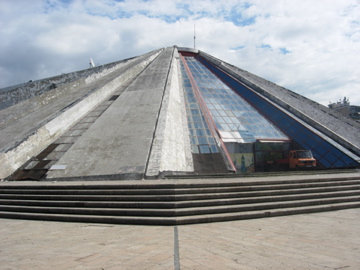
The Pyramid, where protests took place

Sometimes when you travel, a place will steal a piece of you. And sometimes you’ll leave a little piece of yourself in a place—which might be the same thing—some piece of you you hadn’t really known was there, that took the foreign air (smoking chestnuts and car exhaust) to be awakened or realized. And you’re sure you can only ever know that piece or be that piece there—which probably isn’t true but is nonetheless how it feels. Because all it can do is feel, not quite be articulated or explained or rationalized. Which is part of the magic of traveling.

Tirana is one of these places for me—not perfect, far from paradise, but a place I just slid into, like a peg in one of them little holes. I think about my Albanian homies often, and we keep in touch (like everyone else) via Facebook. So I knew when it was snowing there last month, saw pictures of familiar rooftops hazed in a dingy white. I saw pictures from New Year’s, from parties that looked like the ghosts of parties I’d gone to—or rather, parties that had never stopped, kept going, where some piece of me might still be dancing amid the smoke.

And so I knew this morning that shit had gone down. Before I looked at the New York Times or Reuters or listened to NPR, I saw via Facebook. Which made it impossible to detach from, which made it all the more real.

Vincent had been a fellow traveler when I’d been in Tirana, but the lure of the city had inspired him to move there (and helped me to acknowledge that it wasn’t just me being crazy, that the city really does have a kind of special something). He’s been the most vocal of my Tirana friends, though I did get word that everyone I know is okay.

Vincent posted this first-hand account, far more compelling than any news story I read:

I was surprised how well cars can burn, they make hissing and exploding sounds as they slowly die, and usually after two or three minutes, their horns and lights switch on until the circuits are burned through, its like their dying lament.

It’s a funny feeling, I can’t explain it, but I want to be there. For what? To protest? It’s not my fight. To watch shit burn, to run the streets and raise my fist and feel the sting of tear gas? No, that’s not it. To be curled up in someone’s apartment, watching newscasts and hearing the echoes of sirens and shouts and maybe gunfire? Perhaps. To feel that that piece of me I left there, that was so so alive there, is safe?—and that all those people that saw that piece, that shared that piece and maybe even a small piece of themselves, that they’re all safe too?

Because nothing is really safe, and no one is really safe, least of all the parts of you you don’t know, that you’ve littered all over this planet like loose change, like strands of hair, like earring backs and lines from old forgotten poems someone else remembered and reminded you of, when you least expected it, on Twitter of all fucking places—and it sounded like an echo of an ancient sadness and you don’t know what the fuck all this is or means, but just that it doesn’t feel safe, or doesn’t feel like you can save it—which is not at all the same thing, but is all too easy to confuse. And you’ve been confusing it your whole damn life without knowing it.

All of which is to say that you can never predict how this shit will make you feel, what it will bring up. Which is my own way of saying I hope all my Albanian friends—that I love without really knowing, the way I love a part of myself without really knowing it—are safe.

If No Man Is An Island…

Alcatraz Night Tour—wandering around the haunted empty of an old institution, relighted and relabeled, black signs with white letters. All hard lines and sparse materials—cement and steel—littered with the footsteps of tourists, the little echoes we carry in our shoes and our voices and, in some of us, our hearts.

Because you live here, you’d never done it—because there was always some other chance, some other day, any day, it turned into no day, never. So when Nick said he was going to Alcatraz, fuck it, you said you were going too.

So you roved, like everyone else roved, wearing your headset and listening to the gravely voiced narrator of the audio tour, a well-cast choice by any measure. Former prison guards and inmates read their recollections, giving the tour more weight, more significance than it would have otherwise had.

You stopped in front of the steel doors to the solitary confinement cell, and listened to the weathered voices recall what they’d done to wait out the time in the blackness:

But if you would close your eyes—like right now, close your eyes, seal your eyes off with your hand—with a little concentration, you can see a light. And pretty soon that light will get brighter. And you’ve gotta concentrate on it—not a short while; it takes time and practice—but pretty soon you can almost put your own TV there, and you can see things and you can go on trips—and that’s what I did.

And it was an echo, the sound of a memory reverberating from some place inside. It was a night you’d stored away: summer, warm, the window open, the leaves cutting the streetlight into a thousand broken, dancing pieces. He laid on his side, held you under his arm, and you said you couldn’t sleep.

“Let me show you a trick.” And he said it softly—strangely soft, you’d thought, the way we’d whispered as kids in our hiding places, the places only children can fit.

“I used to do this when I was little, when I couldn’t sleep.” He rolled onto his back. “You put your thumbs against your eyes—you’ve got them there?—and you push. Not hard, but not light either. And keep pushing; don’t stop.”

You didn’t. You didn’t stop pushing.

“And eventually you see it.”

“See what?”

“Lights. Shapes. Anything. You go on a trip.”

And he got real quiet, and you listened—listened to the horrible silence and waited for your own show, your own little light parade. You saw only faint traces, dim colors, a couple gray buzzing lights.

He rolled back on his side, towards you. “Where did you go?”

You looked down, ashamed, though you weren’t sure why. “I don’t know. I don’t think I went anywhere.”

And he didn’t say anything, just traced your belly with the tips of his fingers—the fullest part of your belly, the part you hate and pinch and suck in in front of the mirror—and you felt so fucking lonely you thought you might die, that some part of you might die.

And it was the same feeling, standing there, alone with your headset in a silent group of wanderers. Like being a tourist in someone else’s loneliness—or rather, the ruins of someone else’s loneliness, what was left after the guards had gone and the light—now strange and harsh—had returned. Listening to their tricks, the little games they played (Your dad telling you, “Sometimes I’d bite the inside of my cheek, slowly, until it’d start bleeding and I’d play with it.”)—the ways they’d learn to escape, if only for a moment, into some place so deep inside that some piece, it seemed, never came back.

You blinked. You pushed the rewind button and the voice stuttered, restarted, and you listened again. And it was his voice, inside this other voice, and you remembered how you’d put it in a poem—or, you’d tried to put it in a poem, but it’d never amounted to anything, never quite fit, a parenthetical metaphor you weren’t quite sure related, or how it related, until right now, here, under the institutional glare of a tourist attraction, Alcatraz.

You half-smiled—what else was there to do?—and continued on with the tour, walked through the door in the steel bars into another emptied room.

God on the Walls: Abandoned Monastery Outside Grottaglie

If you walk far enough down a dirt road outside of town; if you stalk through the weeds and sweatshirt-snagging thistles; if you scramble and heave and hoist yourself over a crumbly stone wall and follow the dent in the foliage that has become a path, you will find it: an abandoned monastery covered in art.

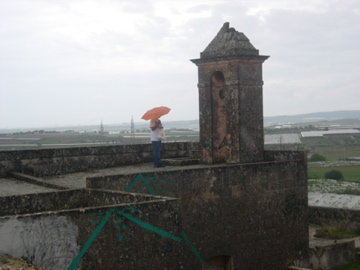
You will be on the roof. You won’t be sure how you got there. The storm will be moving in, and the countryside, the heel of the boot that is Puglia, will stretch out beneath the gray: plastic tarps over vineyards, farms, the coughing plumes of the factories of Taranto.

You’ll circle the perimeter of the roof with your new friends. You found them all—you found each other—like a rag-tag team of adventurers in some cartoon: Rebecca at a cafe, Pedro as you walked through the Old Town, then Greg as he feverishly rode a bicycle away from a herd of grazing animals (“Were they rabid?” “No.” “What were they doing?” “I dunno, they were just in the road. It was some weird country shit.”). You’ve all come alone, all flown from your various big cities to Grottaglie, for nothing more than the love of street art. And adventure.

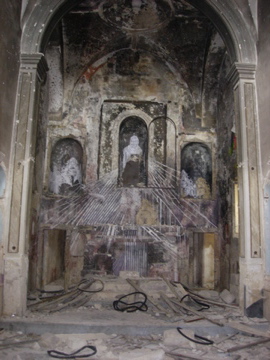
And you will have gotten there. You’ll have gotten to the moldy, peely, crumbling core of What It Is You Came For. Over the last three years of Fame Festival, the abandoned Convento dei Cappuccini has amassed works by visiting artists on its decrepit old walls. It’s become something of a museum of anarchic awesome—where you crunch through the broken glass, through rooms and rooms with bleeding walls; down dank stairways where the mosquitoes buzz and the light don’t shine; down into the guts and internal organs of an abandoned holiness left to rot, left to reborn in the last gasps of its decomposition, its swallowing-back-up by the earth, by the weeds, by the green; left to the artists and the vandals and the punk little kids with bruises on their knees, to the foreigners that don’t speak the language but know that urgent lonesome in the howling of the wind, the coming of the storm, as it blows through the broken windows and walks alongside you.

Pedro on the roof

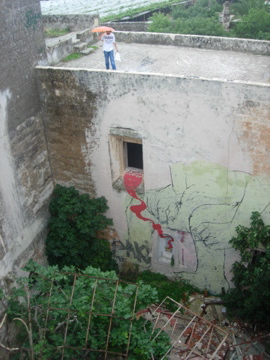
Courtyard

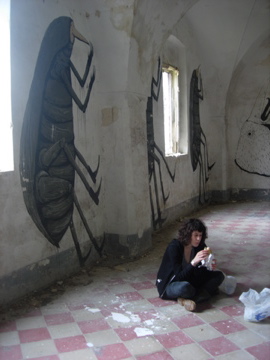
Panini break in the cockroach room

Cockroach close-up

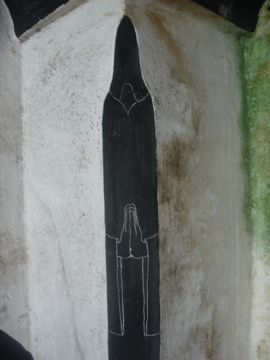
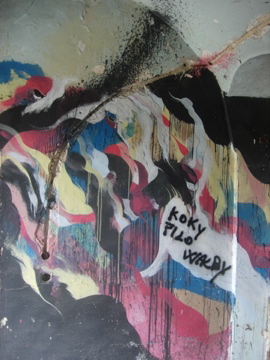
Where two walls meet

It’s not so much about the art, not the monastery or Fame or the streets of Grottaglie. It’s about the spirit, the breathing of new life into the forgotten, the love of the forgotten, saying, “Yes, yes, you can still be something beautiful to me.”

It’s exceedingly tender; it’s exceedingly unexpected that you would find this here: this vision of yourself in the walls of an abandoned monastery outside a small Italian town. As though every painting and stencil and shitty little tag were a message of love, saying, “Even in your wreckage, your falling-apart, your scars and wounds and ragged flesh—something can still love you enough to take the time, to do something beautiful.”

It’s what you like to think of God as. It’s how you’d like to treat yourself, as if you could love yourself as much as an abandoned monastery.

And it’s even more unexpected that you would find three friends to tromp around with you, to be as stoked as you, to love this place and this town and this art as much as you do.

You pause; you take a moment to take it all in, to file it away in the card catalog of your heart, to be able to call upon in those certain difficult times ahead, when you need something, just a little something, to remind you What It Is You Came For. You look around, smile, tuck it under the slot labeled “Best Travel Moments.”

And then you walk into the chapel.

For a far better visual representation, check out Bablegum’s video of their trip to the monastery. The music doesn’t really fit the experience to me—but in those moments when you hear the wind howl, that’s closer to what I felt in there.

Tower of Rubble, Kotor

The crumbled bones of a building rose up, tower some six stories, broken glass and exposed beams, cement like dead flesh. Covered in faded graffiti scribbles, a little bombed-out passage gave a dim glimpse: rubbish piles, sleeping stray cats, green growing from the tumble of rubble, left there as though bombed not some 20 years ago, but just a few months ago.

And laundry lines. Satellite dishes. People were living there.

Kotor was kind of a let-down. The guidebook gushed, but the city was boring to me. Sure, it was beautiful, but it was a manicured beautiful, a theme-park quaint—ancient wall uplit, facades restored, stones scrubbed clean—all in an effort, it appeared, to lure Western tourists an hour south. A new Dubrovnik.

And it appeared to be working. October, and the streets of Kotor’s Old Town were filled with busloads of snapshot takers. It was beautiful, beautiful, but there was nothing for me to hold on to, dig in to, grab ahold of. It felt slippery, like swimming.

So I walked to the bus station to see when the next bus out was. I saw the building—or rather, what was dirty and ragged and left of the building—and thought, Now this, this is something interesting.

Poking my head in didn’t suffice. I needed to see more.

I went around the building’s backside, a dirt road, squat brick structure covered in green foliage and gray tarps, huddling up alongside the tower of crumble. Run-down cars and makeshift workshops, the buzz of machinery and the yap of roped dogs, the slowness of people living their everyday lives.

Two people stood in a doorway, staring out at me. Not hostile, but observing, in that way we observe outsiders that are observing us—suddenly aware, self-conscious of our own reality. This is my life, the arms crossed over the woman’s apron seemed to say.

I smiled and shrugged sort of, pointed to the tower rising up behind their roof, a shadow or a ghost or a dingy kind of demon, a relic. The man, seemingly more amused, walked up to me.

He pointed to the tower, then around him, then right down to the ground he stood on, we stood on. “Bosnia, Serbia, no Montenegro.” He made the shape of an explosion with his hands, big, calloused, oil-stained hands, fingers arched wide, as if trying to contain a growing cloud. “NATO,” he explained, then pointed back to the blown-out tower.

I nodded.

He looked at me, and nodded slowly. We stood there like that, in the silence, having gone as far as our linguistic capabilities would allow.

I pointed to my camera. “Okay?” I asked.

The man nodded. The woman in the doorway laughed, shook her head, turned and went back inside.

I wandered further. I passed a man chopping wood. He stood between two massive piles, one cut, the other uncut. He paused to observe me, nodded slightly, went back to work.

I didn’t want to photograph them. I didn’t want to photograph these people I saw, living beside and inside this huge crumbled building, a relic of destruction, going about their tasks, looking out from their doorways at me. I didn’t want them to feel like they were on exhibit, like they were amusing or exotic to me. I just wanted to see them, to see what was really there, how people really lived in this town, what their lives really looked like.

A small face peeked out, blazing eyes around the pillar its body hid behind. I smiled at the boy. He turned away, as though he’d been caught, watching me observe his world.

I poked up a small ladder, peered in through the broken window—a makeshift carpenter’s studio, desk and a pile of wood, two stories. I gazed up through the gaping wound in the center of the building. Dim light came through ceiling, so many stories up.

I climbed back down the ladder. The little eyes were still watching me; I smiled and turned to walk away.

He came out behind the pillar. He glanced over at me, as if to say “watch me,” and I did. He ran up to the ladder. His small feet scampered up; he crouched down to crawl the fangs of glass.

He stopped, paused, only for a moment, to look back over at me. His eyes seemed to say, “Look. See. This is my life. This is my world. See me.”

I did. Or I tried to. I really just stood there and watched.

The boy ducked down through the window and was gone—him into his world, and me into mine.

Transit Fragments: Views from the Window

I. Bar to Ulcinj

Gypsy children at the intersection
bang on the windows
of stopped cars, pleading
/
until the windows roll up
and they see their reflections,
/
dirt-faced
and pleading back.

II. Ulcinj to Shkoder

Carry that girl
through the rubbish
and field of dead,
the rusted carcasses
of cars,
engineless
and humming wind.
/
Take her,
hold her
under your arm
(bare feet and unbroken skin)
/
Carry her
down that road,
carry her,
take her home.

III. Shkoder to Tirana

Mosques and minarets,
half-constructed buildings
(stairways
and skeletons
exposed)
stripped-down cars
left to rust
in lots of dying
/
A boy with the cheekbones
of an ex-boyfriend
huddles, mutters
into the mouthpiece
of his cellphone
and you can only see
half is face
(turn around
and show me the whole thing, honey)
/
Corrugated tin and tires,
teepee piles of hay
that look like the insides of scarecrows
with nothing left to scare
/
Yell your stop
to the driver, and rumble
that big door open
(wrench the metal
from the metal)—
pay him your fare
and be left there
on the roadside
of somewhere
/
a gas station
and a cheap umbrella

Boys, Boys, Boys: A Solo Female Traveler’s Experience With the Men of Southern Italy, Montenegro and Albania

You know the picture...

“Southern Italy, eh?” He gave me the raised eyebrow of caution. “Watch out for the men.”

This was Alex, his voice lifting above the roar of hair dryers and hip music at the salon, two days before I left on my trip.

A lady friend of his, he continued, had recently spent several weeks in the Mediterranean land of machismo. “Apparently, they all use the same line: ‘I have a girlfriend. But tonight, for you, no girlfriend.’ She said it got really old.”

I laughed. To be honest, it hadn’t crossed my mind yet. Dealing with the men of a country as a solo female traveler is usually one of the first things people ask me about when they hear I travel alone—right after the “is it safe” question. But the truth is, I’ve been doing this sola thing for awhile now, and whether or not the men somewhere will hound me to death doesn’t really factor into my travel considerations. Plus, I’ve done the majority of my traveling in Latin America, where sidewalks can at times feel like catwalks of degradation. As long as the men aren’t physically attacking me, I pretty much feel like I can handle it.

But Alex’s comment did give me pause. When it comes to safety (and drinking tap water), I throw caution to the wind in Europe. It’s the civilized, more highly evolved land of social safety nets and low crime. Hell, the vast majority of Europe is safer than my hometown. My hairdresser’s comment reminded me that, oh yeah, right, I’d be venturing off sola in a scant 48 hours and that maybe I’d ought to mentally prepare.

You stand out as a female solo traveler, and in a way, get to experience a culture more deeply, if no other reason than the fact that its men are talking to you more. My last trip took me to Southern Italy, Montenegro and the capital of Albania (and Croatia, but I only stayed for a day, so I’m not counting it). The men in each these countries treated me totally differently—and, I think, reveal a little something about the culture.

Italy

Oh, Italian men. They have quite the reputation. American women swoon for their accents, their sense of style, their motorinos and chest hair. And they’re known for hitting on pretty much anything that moves, serenading you with sweet odes of professed passion.

I don’t get it. And Italian men, apparently, don’t get me.

During my venture Rome-and-southwards, I was largely ignored by Italian men. Which suited me just fine. Again, having traveled heftily through Latin America and once through Morocco, I’m stoked on anything that isn’t street harassment. I’ll take being ignored over obscene insults any day.

But it did cause me wonder… Who the hell are all these American women who are getting hit on Italian men all the time? I’m a cute enough girl, but do you want to know why I wasn’t getting any attention from the dudes? Because they’re surrounded by Italian women—who are impossibly gorgeous and stylish, with their cascade of curly hair and their moody black eyeliner. I wouldn’t hit on me either.

Traveling through Southern Italy was like an adventure in mutual disinterest—as though every guy I passed on the street exchanged a brief little dialog with me: “Thanks but no thanks.” Italy is a pretty culturally conservative place, and I’m a pretty not culturally conservation person, in appearance or attitude. So it makes sense to me that the Italian men and I didn’t vibe. In person, that is.

While I was in Naples my Couchsurfing inbox got flooded with messages from shirtless dudes in sunglasses asking me if I needed a place to stay. (“Um, no.”) But this was the extent of the Italian sleaze I experienced—an indirect, easily ignored, half-assed attempt.

Maybe that was the secret to the purported flirtations of Italian men: that it’s largely impersonal, having less to do with you and whether or not there’s any real potential for something to happen, and more to do with, I dunno, not having anything else better to do? Hitting on someone just for the sake of hitting on someone?…

Montenegro

If ever a girl was thinking of a place to take advantage of men, Montenegro would be the place to do it. I had more offers for rides, tour guides, free drinks, places to stay, etc than anywhere else I’ve been.

But the curious thing was a) all the attention was from middle-aged men, no guys my own age, and b) they somehow managed to stay just on the right side of appropriate and respectful. I never felt violated or threatened by any of the Montenegrin men; it all just came across as really, really nice.

I was of course only getting the attention because I’m a pretty young(ish) American girl traveling alone. Montenegro is really trying to woo Western tourists, and I think I was something of an anomaly; there weren’t many Americans, weren’t many backpackers, weren’t many women alone. I think I was on the one hand intriguing for this reason; I think Montenegrins in general also really want tourists to feel welcome, want to take care of them. I must have sparked all the paternal instincts of the middle-aged men there. But somehow not in a demeaning way. Most curious.

Albania

At a certain point one night, it got ridiculous. I had to put on my sweater and get the hell off the dance floor.

It was like moths to a lightbulb. I have never received more male attention from males I actually wanted attention from than in Tirana. It was dangerous.

Albanians my age, it seems, really want to be Western. They’ve lived most of their lives in post-Communist Albania, but still relatively isolated from the rest of Europe. They’re ready, it seems, to be a part of the rest of the world.

For most kids, this striving seems to take the form of mainstream culture, the Top-40 kind. Stylistically, Tirana is filled with tons of extremely beautiful nouveau riche girls, who could, at first glance, blend in on Parisian sidewalks. You look a little closer and you realize that they don’t quite have it right yet; they wear a little too much make-up, their clothes not quite expensive enough.

But the point is, they’re trying really really hard. They have the posture, the poise, the carefully cultivated look of class in the arch of their fingers as they lean back and drag their cigarettes. They also don’t seem like a whole lot of fun—a little snobby, to be honest.

So I stood out, and not just for being foreign. There weren’t any other girls in Tirana like me, in sneakers and a band shirt, with short hair and tattoos. I’m a dime-a-dozen in the Bay Area, but in Tirana, I was the only act in town. And every single rock n roll dude, it seemed, was eying me. Or talking to me. Or offering me drinks or asking me out or wanting to dance with me.

Big-fish-in-a-little-pond syndrome. I’d never experienced it. After the initial rush of validation, though, it felt funny. It didn’t seem real and, in a way, it wasn’t.

It was like Genti’s indie rock band. An Albanian turned Brighton boy, Genti was just another dude in a band in England. But in Albania, he was becoming a big deal, selling a ton of albums and appearing on Albanian TV. It would have been easy, he told me, to really make it there. “But, I dunno,” he yelled over the barroom clatter, “do I really want to be the guy who was ‘really big in Albania’?”

I paused, and asked myself the same question. I was pretty damn sure that if all these rocker dudes were suddenly delivered into the Bay Area, they wouldn’t be tripping off me so much. I wanted to tell them, to put my hand gently on their shoulders and let them know, “Honey, there’s a big world out there, and it’s filled with a fuckton of cuter girls with more tattoos than me.”

But they’d have had to take my word for it. Cause it’s so damn hard for an Albanian to get a tourist visa, or to afford to travel anywhere where rock n roll girls live, places steeped in privilege.

So I did all I could do, which was to shake my head and laugh.

Thank God for San Lorenzo Street Art

The last full day of my trip: drizzly grey and a mounting head cold, city still shuddering from the previous night’s storm. I would not be stopped by the weather or my health (I really should have been stopped by that) or my impending departure or my own crappy attitude. I was going to go out and find something cool. Goddamnit.

It was more than my intuition that told me that Something Cool would be in San Lorenzo. It was Jessica from Rome Photo Blog. Specifically, she told me: “Go to San Lorenzo. Take the number 14 street car. There’s lots of cool street art.” It seemed a good enough activity for my final day in Europe. Because Lord knows I hadn’t tromped around in the rain hunting down street art enough on the trip.

I like Rome’s neighborhoods. I supposed every city has its distinct neighborhoods with their distinct vibes, but for some reason the differences feel more marked in Rome, where perhaps the centuries have dug those differences down deep, deeper than in other places. The center, while magnificent, bums me out and exhausts me, with its gaggles of people and trinket shops. There’s not a lot of contemporary culture to dig into. And contemporary culture is kind of what I’m all about.

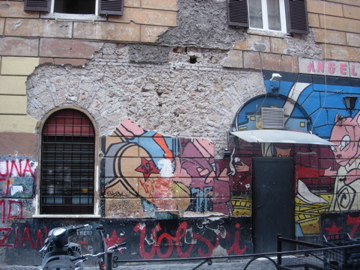
Typical crumbling building

San Lorenzo is one of Rome’s hippest neighborhoods. It’s the bombed-out, more gentrified version of Pigneto—or rather, it’s formerly bombed-out and further along the gentrification scale from Pigneto. The working-class 19th-century neighborhood received the heaviest bombing during WWII, and I don’t know if all that crumble I saw was a remnant of that or just a result of the usual Italian building decay. Either way, it was fucking cool. There’s a lot less immigrants than in nearby Pigneto, and the neighborhood seems to have moved deeply into the third stage of gentrification: when the local business begin catering to the new residents. San Lorenzo’s proximity to the enormous La Sapienza university means there’s tons of students and tons of artists, with a proportionate ton of trendy stores and cool record shops and cafes with wifi.

And a whole mess of graffiti and street art.

I hopped off the tram when the walls began to resemble a two year old’s furious crayon scribbling.

I was delighted to see some good ol’ Space Invader the moment I got off the 14. He’d recently come to Rome, and has an upcoming solo exhibition in the city. Word has it (ok, Jessica told me) that Roman street artists are pretty stoked about Invader’s, um, invasion (I hate myself for using that pun)—hoping it’ll lend a little more attention and validity to their own work.

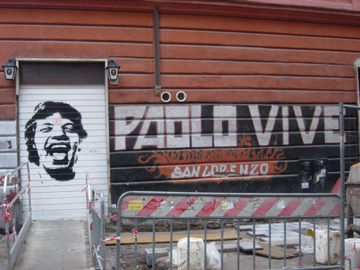
I wandered about a bit, until I found what I was looking for: Something Extremely Cool. Along Via Delgi Ausoni, on a wall surrounding the block-long Fondazione Cavalieri di Colombo, was the best street art I found in the city. It was like the Clarion Alley of Rome.


Hey, Ekua, check it out: a whole wall of Hopnn!


Okay, so the picture doesn’t give you the full effect, but a shadow/inverse of the stencil was actually put on the sidewalk in front of the wall as well—so it felt like you were walking through some weird mirror of the piece. Cool ass effect.


Too cool for just one picture…

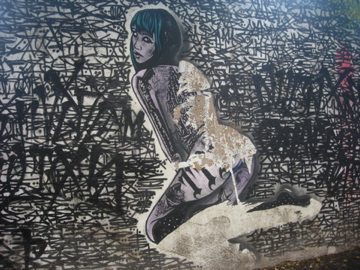
This reminds me of Retna:


I’m not totally sure what’s going on here, whether the figures were wheatpastes that got taken down, or if that was an effect was created intentionally—but a pretty fresh, haunting effect, especially given the message written:

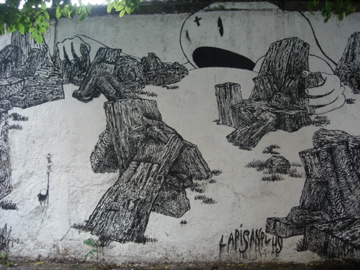
But to be fair, most of the stuff on the walls in San Lorenzo looks like this:

Okay, so I’m gonna be the asshole and say it: this is not aesthetically pleasing. But it reminded me of this conversation I had with Pedro at Fame Festival, about the need to create urban spaces designated for street art, like they have in Melbourne or in that tunnel in London. I can totally feel people when they complain about piss-poor chicken-scratch tagging all over their neighborhoods; it’s ugly. But cities need to have some kinda strategy towards graffiti that goes beyond just prevention.

When I was growing up, the Oakland Public Schools had a full-time employee whose sole job was to go around and paint over graffiti on all the school campuses. Which seems like a damn waste of resources. The sad thing, to me, is that these kids obviously have something to say, something they wanted to communicate, and no other way to do it. I think it’s important to create those spaces, walls and zones where they can throw up pieces—to give kids the space to say what they need to say. (I’m assuming this is what’s being discussed in this news coverage of Pedro’s Crono Lisboa project…)

Because you never know which one of them just might grow up to be a dope street artist. And because it limits the amount of tagging elsewhere. And because it looks cool as shit.

I’m not sure what all that has to do explicitly with San Lorenzo, except that I was thinking about that as I wandered around the neighborhood. Here’s some more stuff I spotted:

This C215 piece was actually on the wall of a church. It blended so well I wasn’t sure if it was street art or the church’s actual art work until I saw the signature logo:


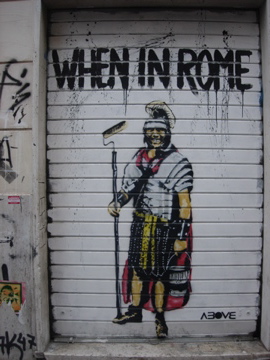
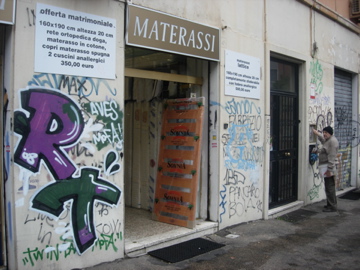
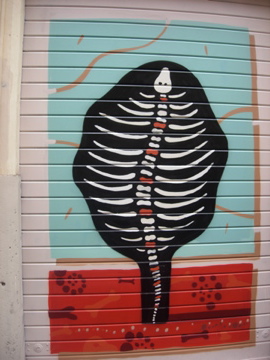
Lots of stores had pieces on their shutters…


But I think my favorite might have been pieces that worked with the crumbling facades of San Lorenzo. I get pretty stoked on well-done site-specific street art, when the environment and the art interact with and inform each other…


Walking around there, damp-footed and achy-throated, I had to say a little thank you to San Lorenzo, for giving me one last cool adventure on my trip. And for reminding me that Rome is more than history and monuments—that it’s a damn big city, and a damn great city, and that there is contemporary culture—just beneath the surface, below the rubble, just a short tram ride from the center.


Lauren Quinn is a writer and traveler currently living in Hanoi. Lonely Girl Travels was a blog of her sola travels and expat living from 2009 to 2012. She resides elsewhere on the internet now.
Join 490 other subscribers

Buy This Sh#t

Categories