Posts Tagged 'Blunders'


WTF Moment of the Day: Street Monkey

So about once a day here in Phnom Penh I have a massive WTF moment. I’ve been catalouging them: a boy stabbing birds, Western beggars, my guesthouse posting a sign about not offering “the sex services,” and pretty much any occasion I open the Phnom Penh Post. Strange things, bizarre things that my Western brain can’t compartmentalize—where all there is to do is shrug, shake your head and say “What the fuck…”

Today’s WTF moment came as I was walking home. It was a mellow day, filled with writing and street food, and I was retiring early, walking down a dusty road lined with corrugated metal fences, behind which the humming of machinery had ceased for the day. Men still wearing their hardhats bicycled past; teenagers in school uniforms clustered at the street corners, eating grilled meats from street stalls.

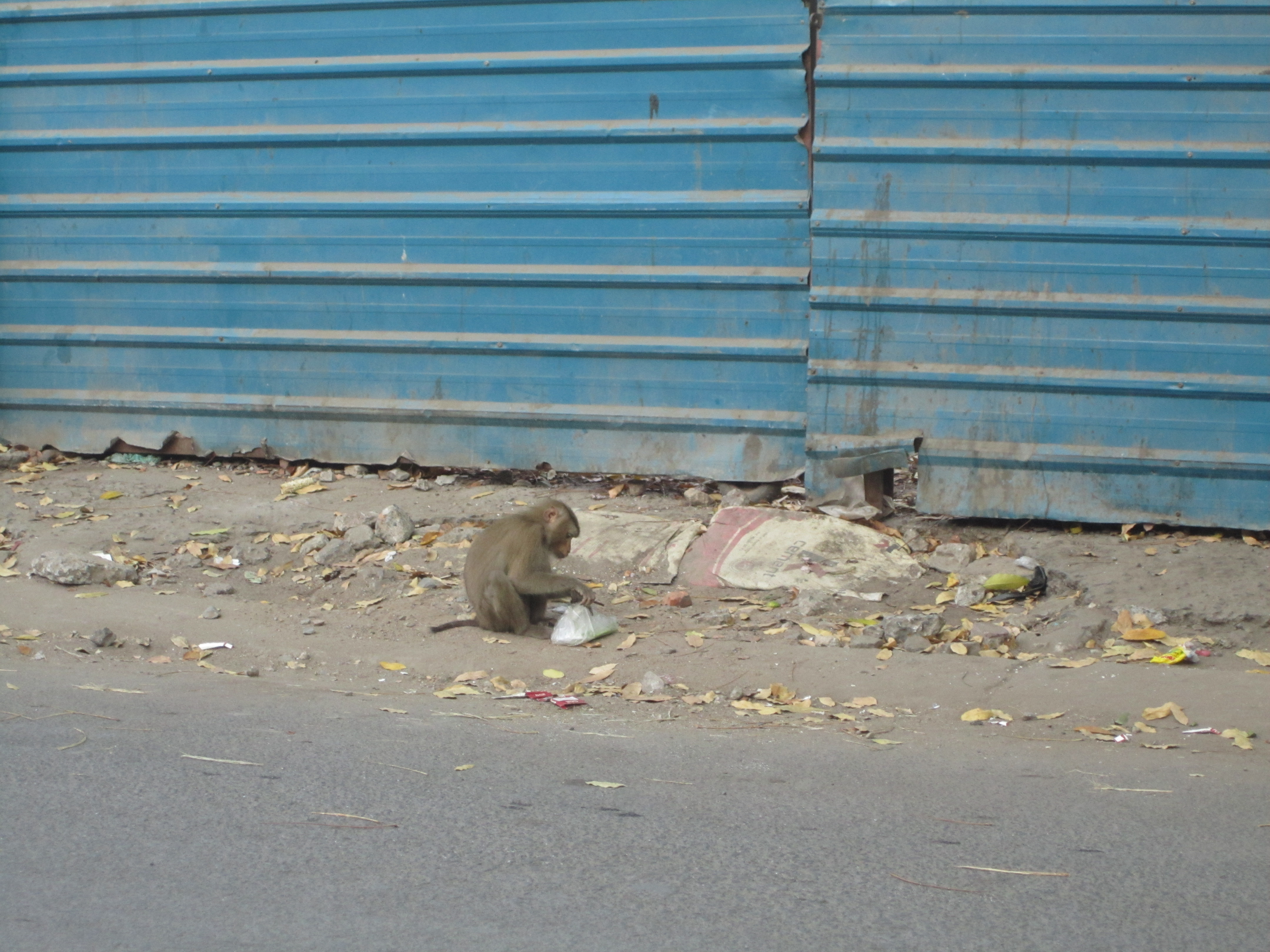
Then I saw this fellow:

Now, I’m familiar with street dogs and street cats and rats and mice and raccoons and squirrels—but WTF?! A street monkey? Phnom Penh isn’t the fucking jungle; it’s a city.

Where did the little guy comes from? Why wasn’t he in a zoo? Why was he just chilling there, riffling through a bag, trying to fish out a little food, sticking his red ass in the air as he repositioned? Why was no one doing anything? Why were they all going about their business like it was no big deal, perfectly normal for a hairy primate cousin to be out and about on a humid late afternoon?

I stood and watched him. I took a picture. A security guard down the road looked at me curiously—What’s this crazy white girl taking a picture of a monkey for?

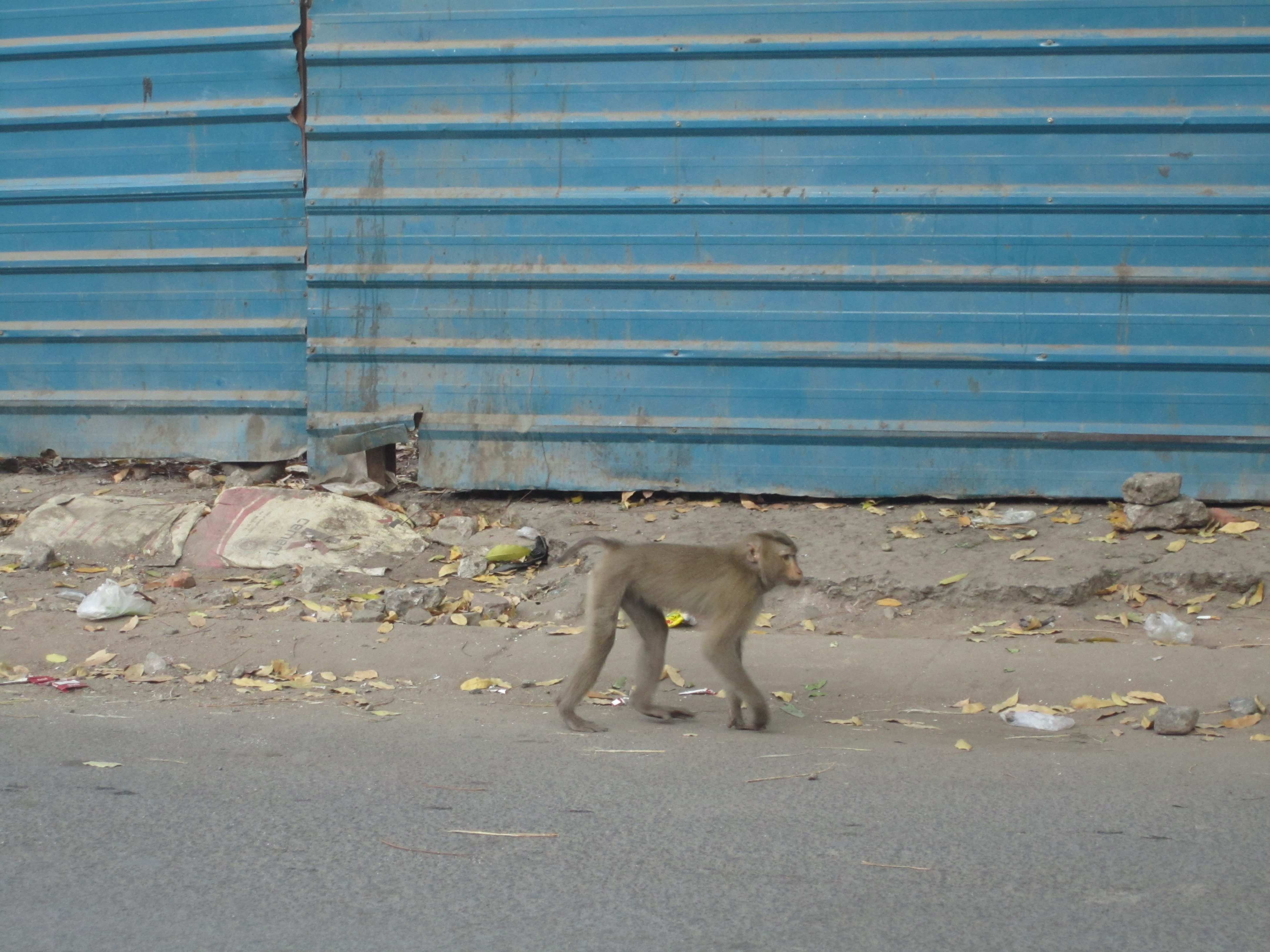
The monkey tired of the plastic bag, threw it aside. He stretched his limbs and turned, looking into the traffic. He began to cross the street slowly, the same way I do, sensing out the rhythm of the road. He knew what he was doing. He was better at crossing the street than most tourists. The motobikes and tuk-tuks and cars slowed and swerved seamlessly around him—just another monkey cruising across the street.

Then he spotted me.

I still had my camera in my hands; maybe he was offended that I was taking pictures, objectifying him like an animal in a zoo. He gave me a real menacing look, bared his teeth slightly. He walked towards me.

Here I should clarify that I am 100% a city kid. I used to be afraid to swim in water I couldn’t see the bottom of. I’m easily impressed by the appearance of any stars whatsoever. Wildlife freaks me out about as much as uber urbanity freaks other people out. And everything is wildlife: from the geckos on the wall to the squeaks of bats. If it’s not a cat or dog, it’s probably got rabies and wants to eat you.

I thought of Greg, who I met bicycling breathlessly down a dirt road in Southern Italy. Greg was straight outta Queens, his speech peppered with more “yo”s than my own “hella”s. He’d just run into a herd of sheep in the road. He’d freaked—what were they doing? (“Probably grazing,” I offered.) Wildlife, fuck that. He hadn’t wasted any time in pedaling the other direction, and I immediately understood his panic.

And so the gangsta street monkey swaggered towards me. I moved slowly (“keep it cool, don’t ask scared, he can smell your fear”), stepping carefully, one foot at a time, in the opposite direction. When he disappeared between two parked cars, I walked briskly away, shaking my head and thinking, “What the fuck, what the fuck, what the fuck.”

Lost in Navigational Translation: The Tuk-Tuk and Motorbike Drivers of Phnom Penh

“Tuk-tuk la-dee?” “La-dee, moto-bike!” “Where you go?” “La-dee, la-dee—you need moto-bike!”

This is the chorus you hear, endlessly, walking through central Phnom Penh. It’s like birds chattering, only more jarring, less song-like. It comes accompanied with a raised arm, two fingers extended—more of a summons than an offering of service.

By the touristy riverside, the touts can be pushy, but for the most part they’re just guys trying to make an honest(ish) buck. At first I tried to respond to all of them—Lisa ran a tuk-tuk company in Phnom Penh, given as part of her dowry, before the Khmer Rouge—so I feel a special responsibility to be respectful. I smiled politely and said “no” or “ot te.”

Eventually it got to be too much to respond to each other them, perched on their bikes at every street corner, crying out to you when you’re half-way down the block. I began to just shake my head, and soon stopped making eye contact. I started feeling like a bobble-head toy, my neck hurting from the constant swinging. Now I barely respond at all.

But I suppose that’s not so unusual, the constant barrage—being a Westerner in a city like Phnom Penh, where you stand out, gleaming of privilege and sweat and thin layer of sun screen. You take it in stride, a small price to pay for the relative welcoming warmness of the Cambodian people.

But here’s what is so unusual: most of these tuk-tuk and motorbike drivers have no idea how to navigate the city. A city, I should add, that’s laid out in a neat grid. And not just a grid, a numbered grid, where even numbered streets intersect the odd.

It is perhaps the easiest city I’ve ever learned. And I don’t make my living by driving its streets. So what, what, what is going on here?

It took me a few days to clue into it. I did a lot of walking at first, and when I did finally take a motorbike, chalked the confusion up to language barriers and my hotel’s offbeat location.

On Friday night, I was headed from a party back to my hotel. “Street 141 at 232,” I told the driver. The glassy gleam of incomprehension stared back at me, followed by a vague nod. This did not produce a feeling of confidence in me.

Must not know his English numbers yet, I thought and whipped out a piece of paper. I wrote the street numbers as largely and legibily as I could. I showed him. He nodded a little more vigoriously; we negotiated the price and I hopped on.

We slid down the wide Norodom Boulevard, nearly empty of its honking, and I felt the breeze of the night on my arms, my legs. I closed my eyes and let it kiss me.

I’d been in the city four days by that point—so I knew when we were making a wrong turn.

“Um, no,” I said and pointed back to Norodom. He shot me a confused glance. I pointed to the street sign. “This is only 156. We go to 232.” I waved my hand down the road.

A series of slow circlings and U-Turns ensued, me growing ever crankier on the back of the bike. It devolved to me leading the motorbike driver street-by-street back to the hotel.

He must be new at this, I thought as I finally hopped off.

But the phenomenon repeated itself: the glassy look, the vague nods, the wrong turns and aimless meandering. Another characteristic element to the typical un-joy-ride, I soon discovered, comes when you stop every couple blocks for the driver to discuss with other drivers the intended destination of the passenger, locked in some sort of secret code no one is able to decipher. Lots of pointing and shrugging ensues. This is apt to repeat two-to-four times before one finally arrives.

At first, I blamed it on my own inability to say Khmer numbers, and took to only writing locations, following it up with a big, you-get-it? grin.

The answer you always get is “okay, okay.” The ride you get is not always “okay, okay.”

I was utterly confused and out of ideas. Maybe they were guys from the countryside, who’d only just come to Phnom Penh. Maybe they didn’t know the city that well yet—but come on, how long does it take to learn a city? A numbered grid of a city at that?

No, no, there was something more going on here—some kind of deeper divide than just language or location familiarity. There was so kind of vast cultural chasm, a disconnect.

“Oh no, no, no,” Mathilde told me. “They don’t know street names, only landmarks. It’s better to say ‘near to Independence Monument,’ or ‘Royal Palace.’ These they know. But sometimes even then…”

I’ve worked that into my repertoire, a long, drawn-out process in which I use every means I can fathom to communicate my destination. “Sihanouk, near Independence Monument,” I told the driver yesterday.

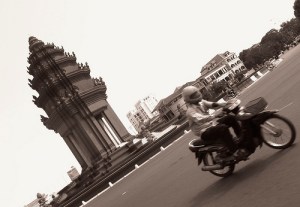
We got closer this time, but just before the up-lit monument—positioned handsomely at the crossroads of two main thoroughfares and surrounded by the massive honking roundabout—we took a turn down a random sidestreet. I sighed. We U-Turned.

I reported my failure back to Mathilde. “They will always say ‘okay,’ even if they don’t know.”

“So, how do they work? How do they live and get around a city they don’t know at all?”

She shrugged, and I guess that’s all you can do. Because they must know it—there must be some way they know it, some entirely different way of interacting with a city and a landscape that doesn’t even occur to me, that I can’t even fathom—as foreign as another language, as mysterious as an alien scribble, written all over this city in a way I can’t read, can’t decipher—in a way that I can’t even see.

Perhaps I’ll figure out the mystery. But for now I’ll keep circling, keep ambling, keep pointing to a destination I can’t communicate, hidden somewhere in the gap between cultures—foreign, mystified and helmetless on the back of a Phnom Penh motorbike.

No Hue: Hue Riders Knock-Off

Um, is this supposed to be something important?

Mr. Loc is over it.

He slows the motorbike, pulling over to the skinny shoulder of the highway that wraps seductively around the lush green mountain. He points. “Photo.” It’s more of a command than a suggestion. I snap of shot of the vista—pretty, with rice paddies and a cloak of fog. But I couldn’t tell you any more about it.

That’s because Mr. Loc isn’t having it. He’s shown us the goddamn vista, his posture seems to say, what more do we want?

Even the most skilled and adept of independent travelers (and I’m certainly far from one of them) falls for an imitator sometimes. It happens: we’re tired, we’re rushed, our guard is down, it seems like a good idea. We wind up paying top dollar for a half-assed adventure.

I’d heard about the Hue Riders one night in Hanoi. Instead of a boring old tour bus, they take you on motorbikes from Hue to Hoi An, an historic trail that stops at waterfalls and pagodas and old American bunkers. “It’s supposed to be brillant,” one of Jacob’s friends told me, hunched on our plastic stools over the billow of BBQ smoke.

Killer. Sign me up.

I asked my hotel in Hue if they’d heard of the Hue Riders and they nodded enthusiastically, leading me over to the dude posted at the cafe next door. He thumbed through his photo album—him with smiling white girls, him with white dudes giving the thumbs up sign. He showed me an entry in his customer comment notebook from a girl who was “from your country!”

I couldn’t tell if it was cause to be suspicious, or if he was just that certain kind of proud that third-world tourism workers sometimes are. He showed me his business card: “FIFTEEN YEARS Experienced, All’s for your satisfaction.” But hey, it said “Hue Riders” under his name.

It was only later, after I’d paid and signed up, that the real suspicion began to mount. I googled Hue Riders. And holy shit, there was an actual, legit website. For the real Hue Riders. Of which Mr. Loc was not one.

Oh well, I told myself. Chalk another up to experience. Sometimes the DIY, hustling tour guides can be just as good as the bona fide ones your LP recommends.

Which is true. But Mr. Loc, I’m discovering, isn’t one of them.

He isn’t terrible; he’s just monumentally not into it. Fifteen years of experience has translated to boredom.

Our first stop was a fishing village off the highway: a dirt road strewn with debris; a couple of kids playing soccer; a clutter of wooden boats, docked and sleeping; nets laid out like the vacated skins of snakes.

“Fishing village,” was the extent of explaination given.

Joe, the upbeat and friendly male half of an American couple who’d also gotten roped into the tour, attempted to ask some questions. “Do they go out in the morning?” We got a sort of unintelligble, one-word answer.

Now at a mountain pass—but was it the first or the second pass?—I attempt to eavesdrop on the tour guide next to us. Something important about these cables, this view, something about Americans? I try to ask Mr. Loc. “Was this something important during the war?”

“Yes, I think so.”

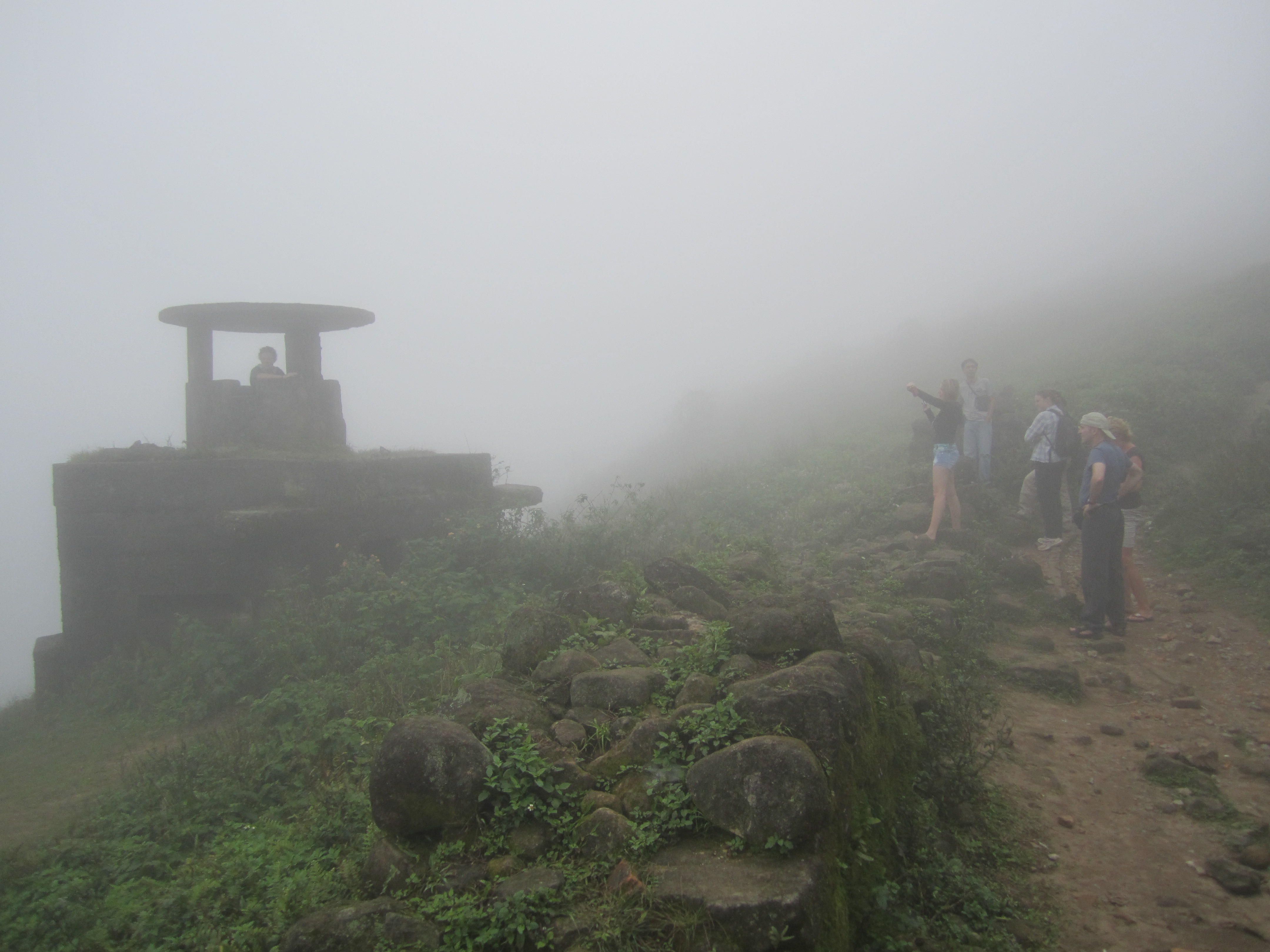
Tourists at a former bunker

We move along. It’s a foggy, white-wrapped day, and all the sights we stop at are equally shrouded in hazy incomprehension. We stop by bunkers used during “the American War” (now a tourist trap—more on that in a later post). We stop off for overpriced coffee at a cheesy resort. We pull over at the roadside operation for a kind of cosmetic oil made from a local leaf. We stand around awkwardly as Mr. Loc tells us the prices of the different sized oils.

“Not much of an oil type myself,” Joe declares good-naturedly. He’s pathologically cheerful, in that particular American way, with his buzz cut and beaming cheeks. “When do we get to the waterfall?”

“No waterfall today,” Mr. Loc declares. “The weather,” he gestures around us, “road too slippery.” He makes a skid-and-crash motion with his hands. We nod solemnly, disappointed.

We stop at Marble Mountains, thrust from the flat earth near China Beach like a glittering rock of crystal. Pagodas and temples abound. Joe maintains his positivity, reading aloud from his Lonely Planet to make up for our lack of tour guide. I’m grateful for his unrelenting optimism.

Holy light

We wander into a cave that feels like a cathedral—a carved Buddha in the stone, incense like breath, sunlight filtering through the ceiling like the fingers of gods. There’s the hush of a holy place there; Joe reads that during the War, it was used as a VC hospital.

In a corner, a bat with a broken wing arches and flops. He squeaks intermittenly, and it sounds like a very small prayer, echoing against the rock.

We descend the mountain and find Mr. Loc waiting for us, leaned against the motorbike. “Okay, we go.”

I realize the thing about Mr. Loc isn’t that he’s rude or unknowledgable or even a shitty tour guide. It’s that he’s supremely Vietnamese. It’s this certain way, this certain attitude, that I’ve begun to understand, the same as in the nail shops at home—matter-of-fact, blunt, nothing sugar-coated or said sweetly. Here’s your tour. There’s a sight. Good? Okay.

“Vietnamese people aren’t very nice,” other travelers have told me. I understand where they’re coming from, but I don’t think it’s a simple matter of not being nice; I think it’s a profound cultural difference. (“You want pedicure? Okay, you pick a color.”) Brusk and brash—jarring as the chorus of honks from the motorbikes.

We arrive in Hoi An wind-blown and dirt-covered. My eyes well from the thousand particles of crap swimming around my contacts; my hair’s matted to my head from too many hours wearing a helmet.

Mr. Loc drops me at my hotel. “Happy?” It’s a business-like question.

I nod. Why not?

Albanian Death Flu, and The End to a Charmed Trip

Dog is my co-pilot?

It had been the best trip I’d ever been on. And, you know, I’ve been on a few trips.

But at last it happened: the perfect constellation that had hung above my trip cracked, shattered, rained down in a million filaments on to my cigarette-stained clothes until the smell writhed back out of rank layers. Not that I could smell it.

On my best trips—well, no, even on my worst trips—I don’t really feel in charge. That’s one of the things I love about traveling: it shatters any illusions of being in control, of running the show, so to speak. Serendipity drives the car; you just ride shotgun.

And I’d been really quite pleased with Serendipity’s navigational prowess on my latest trip, taking me to random small towns, big crazy cities, introducing me to rad people, giving endless writing material, keeping me in good spirits. I approved. “Job well done.”

But on my way back to Rome, something snagged, tripped, pulled the plug. It was my attitude. And my health. Things were no longer going my way. And so I ended my trip slumped over in a plastic airport chair, achy-boned, runny-nosed, sleep-deprived and pissed as fuck.

I didn’t want to leave Tirana. The only date I locked myself into on my itinerary-less travel was my flight from Tirana back to Rome, mostly to avoid another sleepless, freezing cold ferry ride. It was a cheap ticket, the kind you can’t change—so when I had to pass on the opportunity to drive up to Shkoder to get tattooed in an abandoned bunker and instead fly back to expensive-ass, whacked-ass Rome, I was slightly bummed. To say the least.

On the flight, I began to feel a tickle in my throat. I coughed. I assumed it was the result of the pack of cigarettes I’d smoked in the previous 48 hours, or the succession of late nights, or the guzzling of tap water that I wasn’t really supposed to be drinking. And it probably was those things. It was also the beginnings of what I’ve dubbed Albanian Death Flu (incidentally, also the name of my new metal band).

It started slow and steady as a rumbling drum beat—the amplified echo of my own heartbeat in congested ears. It’s okay, I could power through. I had a few different friends that also happened to be in Rome at the time that I wanted to meet up with, some events I wanted to check out; I’d fill the time.

It was like a see-saw: the more things unraveled, the shittier I felt. Or the other way around. Whatever. I never got in touch with any of my friends. The events either fell through or were kinda lame. After blissfully cheap, tourist-free Tirana, Rome was an expensive, American-swarmed jolt to my sick system. And I wasn’t helping myself any. I was cranky, torturing myself with the shoulda’s and why-didn’t-I’s. Serendipity may have been driving the car, but I was being a pretty big backseat driver.

It all came to a fevered pitch at the airport. I didn’t sleep at all the night before, six hours of tossing and turning and coughing and groaning. The overpriced train ride to the airport had robbed me of my last few Euros, so, with no cash for breakfast, the post-nasal drip stirred in my stomach in an unsettling stew. And I had no patience for my fellow travelers.

Rome is a most beloved destination of Americans, right up there with Paris and Disneyland. But it’s a pretty culturally conservative place—not a lot of contemporary arts or music going on—so it doesn’t tend to attract our most dynamic demographic, what I call our A-Team. It’s most popular with the Joe-and-Marge-from-Iowa demographic. Not that I have anything wrong with Joe and Marge; it can be, actually, just as culturally fascinating and foreign to observe them as Romans.

It’s just that Joe and Marge don’t travel much. They get stressed out easily, and they bicker with each other. They aren’t as adept to rolling with cultural differences, and feel it necessary to (loudly) point out contrasts and the discomfort those contrasts provide. They get lost easily. They aren’t urban people, and they get confused by public transportation, crowded spaces, the Italian irreverence for lines at espresso counters.

All this I’m more or less willing to take in stride. Except when I’m sick, nauseous, sleep-deprived, and generally fighting the gods of circumstance. Then I sit in a plastic airport chair with steam seeping out of my ears and one eyeball slowly twitching.

I gave up. I couldn’t fight it anymore. My body—and Serendipity—were trying to tell me something: the party was over. It was time to slow down, sit still and accept what came my way.

I went to a pharmacy and bought some mystery Italian cold medicine on my credit card. I changed a little cash back into Euros and bought a stale, overpriced panini. I moved over to an empty gate and slowly munched my bread in relative peace. Then I boarded my plane and promptly passed out in puddle of drool and sneezes (yeah, I was that person).

Even great trips have bad moments, and every trip, even the best, has to end. I suppose the trick is letting that happen gracefully. Still working on that one.

Bolsa Blues: Adventures in Cuban Plumbing

This is half of a narrative written about my raucous New Year’s in Havana. The first, less-gnarly half is being considered for publication (fingers crossed and breath held), but I’ve decided that this side of the story is far too raunchy to get accepted anywhere. So, I’ll inflicted you all with it…

Bolsa Blues or The Other Reason You Should Always Carry a Plastic Bag in Cuba

I waken to a pale face in half-light. It looks down at me, desperate and pleading-eyed, washed in a light sweat and slashed by the stripe of sun that invades through the crack in the wooden shutters.

“Dude,” I croak. “What the—“

A tight-throat urgency cuts me off. “The toilet’s busted,” my boyfriend declares. “And I gotta crap.”

It’s New Year’s Day, and we’re stark naked in our tiny casa particular room, somewhere near the crumbling heart of Havana. The cigars, Rumba and rum of the previous night rumbles in our stomachs.

It’s the cardinal rule of Latin American traveling: never flush the toilet paper. A continent-and-a-half held together by a rattling grid of rusty old pipes, the Western traveler is beseeched by earnest signs Scotch-taped to the walls of restrooms: “Dear Mr. Customer, Please to not put paper in the toilet.”

It’s a hard-to-break habit of ours, this depositing of smeared bundles into the toilet bowl; it takes a couple days to train the hand to shift, move, not drop the paper straight down but into a wastebasket beside the toilet. It was only our third day; we had a couple slips. But surely, I assured Adam the night before, nothing extreme enough to reek pipe-wrecking havoc.

But the plumbing gods were watching, laughing, and struck swiftly with their reprisal. And my boyfriend, beset with hangover bowels, is paying the price.

I leap from the tangled sheets, hair sticking straight up and nude. I peer in at the toilet from the doorway. “There’s no way,” Adam answers before I can ask.

He’s right—the mess inside has disintegrated into a thick, gurgling stew at the bottom of the bowl, streaks running down the sides. I glance back at Adam, hunched over and leaning against the wall. “It’s bad,” he tells me.

“Let’s get dressed and go somewhere.”

“Yeah, but where?”

Attempting to smoke a cigar, the previous night

He’s right again—all shops and restaurants in walking distance have less-than passable, if any, facilities. I suggest taking a cab to the fancy hotels in Centro and using their lobby bathrooms, a tactic we employed earlier during our outings. Adam shakes his head, “I don’t think I can make it. I’ve been holding it all night.”

I suggest trying to use the casa owners’ bathroom. I then consider the vocabulary necessary to construct a plausible explanation, and nix the idea. “You could go in the trash can,” I laugh. He chuckles, grimacing slightly. “Or in a plastic bag.” We laugh harder.

Our laugh gives way to silence. We look each other in the eye and nod. “Lemme see if we have one.”

I begin rummaging through our piles of clothes, books, snacks, while Adam sits on the rim of the tub, mentally preparing. “Got it!” I exclaim, waving like a flag the small plastic bag that carried the crackers we’d bought during our layover in Mexico. I hand it to him with a reassuring smile.

“Okay.”

“Okay.”

I shut the door behind me. I intend to go wait politely on the edge of the bed, but the camera appears in my hands. I creep towards the door, inch it open. He’s squatting in the middle of the room, veins bulged in concentration, with the black bag clutched under him. I get him in the frame; the camera clicks.

“Oh, come on! What the fuck!” he shouts. I giggle and slam the door.

“Really, Lauren,” he says from the other side. “Is that necessary?”

“Yes.” I laugh hysterically as I examine the view finder. “Yes, it is.”

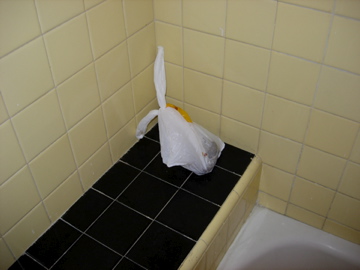
He emerges from the bathroom a couple minutes later, eyes down. “Well?” I ask. He looks at me, nods. I peer in the bathroom; he’s neatly tied the handles of the bag and set the bundle on the edge of the tub.

“What do we do with it now?”

It seems wrong to leave it there, in plain view, when the poor owners will have deal with the mess in the toilet already. I picture us sneaking into the kitchen and throwing it in the trash, but that doesn’t seem right either. Nor does our sheepishly handing them the bag and running out of the apartment. “We could hide it in a drawer and flush it when the toilet’s working again,” I offer half-assedly.

“Do you have any idea how awful it’ll smell in here when a bag of shit’s been festering all day?” Adam, always the practical one, retorts.

“We could smuggle out in my bag.” It seems like a viable option.

Adam gets off the bed, moving towards the window. “I wonder if we could open these shutters.” He runs his hands down the solid wood covering the windows.

“You wouldn’t really throw it out of the window, would you?”

“You wanna carry my shit in your bag?”

We pry the latch open and groan the hinges open. Daylight blasts into the room; our pupils wince.

Adam stands on a chair, craning his neck to see as far out the window as the wrought-iron bars will allow. “What’s out there?”

He steps off the chair, defeated. “It’s one of those air shafts. People have all their laundry hanging up. And someone’s got a garden down at the bottom.” I refrain from a bad joke about fertilizer.

We collapse on the bed and stare at the ceiling. “Well,” I venture, “we could just put it in the bathroom trash can. I mean, it’s already got our used toilet paper in it, so I doubt they’d really look.”

“I guess you’re right.”

We get dressed quickly. I gingerly bury the plastic bag beneath the top layer of used toilet paper in the wastebasket. I put the lid down on the toilet before we leave the room.

“Bueno dia,” our casa owner greets us warmly, looking up from the newspaper.

“Bueno dia,” we mumble (we’ve learned to drop our “s”s, just not our toilet paper).

“Quieren desayuno?” his amicable, aproned wife asks.

“Um, no, no gracia.” We stand there for a moment, awkwardly. I take a step towards the owner. “Um, pardon, senor.” I fidget, look down. “Hay un problema en el bano.” He nods earnestly at me. “Lo siento.”

Maybe it’s a situation he’s encountered before—poor plumbing meets the foreigner’s paper-flushing habit, topped off with a rocking drinker’s shit. We exchange helpless smiles, and Adam and I scuttle out the front door as fast as we can.

Down on the street, we feel relieved. Neither one of us can stop laughing.

“I think,” Adam declares, “that you’re the best person to be in a bad poo situation with.”

“Really?” I beam at the compliment.
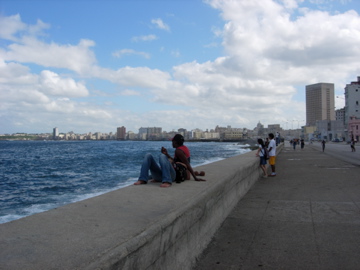
Malecon

“Well, yeah. I mean, anyone can be practical. That’s not really what you need in a bad poo situation. What you need is someone who will find it absolutely hilarious.”

I take his hand. “I’m honored.”

We continue down the street, holding hands under the half-clouded Cuban sky, towards the Malecon, and a new year.
Vomit Ride Through the Heat-Land: Part II

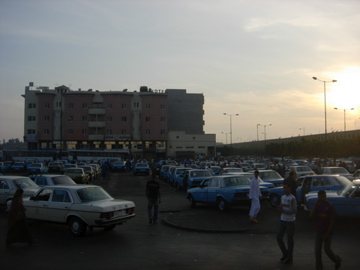
Grand taxis outside the bus station

Grand taxis outside the bus station

We groaned our way along the highway, rocking and swaying with every dip in the road. The air-conditioning had completely given out; I was grateful to be sitting by one of the few curtains, blocking out the mid-day sun. I shifted around the cheap shawl I had covering my bare arms and realized I was sweating so badly the blue dye was wearing off on my sticky arms.

I devolved into lamaze breathing. Well, no, not really—but I did employ the breathing technique I learned in yoga class to release heat: exhaling with a “hah,” like you’re fogging up a mirror (or a steaming bus window). Burning it up in a power lunge or cramped to hell on a sweat-bomb bus, it really does help. It also took my focus of my increasing nausea, not at all abetted by the chorus of gagging and spitting surrounding me. Despite having passed all those littered landscapes, I felt immensely grateful for plastic bags.

Others around me weren’t so lucky. The poor boy left crouching in the stairwell—some kind soul had supplied him with some newspaper to sit on—had been puking more or less constantly the whole ride, now approaching 3 hours. He’d been provided with an arsenal of plastic bags, a supply he apparently exhausted. That’s right—I saw his desperate face, checks full and eyes searching, then heard the sound of splattering on the stairs. A chorus of shouts erupted; the tout appeared with a fist full of newspaper and women waved robed arms in an effort to fan away the smell. It didn’t help much—in the heat, the vomit pile festered, wafting odiferously through the bus carriage in rank waves.

Any minute now, I told myself, we’ll get to Agadir. It wasn’t my destination, only a little more than half-way along, but a big transfer point. Hopefully the stop would be long enough for someone to hose down the floor.

We careened past a cliffside, a gorgeous view that I could almost enjoy through the misery. We passed construction cranes and cinderblocks outside Agadir, a package holiday town more akin to Miami than Morocco. Traversing a tangle of traffic, we pulled into the bus station. Doors sighed open and people pushed towards the front stairs to disembark.

Most of the passengers weren’t staying on for the rest of the ride, so I took advantage of the time before the next batch of grim faces boarded and got myself a primo seat: closer to the front, on the unsunny side, under the blowingest vent I could find. I smiled to myself, privately pleased that I had endured the trip without vomitting. You’re tougher than you think, I congratulated myself. I felt validated,  rewarded by the best seat on the bus.

We sat for awhile. This didn’t surprise me; most non-first-class buses don’t maintain timetables, just wait until the bus is full—or overly full—before departing. A new round of unsmiling people trickled on, along with the usual tissue, jewelery and snack sellers that enter through the front doors, shout the names of their goods as though you couldn’t see what they were, then exit through the back doors. Additionally, a sullen woman with a dirty scowl distributed those Xeroxed scraps of paper, telling her story of hardship, to each passenger; as per usual, she made her way back down the aisle, recollecting the papers and giving an even dirtier look to anyone who didn’t give her a couple coins. Though the paper was hand-written in jagged Arabic and I could have feigned ignorance, her bullying expression inspired me to give her some change.

No one, I noted, was coming to clean up the back stairs. I sighed, taking solace in my good seat and that fact that the worst heat of the day had passed.

The tout poked his head through the open door and pointed accusingly at me. “Tiznit?” he bellowed. I felt all eyes on me. “Tiznit,” I echoed with a nod, confirming my final destination. He gave one hard nod and disappeared.

He came back a couple minutes later, placed his hand surprisingly softly on my shoulder and launched into a choppy French explaination I couldn’t begin to understand as he ushered me off the bus. “Tiznit?” I asked feebly, pointing at my well-earned seat, fading as I stepped down the bus stairs. “Oui, oui, Tiznit,” he replied as he dug my dirty backpack out of the luggage compartment, hoisted over his shoulder, and walked me over to another, scrawnier bus. He tossed my bag into its luggage compartment, patting his hand firmly against the dented side of the bus. “Tiznit!” he assured me, and then was gone into the scurry of bodies and glint of steel that filled the station lot.

I stepped disheartened onto my new bus. The seats were scattered with a couple forlorn looking faces. They looked like they’d been there awhile; from the number of empty seats, I didn’t anticipate leaving any time soon. I flopped into a sun-baked vinyl seat and scowled. Through the window, I watched my sense of victory lumber away on the previous bus.

It was an hour before we left the station. Night fell pinkly and hazily between the palm trees and pebbles outside the window. Exhausted, I surrendered to a neck-jerking broken sleep; I woke just as a row of lights was growing closer.

Instead of a bus station, I was deposited on the side of a half-deserted road. Some teenagers hooted at me as I hoisted on my backpack; I gave them the finger and crossed the street to the Teleboutique. I had to call my hosts—at last, I had arrived.

Vomit Ride Through the Heat-land: Part I

1009173272_3ef7bfbbe6Yesterday I had the most authentic Moroccan experience of my trip so far. It wasn’t in a medina, it wasn’t at any monument; it wasn’t outside of a mosque or inside of carpet shop. It wasn’t in some exotic spice souq, or even with a witch doctor.
It was knees-to-chest, sweating obscenely, holding my breath and trying not a vomit in a catastrophic cauldron that careened its way through the countryside. That is to say, it was on a bus.

There’s two kinds of buses in Morocco: the first-class and the “other.” My previous two bus rides had been on the plush, first-class CTM company. The guidebook doesn’t just recommend CTM; it virtually doesn’t list the times, prices or destinations of other companies. In most cities, CTM’s buses depart from their own seperate offices, far from the chaos and heat and exhaust-laced smell of rotting ass characteristic to most bus stations, not just in Morocco, but around the world.

CTM accepts credit cards and assigns seats; their desk workers speak English. These are not the buses of screaming children or those checkered mesh bags fraying at the plastic seams from the weight of all some old lady’s worldly possessions. These are the buses of laptops and exquisite scarves, polo shirts and heavy gold rings. And independent travelers with Western standards and a low tolerance for long-distance discomfort. Together, we bound competently down the highways, stretching our legs and basking beneath the gentle blow of air-conditioning vents.

Once on board a CTM bus, you usually make a stop at the big messy main bus station before departing a city. In Tangier, I parted my curtain and peered out at the shouting, scrambling insanity of the real bus station. Jam-packed buses, a jumble of children’s bodies and grim faces pressed against tinted glass, heaved and wheezed and lurched haphazardly through the lot, shouting touts hanging from still-open doors. I have to say, I felt kind of like a chump from my kooshy assigned seat in a half-empty bus. At least once on this trip, I told myself, I’ll ride a real bus.

I intended to fulfill this brazen commitment on some short-distance route—45 minutes, an hour tops. Just, you know, to feel like I’d done it, gotten a taste and promptly gotten out.

The problem is, CTM runs infrequent services to only a few destinations, especially towards the south of the country. In my great haste to flee dishearteningly over-touristed Essaouira, I weighed my options: languish at the bus station and continue to get hassled by hotel and taxi touts for two hours while I wait for the CTM bus, and then have to make a connection mid-way through my journey, or hop on a direct “other” bus leaving in 15 minutes. Comfort flew out the window as I climbed the sticky stairs of the second-class bus.

I found an empty seat towards the back, and observed. This was the bus of acne and deep wrinkles, missing teeth and stern expressions. Children didn’t get seats, were left to swim on the laps of their parents. Upholstery was browned; I could feel the springs through the thinned seat fabric. A tout with a scar on his chin and impossibly stained fingers came off and on the bus, taking money, scribbling crude tickets, counting seats. I was grateful for the wobbling vents that blew a little air down from above my seat.

As the seats filled and the horn honked, people continued to pile on. The tout appeared with a stack of plastic stools; he strained to tug them apart and, after some shouting and coordination, placed them in the narrow aisle. Women were given stool seats first, then men; an adolscent clutching a book and a plastic bag was left standing. As the bus began its lumbering, the tout yelled at him to get down. The boy curved himself into the back stairwell—we slid past the officials at the station gates and were on our way.

The tout continued collecting fares and writing tickets as we lurched through the taxi- and scooter-swarmed streets—not an easy task on an old bus with poor shocks and an aisle full of huddled bodies. To get the job done, he balanced his feet on the edges of seats and literally climbed over people, his crotch in this lady’s face, his elbow in that guy’s chest, his entire torso smashed against my already-sweating body. He clutched a fistfull of bills, carefully folded between each finger, and with each new fare, made an almost tenderly careful note on a worn piece of paper.

We left the city center and began up a steep hill. The bus struggled, slowed to a speed scantly faster than a donkey cart. The effort cut out the faint blow of air-conditioning, and arms raised to fiddle hopefully with vents. The boy next to me unscrewed the top to a pocket-sized perfume bottle, pressed it against his nostril and inhaled. The tout distributed black plastic bags—vomit bags, I suspected. Beside me, the boy tossed a jacket over his head, leaned against the window and was gone.

Less than 15 minutes after departing, the adolscent in the stairwell began politely hurling with a liquidus sound into his plastic bag. I could make out, displayed proudly on the top of the windshield, just the last words of the bus company’s name: “Fadl Allah.” I jokingly translated this to myself as “pray to f%^*ing God.” The boy in the stairwell caught his breath and discreetly tied the handles of his bag together.

We made our first stop, and much shouting and shuffling ensued. The tout had the disembarkers already climbing over the aisle-sitters before the bus was stopped. We paused only momentarily; those getting off were left on the dusty roadside, struggling with heavy bags. Stools were cleared for vacated seats, and a new slew of stern faces took their squatting place on the plastic as we bumbled back on the road.

We fell into a determined quiet, just the struggle of the bus, soft conversations and the gentle gagging of vomiters. The scenery was pebbled and stark, branches bent cryptically; with the vent back a’blowing, I was almost comfortable enough to fall into a ragged sleep.


Lauren Quinn is a writer and traveler currently living in Hanoi. Lonely Girl Travels was a blog of her sola travels and expat living from 2009 to 2012. She resides elsewhere on the internet now.

Join 490 other subscribers

Buy This Sh#t

Categories