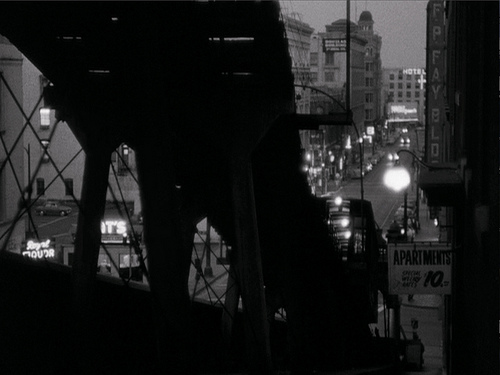
“Los Angeles, give me some of you! Los Angeles come to me the way I came to you, my feet over your streets, you pretty town I loved you so much, you sad flower in the sand, you pretty town.”
John Fante, “Ask the Dust”
Us Northern Californians are prejudiced.
That’s right: prejudiced. We look down our noses, down the long craggy coastline, at Los Angeles as though it were the traffic-clogged layer of Hell Dante forgot to mention. Tanned and Botoxed and full of silicone, Southern California steals our water, votes Republican, gave us the Governator. In its smog-laden haze of red carpets and reality shows, it skews our state’s reputation, bogs down our ethereal quest for Prius-driving utopia of gay marriage and legalized marijuana. It’s Sparta and we’re Athens, the “LA face and Oakland booty” that never quite make it onto the same person, never combine to create the ultimate bad-ass state, but instead go careening on their own individual, bickering paths of disapproval (NorCal) and complete unawareness/indifference (SoCal).
I once read an essay that whittled the whole Northern-Southern divide down to the difference between internal and external—Southern California was the glossy, teeth-whitened facade, Northern California the soulful, spiritually searching inside (you can guess which side of the debate the author fell on). It’s Bikram and we’re Hatha. And while Southern California remains too self-absorbed to even notice our despising of them, people write whole books on the cultural clashes of the US’s most populous state.
But I’ve long suspected that there’s more to Southern California than SUV-driving anorexics and flip-flop-wearing bros. It may have given us Kardashians and Speidi, but what about Charles Bukowski and John Fante, Camille Rose Garcia and The Date Farmers, The Germs and NWA? There must be, I’ve thought, a whole nuther Los Angeles, down beneath the glittering grotesque surface, that most people never see—hidden and raw, like an open wound or a small, beating heart.
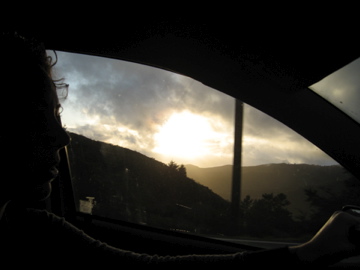
I’m going to find it. I’m going, filling my beat-up car with gas and kicking the tires to check the air, going down the writhing road of Highway 1, past old Missions and crumbling cliffs, sleepy mansions and under-funded state parks. I’m headed into the desert, to psuedo-Old-West honky tonks and lawless squatter encampments. I’m watching swallows return from their long flight, to build strange nests and swoop their shadows through the dusk. And then I’m headed into the city itself, the city of Angeles and dreamers and dirtbags I’ve adored. I’ve got no traditional guidebook, no road map—just my phone and a smattering of tips divulged by friends and dug up on random websites.
The voice was barely discernible, muffled by whizzing traffic and excitement. “I just rode the bus with Epic Beard Man! He was giving out candy bars and autographs, and I got a photo with him!”
My friend’s Friday evening commute home had been spiced up by a sighting of Oakland’s latest internet phenomenon. As the number 53 heaved down Fruitvale Avenue, passengers posed for pictures and chanted “Epic Beard Man,” as the grizzlied old dude distributed candy from his backpack and basked in the adoration of the bus riders.
Regardless of your take on Oakland’s latest internet sensation—racist, vigilante or mentally ill bad-ass—one thing is for sure: Epic Beard Man has reached celebrity status. And while a heated, racialized debate rages in chat rooms and on blogs, the actual riders of AC Transit appear to have risen Epic Beard Man to the revered status of folk hero.
Quick low-down, in case you’re out of the loop: earlier this week, a YouTube video of an AC Transit (Alameda County Transit) altercation between a middle-aged black man and an elderly white man (now dubbed Epic Beard Man) made quite a stir—over a million page views in its first day, and countless comments and ensuing discussions over issues of race and safety in Oakland. The story was picked up by local blogs, news outlets, even the Huffington Post. Know Your Meme offers the most complete run-down of the controversy, featuring video responses that capture some telling Oakland sentiments.
You can go to YouTube and dig through all the remixes, follow-ups and tributes, but here’s the original video. Yes, it’s graphic:
It’s no surprise that the video is so popular. It’s another opportunity for people to glimpse into the dysfunctional “urban” reality of Oakland, and people outside of Oakland never seem to tire of that. Several years ago, the city’s other big internet phenomenon fascinated outsiders with its oh-so Oakland cultural collisions and colorful characters (I was living in East Oakland at the time, and the screeching sound of whistle tips really did echo through the streets at all hours).
While responses to the latest video vary, they largely fall into two camps: Epic Beard Man is a racist, or a hero. He’s either an old redneck who asks a black man to shine his shoes, then beats him, or he’s a tough dude who stands up to a punk-ass thug who’s instigating and harassing him. In general, the first camp seems to be populated by guilty white people and advocates of all things ghetto, while the second camp is composed of kids, bus riders and enthusiasts of drama and smack-downs.
My own response lies somewhere between the two. Both men are unstable, not the kind of people you want to sit next to and exactly the kind of people you meet on East Bay buses. Epic Beard Man is obviously not well, further evidenced by follow-up interviews; turns out he was also the star of another YouTube phenomenon, a video where he gets tased at an A’s game for unruly behavior. He’s a deranged old Vet with a tenuous grasp on reality, prone to violent outbursts. Not someone who should be milling around the streets, trying to take care of themselves, but hey, that’s America (thank you, Ronald Reagan). The other dude should have left it alone, realized Epic Beard Man was not all there and not worth the trouble—but in his bravado, he got pumped full of ego and shit-talking and, well, he got served.
What’s most interesting to me is how the people most closely related to the issues raised in the video reacted—that is, AC Transit riders and people with exhaustive experience dealing with both the tiringly whacked-out and tediously ghetto. Most of the folks I’ve talked to feel that while, yeah, Epic Beard Man is totally deranged, dude got what he deserved.
It reminds me of an issue several years ago when an Oakland resident was both vilified and exalted for standing up to the thug kids that plagued his block, in what became a violent incident. While both parties in this instance were African-American, so the race issue wasn’t raised, responses were similar: he was either a vigilante hero, or a villainous attacker of innocent youth. Throughout the controversy, the man insisted that all he wanted was a safe neighborhood in which to raise his kids—what I’d argue the majority of people in Oakland are looking for. In the end, he did what most of the families I grew up with did—unable to afford a nicer neighborhood in Oakland, he moved to one of the outlying working-class suburbs.
Responses to that issue, as well as this one, tap into some very central Oakland issues. While the man from a few years back was a much more sympathetic (and sane) character, and didn’t want to be a hero, many people regarded him as such. I think it speaks to the extent to which people are sick of all the bullshit. People are tired of dealing with puffed up a-holes who think they can say/do whatever to whoever and get away with it, tired of shit-talkers, instigators and intimidators. So much so that they’re willing to revere violent behavior.
The riders on the 53 last night, majority non-white, were literally cheering for Epic Beard Man. Yes, some of it was surely star-struckedness and a glorification of school-yard theatrics, but I think there was something deeper going on there, something almost beyond race. Most of the video responses I’ve encountered are, in fact, from people of color. Epic Beard Man may be nuts, but the other guy was an ass. There’s no video glorifying him—and I don’t think it’s just cause he was the loser in the altercation. It’s a strange thing: an incident so racialized, that at its core, to the people who deal with this stuff day in and day out, has more to do with harassment and basic respect than race.
That the incident took place on a bus is no coincidence. A San Francisco Chronicle blogger (and fellow gym goer) centered his coverage of the issue on the ridiculousness of AC Transit—for him, it was all evidence for why he doesn’t ride the buses in Oakland.
Word. I grew up riding AC Transit, and it served as a serious education in the world. The first post on this blog was a reflection of how riding the East Bay buses prepared me for world travel, while the very first piece I published, as a teenager in The East Bay Express, was a narrative about my fucked-up experiences on AC Transit (I used a line from the piece as the title for this post). While shit like this doesn’t go down on the vast majority of bus rides, it’s not some sort of exceptional incident—it just happened to be captured on tape. I’m grateful for the schooling AC Transit administered; as a result of vital life skills learned on those blue plastic seats, people generally don’t fuck with me. But I’m even more grateful to have a car now.
The Epic Beard Man hype will surely die down—like everything these days, it’ll be discussed and linked to and tweeted wildly, then fade into the buzzing gray, the next craze taking its place (in the digital age, it seems everyone’s 15 minutes of fame are whittled down to 15 seconds). But for the rest of us, the issues the video captures will continue on: race, safety, the crazies that fill AC Transit. They’ll continue to roam around, screaming and bleeding all over our commutes, and I will carry on with my self-centered, polluting aversion to East Bay mass transit.
But I will say—being on that 53 with my friend last night would have been an experience. If for nothing else than the photo ops.
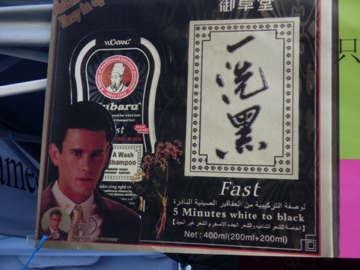
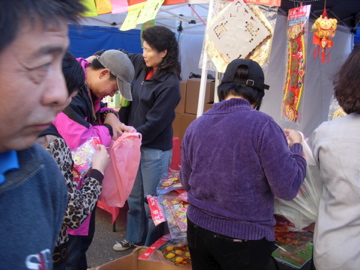
Short women elbowed through stacks of neon flowers. Banners boasted the rejuvenating wonders of herbs, tea, hair dye: “No. 1 Selling Brand in U.S.A.”, “Prince of Peace, The Name You Can Trust!” Distorted pop vocals crackled and hummed from a far-off stereo. Children gazed up at their toy windmills, decorated with carton tigers or Dora the Explorer, black eyes shinning and mesmerized by the spinning, spinning.
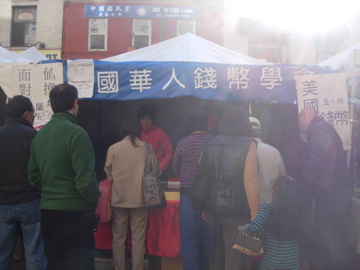
This last weekend was Oakland Chinatown’s annual Lunar New Year “Bazaar.” Not quite a street festival, not quite a farmers market, and anything but the well-known San Francisco Chinese New Year Parade (ahem, the “Southwest Airlines Chinese New Year Parade”), the event captured Oakland’s Chinatown: non-glitzy, utilitarian, and not particularly concerned with outsiders.
I’ve been meaning to do a post about Oakland’s Chinatown for awhile. As its Chamber of Commerce website declares: “Oakland’s Chinatown is one of the most fun and authentic of the American Chinatowns. It is quite safe. It is not a line of t-shirt and postcard shops like much of other Chinatowns.” I recently tromped through San Francisco’s Chinatown with out-of-town relatives, which actually gave me a renewed appreciation for its lanterns, pagodas, skinny alleys and countless trinket stores. Growing up here, it’s easy to get blase about what remains alien and alluring for a lot of people. My cousins loved SF’s Chinatown, and I wouldn’t think of bringing them to Oakland’s—it would be totally uninteresting to tourists.
Diagonal crosswalk
Oakland’s Chinatown isn’t glamorous; there’s no self-conscious gestures towards exoticism. It’s not even really a “Chinatown” as much as it is an “Asiantown,” filled with a good number of Southeast Asians (and thus, one of the best Vietnamese sandwich shops around). Still, the history of the neighborhood is Chinese—as evidenced by the bilingual street signs—and the attitude, well, that’s Chinese too. It’s not hostile by any means, it just doesn’t go out of its way to include outsiders. It reminds me of the sentiment Pico Iyer captured in his 1980s essay “The Door Swings both Ways.” A lot of the stores and markets don’t bother to translate signs. Despite one of its main thoroughfares being four lanes wide, double-parking is so rampant it still takes ten minutes to drive two blocks. People ignored crosswalks and traffic signals so much that the city eventually gave up and installed Oakland’s only diagonal crosswalks.
Dingy awnings, block construction and an eerily empty mall are part of the unexotic offerings of Oakland’s Chinatown. And, this last weekend, two of its main streets were closed off for what’s marketed as a Lunar New Year Bazaar, but what’s really a stock-up opportunity for locals. I ran into an old friend who was working the event, and her aunt helped illuminate my hazy understanding of New Years traditions, informed mostly by the annual dragon dance on the playground of my grade school, when we got to throw cabbage and eat those chewy candies covered in rice paper.
Aunt Kathy told me about the purpose of the market, which is to stock up on bright flowers to decorate the home with. Yellow mums and reedy stalks (whose English name we couldn’t figure out) are most popular for their bright color and longevity. People also bought up red envelopes, for money giving; what I didn’t know was that only single people receive envelopes (hint, hint). As opposed to Chinese celebrations, when people have a week off work to visit relatives and feast, American celebrations are more condensed—people usually gather at a relative’s house for a night, eat a ton, and exchange envelopes, candy and sugar-coated fruit. “Like Thanksgiving”—but with a lot more red.
Like most things in Chinese culture, the traditions of the New Year seem to all go back to “good luck.” “Why the colorful flowers?” “For happiness and good luck.” “What’s the significance of the long stalky flowers?” “They live long, don’t die. Bring good luck to the house.” “Why all the candy?” “It’s sweet, bring good luck.”
Oakland’s Chinatown doesn’t hold a New Year parade or celebration, just one big market for all your flower, herb, sunglasses, socks, DVD and good luck buying needs. A couple of other non-Asians milled through the crowd, not quite sure what to do with themselves or why they were there. Where were the food stalls? The ethnic trinkets and radio stations? Meh, it was Chinatown. This was their affair, and they weren’t gonna dress it up for anyone.
Nature lover, pagan, hippie, cheapskate—call me what you will, but the Muir Woods Solstice Event ruled. And not just in a Wicker Man kind of way.
The free, annual event honoring the longest night of the year is uber North-Bay: wholesome, granola-y, non-denominational family fun, set amid old-growth redwoods and adorned with weedy handmade garlands. Luminaria-lit paths fill with white-breathed revelers, whose flashlights make the falling rain look like snow, or that scene from Edward Scissorheads. Puppet shows, antler-clashing Germanic dances and de-Christianized caroling ensue in an event that makes even a cynical 20-something (me) smile.
The promise of free entry and free hot cider lured me out on a moody Monday afternoon, to brave the bridges and highways of a Bay Area rush hour. On a slow Saturday, I’d gotten to chatting with some regulars at work, who gushed to me about the event. Traipsing around the damp dark of one of the Bay Area’s most impressive natural attractions had sounded like a damn good way to spend the longest night of the year. I grabbed a crappy flashlight and a hooded puff coat, roped a friend into riding shotgun and playing DJ, and we set out, sliding along the green curves of Marin, through afternoon sun that shone through the clouds like light into a church.
A ranger with plastic encasing her hat ushered us past the forever-full parking lot; we joined the assembly of cars lined up along the soft shoulder. We walked a muddy, pleasant 15 minutes to the park entrance. Slicker-clod kids tromped puddles as their parents juggled umbrellas and thermoses.
We arrived just as the crowd was thickening. A bearded ranger that looked like a nervous cross between a bluegrass singer and a surfer handed us a booklet of Solsticized/Muirized Christmas carols, complete with lines and titles such as “Deck the woods with luminaria,” “I’m Dreaming of a Green Solstice,” “O Redwood Tree,” and “Come All Ye People.” My personal favorite was “On the first day of Solstice / A Ranger showed to me / A spotted owl in a redwood tree.” The adapted songs captured the progressive eco-politics and non-religious spirituality of Marin better than an Anne Lamott novel. You know that stir a couple years back when right-wing Christians got their knickers in a twist over “Happy Holidays” replacing “Merry Christmas”? Well, these were the folks they were pissed at.
It was, as you might guess, a mellow crowd of nature-y families and local weirdos (a simplification that I suppose puts me into the latter category). We grabbed some cups of cider and strolled around in the intermittent rain, soggy sneakers and cold noses. The creek was full from the recent storm, the stumps mossy; everything felt wet and alive.
We joined the huddle of firepits and hunched shoulders encircling a small, makeshift stage. It was time for some wholesome, non-offensive entertainment. The crowd sang a couple carols, and was then held rapt by a story-telling performance featuring exuberantly portrayed animal characters that I’m sure have inspired several voice-over school rejections. We agreed that the confused shadow puppet show was most definitely the improved result of a flash of marijuana-fueled brilliance. We took it as our cue to stroll the now-dark trails.
Candles in white paper bags lined the trails, making it feel almost like we were walking through an altar. Raindrops held heavy on the tree branches as little kids ran past in a bobble of flashlight beams. Other than that, it was all sound. It reminded me of an interview I’d read with a travel writer (Don George?) who’d wanted to write about something other than the cathedral-ish quality of light in Muir Woods. He’d blindfolded himself and walked around, experiencing the famous woods with mostly just his sense of sound, and written the article from that perspective. It was true that it was a totally different Muir Woods without the light and the sight of redwoods—all rambling water and the solid, rooted presence of those trees, the way you feel a stranger in a dark room.
We got back to the caroling crowd just in time to catch the most bad-ass and spooky performance of the night, a Germanic Solstice dance by the Christmas Rebels (which sounds kind of punk rock). Composed of members of the German fraternal society California Rebels, the group did a slow, hypnotic folk dance that included antler-clashing and creepy flute playing. A bearded dude with a crazy eye hushedly explained the pre-Christian roots of the dance, which got back to the potent mix of fear and worship that fuels most religions, not just Paganism. Under the illuminated, snow-like mist, the clanks of the antlers and the wet clomp of the determined feet felt like a ritual not from long ago, but rather some deranged allegorical movie. Which is to say it was rad.
Toes numb and bellies hungry, we trekked back to the car under the dim halo of my flashlight. A half-grin of moon cut through the heavy clouds, and the earth rustled, sighed, pulled a blanket of darkness up to its chin and settled in for the longest sleep of the year. And Marin celebrated, the way Marin knows how: amid the trees.
“Oh hell no,” the text read. “Hipster douches filming Oakland travel video outside the shop.”
This was my best friend, writing from her post behind the counter of Tattoo 13. For years, she and the fellas have maintained a comical running commentary on the goings on of the now-trendy Temescal neighborhood, knowing every event, incident and wily character within a 10-block radius. Of course, she’d be the first person I’d hear about such shenanigans from.
It actually turned out pretty good, with the bit filmed in front of the shop capturing hipster sentiment with striking accuracy. Amid the recent annoyance over the woefully narrow Cool Hunting’s Oakland Word-of-Mouth Guide, I was inspired to dig the “hipster douche” video back up, and discovered some other YouTube gems along the way. And I hate to say it, I think the douches did it best. Or at least the most forthrightly.
Cool Hunting promotes independent art and design, featuring video guides on artists, cultural events, how-tos and destinations. The most recent installment visits independent businesses and local artists in Oakland, interviewing “the people who call it home.” They hit some great, popular local spots, but there’s a problem—the video only visits a very narrow section of the population, and the city. Businesses featured are almost exclusively in the North Oakland/Temescal and Downtown/Uptown areas, and, um, all the people interviewed are white. There’s a lot more white people in Oakland these days, but not that many.
Perhaps in an attempt to be inclusive, the video includes a couple shots of non-white, non-artist folks. They exist as passing, silent figures, riding bikes and making sandwiches—almost as though on another plane. I think it’s rather telling; I’m sure there’s people who’ve moved to Oakland that interact solely with the arts/”yuppie” communities, who experience the rest of the city only in tangent, realities that intersect on sidewalks and in cheap cafes, but no where else. I’m stoked to see my city getting recognition, but sad to see the guide left out so much of the city, what makes Oakland Oakland.
On the complete other side of spectrum, I stumbled across Thizz Nation’s neighborhood guides during my YouTube quest for the “hipster douche” video. Amid Mac Dre’s ever-generous contributions to Bay Area culture (I’m not really being sarcastic here), his Thizz Nation & On Point Productions created Treal TV Series, video guides that feature notorious Bay Area neighborhoods that birthed prominent figures in the rap community. (If you’re wondering what “thizz” is, check out old high school buddy Rachel Swan’s East Bay Express article from a few years back.) Installments include North, West and East Oakland.
I’m convinced these will someday be used as important specimens in some cultural anthropological study of Oakland. These guides do a little more to reveal the history and culture of certain neighborhoods, as rugged as they may be. But of course, they are also terribly narrow, and could leave one with the impression that Oakland is filled with nothing but 20-something, hard-as-shit black guys. Murder Dubs was one of the better ones:
A stab at a more balanced portrayal is made in the endearing “Oakland B Mine” video. A trailer for a short film that will be showing on a 30-foot screen at the Oakland Airport’s baggage claim, “Oakland B Mine” is pretty damn sweet. I never thought of my city being the backdrop for an artsy dialogue-less love story, but hey, I can roll with that. The trailer features some shots of everyone’s favorite farmers market (okay, my favorite farmers market), and the bad-ass old folks that do Tai Chi by the Lake Merritt BART station in the morning. While definitely more balanced and definitely the most well-done, one could still walk away from this one with the idea that Oakland is filled with nothing but good-looking, casually well-dressed hiply ethnic types. Which is fairly accurate, but still incomplete.
Which leaves the douches. While still narrow and incomplete, their video does something the others all don’t: makes fun of itself. It doesn’t just make fun of hipsters and gentrifying yuppies, it makes fun of cheesy travel guides and the abhorrent “staycation” phenomenon. But most importantly, the video gets at some of the very real issues inherent to living in Oakland, the preposterous dysfunction that manifests in sideshows, prostitution and, yes, the smells emanating from the Lake. And while the underlying message is that Oakland is “crappy,” the video captures the kind of delusional exoticism so many fall spell to.
It’s not Mexican Halloween. Or Northern Californian Halloween. It’s Dia de los Muertos, and it’s everyone’s holiday now.
You can’t escape Dia de los Muertos in the Bay Area. That’s a good thing. It’s a pretty bad-ass holiday, based in the Aztec belief of death not as a definitive end, but merely a continuation in a parallel form. Aided by elaborate graveside altars, souls of the departed return for one night (traditionally two) to kick it with the living. The celebratory approach towards death comes complete with a comically macabre aesthetic derived largely from a good ole’ revolutionary, Jose Guadalupe Posada (see: my first tattoo).
What makes the holiday fascinating to me is its endurance and evolution. Dia de los Muertos is the little holiday that could: millennia-old, it’s survived colonialism, Catholicism, and more recently, the United States. But while all these outside elements have altered the holiday, the fundamental spirit has managed to survive. Observances vary wildly, both within and outside Mexico, and serve to say a lot about their respective communities (see: my latest Matador article). Case in point? Oakland versus San Francisco celebrations.
The Bay Area’s enormous Hispanic population has two established homebases: East Oakland’s increasingly cleaned-up Fruitvale district, and San Francisco’s contentiously gentrified Mission District (claimed to be birthplace of the burrito). Both host huge Dia de los Muertos celebrations that shut down city blocks and draw thousands with marigold-adorned, incense-laced festivities. Neither celebration is traditional, in the Patzcuaro sense of the term, but neither are the same. They contrast as starkly as an SF hipster’s ironic mullet and an Oakland hyphy kid’s synthetic dreads.
International Blvd during the Dia de los Muertos
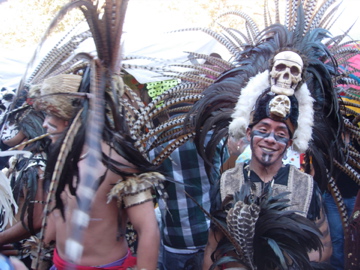
Oakland celebrates with a family-oriented daytime street fair on the Sunday preceding the holiday, this year November 1. While drawing a healthy cross-section of the city’s ever-diverse population, the event is mostly representative of contemporary Mexican and Latin culture in the Bay Area. Powerhouse Spanish radio stations, La Raza and La Preciosa, set up stages on opposite ends of the festival and vie for on-lookers. Local taquerias set up stands that pump out carne asada smoke, while DIY vendors push helado carts and set up raspado stands. Women hawkers cry, “Churros, Churros, Churros!” while others wrap still-steaming elotes in foil. Local businesses abut booths with corporate superpowers like Safeway, while non-profits erect altars next to those of neighborhood school kids. Dancers decked out in Aztec garb (the feather- and skull-adorned headdresses are bad-ass) break into spontaneous drum-infused performances, and there’s more men in cowboy hats and little girls in mini-skirts than you can count.
On November 2, San Francisco holds an evening procession that a jaded friend of mine has dubbed “Gringos Gone Wild.” True, the participants are largely not of Hispanic decent and, boy, do they get down. People dress up in calavera face paint and elaborate Tim-Burton-esque costumes that I suspect derive from Victorian Catrina dolls. A modest group of Aztec dancers leads the procession, which then follows with revelers of the purely San Franciscan variety: costumed people with politicized signs, curious interpretive dancers, bicycle-powered floats, and a whole lotta candle-clutching white folks. The procession ends at a public park filled with some seriously artistic altars—this year, an anatomical heart suspended by red nerves, a papier-mache carniceria, a parlor scene that looked like the inside of Edward Gorey’s head.
I can see how people get down on San Francisco’s Dia de Los Muertos celebration for not being authentico; I understand why others deem Oakland’s as boring and not creative enough. But isn’t that just an extension of the Oakland-SF rivalry, the cities’ differences demonstrated through the observance of another culture’s holiday?
I’m an Oakland girl, so I’m partial to an event where I run into about a dozen people I know. And if nothing else, the Fruitvale festival is thrilling for the mere fact that Oakland manages to hold a peaceful public festival (I remember seeing stray post-Festival-At-The-Lake rioters pass by the bottom of my block as a kid—that was the end of that neighborhood event). Events like the Dia de los Muertos celebration remind me why I love my hometown—though I never really forget.
At the same time, the Mission procession captures so much of San Francisco’s cultural landscape. Just when you get disheartened, want to write the whole place off as over-priced and gentrified, the city comes through with something insanely creative or beautiful. Despite the changing demographics, beneath the paling population and depressing socioeconomics, San Francisco’s still a city with soul.
And at the center of both of these celebrations is the fact that they don’t derive from, well, here. They aren’t American, have been brought over by immigrants and subsequently Americanized. Some shout cultural appropriation, and, sure, these festivities are a far cry from the all-night graveside vigils I attended last year in Tzintzuntzan. But, at the core of these modern interpretations, both stay true to the fundamentally celebratory Aztec approach of the holiday. And if that’s not survival, I don’t know what is.
Lauren Quinn is a writer and traveler currently living in Hanoi. Lonely Girl Travels was a blog of her sola travels and expat living from 2009 to 2012. She resides elsewhere on the internet now.
 “Los Angeles, give me some of you! Los Angeles come to me the way I came to you, my feet over your streets, you pretty town I loved you so much, you sad flower in the sand, you pretty town.”













 It’s not Mexican Halloween. Or Northern Californian Halloween. It’s Dia de los Muertos, and it’s everyone’s holiday now.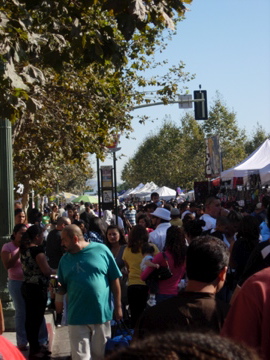
 On November 2, San Francisco holds an evening procession that a jaded friend of mine has dubbed “Gringos Gone Wild.” True, the participants are largely not of Hispanic decent and, boy, do they get down. People dress up in calavera face paint and elaborate Tim-Burton-esque costumes that I suspect derive from Victorian Catrina dolls. A modest group of Aztec dancers leads the procession, which then follows with revelers of the purely San Franciscan variety: costumed people with politicized signs, curious interpretive dancers, bicycle-powered floats, and a whole lotta candle-clutching white folks. The procession ends at a public park filled with some seriously artistic altars—this year, an anatomical heart suspended by red nerves, a papier-mache carniceria, a parlor scene that looked like the inside of Edward Gorey’s head.
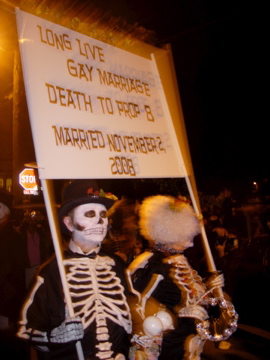 At the same time, the Mission procession captures so much of San Francisco’s cultural landscape. Just when you get disheartened, want to write the whole place off as over-priced and gentrified, the city comes through with something insanely creative or beautiful. Despite the changing demographics, beneath the paling population and depressing socioeconomics, San Francisco’s still a city with soul.

 Lonely Girl Travels
Recent Comments