Archive for the 'Places' Category


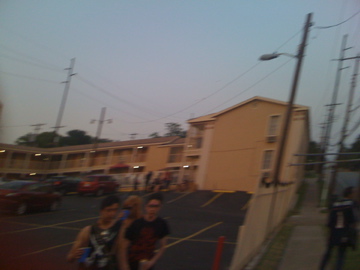
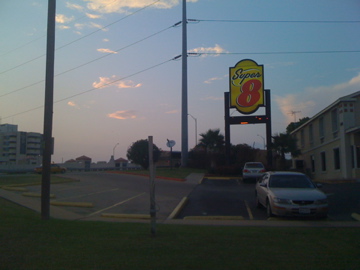
Sunset at the Super 8

Dusk and the birds come out.

Diving dark bodies against a fading pink—the kids are getting ready.

Ripples in the pool, empty cups and sagging neon intertubes, nodding “yes, yes.”

Drums and distortion and a screaming rage, rattling out of too-small speakers, a half-open door. Hanging over the rail of the balcony, smoking and slouching, bad postures and back patches.

A bird swoops, circles, disappears inside a nook under the drain pipe—small squabbling voices: hungry. Ready to be fed.

Skateboarding in the parking lot of the Super 8 as the light fades: pink and darkness stretching, chasing, reaching for the sun and consuming the city instead.

Night is coming, the shows are starting, the air exhales and a breeze from no particular direction blows across the pavement, the hot stretch of steel, winking windshields, “yes, yes.”

The birds keep circling, searching for something to take between their beaks. They are only aware of their wings, the wind—not of their dancing or the shape it makes against the sinking Austin sky.

Chaos to Kona: This Will Be Epic

SFO –> AUS –> SJC –> LAX –> KOA –> LAX –> SFO: This will be epic.

It happened like this: my brother’s family was going to Hawaii. It’s an annual thing. My sister-in-law has a good family friend who is famously, fabulously wealthy, and owns a private villa along the Kona coast (“It’s like your own personal Four Seasons,” my parents told me). They go down and stay at the house every year, usually with a big group of people in January (when you can watch the migrating whales from the pool deck). The imminent arrival of my new baby niece pushed the party back till the end of May this year, which gave me enough time to scrape together airfare and justify taking a proper vacation (travelers don’t vacation, see below…). I roped my hard-working best friend into getting some time off from her fancy scientist job and come along with me.

Aside from the not-paying-for-a-place-to-stay bit, it’s kind of the classic American vacation: a relaxing one-week Hawaiian beach vacation. We’re renting a car (which I’ve never done while traveling), traveling with family, have nothing on the agenda other than morning yoga, noontime naps and all-day sunbathing. Which means, of course, it was nearly impossible to justify. I don’t relax when I travel; that’s not the point. If I need to relax, I’ll sleep till noon and go eat ice-cream cones in Dolores Park. I travel to see the world, dig in, explore, run myself ragged on third-class busses. When I travel, virtually no sacrifice is too big: I’ll bankrupt myself, take as much time off work as I can without getting fired. But when it came to taking 5 days off work and spending $436 to fly to Hawaii, I balked. It seemed like a lot to do nothing, learn nothing, gain nothing but a couple pounds from my brother’s bad-ass cooking.

I took it on as a sort of spiritual challenge: a traveler vacationing. In a lot of ways, it’s going to be my first vacation in 5 years. Unwinding, unplugging. But of course, I’ll have to write about that. And bring my laptop along. And then a friend gave me some tips on non-touristy places to go on the Big Island. An independent traveler tackling the most touristy place in the US? Sounds like a killer article…

Already, I was chipping away at the “vacation” element of my vacation. And then came Chaos.

It’s the dirtbaggiest, DIY-est music festival of the year. Organized by one dude with a blog and Xeroxed flyers, Chaos is Tejas brings out some of the biggest names in punk/crust/sludge/metal for four days of sheer debauchery in Austin, Texas. Friends had been road-tripping out since its inception 6 years ago. I finally went 2 years ago, and partied like I was 15 (minus the malt liquor and methamphetamines). I stayed with a tattooer/artist friend of mine, and ran around the streets till 4 in the morning, lighting off fireworks at after parties and making out in the back of a truck with some dude while his friends careened us around the city. And that was stone-cold sober.

I remembered the festival as being in early May. A tight squeeze, but I could fit it before Hawaii, right?

Turns out Chaos in Tejas (which has entered the digital age this year with a Facebook page) is Memorial Day weekend. And I was leaving for Hawaii on that Sunday. Some friends were planning to drive out. A hair-brained scheme began to hatch.

The road-tripping part had to get chopped out, but here’s how it’s ended up working out:

Wednesday: Fly to Austin with Liz and Melissa.

Thursday – Saturday: Rock our effing brains out. Killer bands from all over the world playing nearly 20 different shows. 3 single girls in a sea of crusty boys: think “Girls Gone Wild,” but with more tattoos.

Sunday: Fly from Austin to San Jose. Meet Alicia at the airport. Fly from San Jose to LA, where we’ll connect and fly to Kona. Grab our rental car and traverse the dark turns of some deserted highway, arriving at the gate to the mile-long driveway.

Monday-Saturday: Chill-ax.

Saturday night: Red-eye back to LA.

Sunday morning: Fly back to San Jose. Get a ride back to Oakland. Be at work by 2:30.

It’ll be one end of the spectrum to another: ridiculous partying to ridiculous relaxing. Punk rock shows to private properties, dirtbags to nieces, stinky clubs to island paradise. 11 days, 2 destinations, 7 flights, 1 rental car, 3 girls in 1 cheap hotel room, 15 people in 1 oceanside villa, 99 bands and 1 me to live (and write) it all.

Domestic Travel for the 25% Club

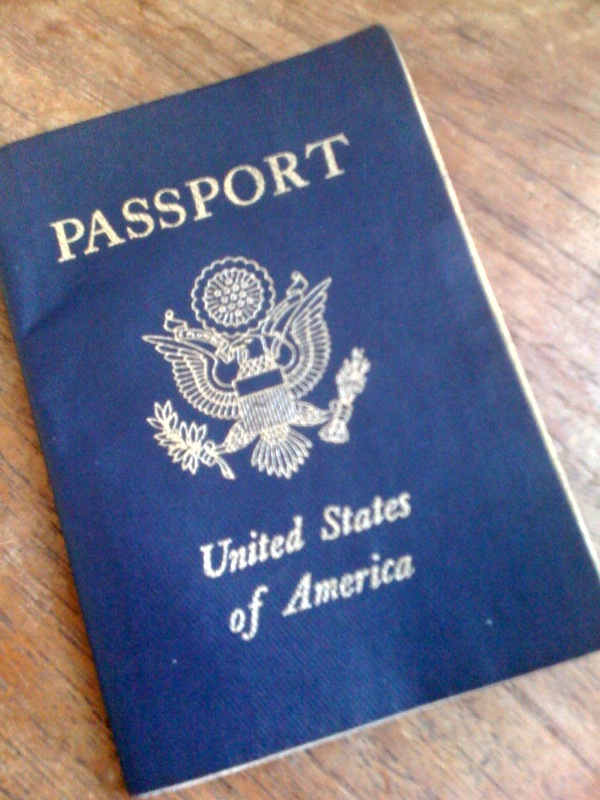
It’s a tired, tongue-worn statistic that staggers gasping into travel discussions across the internet: only 25% of Americans hold passports.

Usually meant as a sad accounting for the geographic and cultural ignorance of Americans, it has the opposite effect on those of us in that illustrious quarter percent. We are the daring, the open-minded, the shrewd and worldly elder all the glowing faces at the campfire are huddled around. We have seen the world, and we have stories to tell. (Whether you not you really want to listen.) The only real travel is international travel—all else (minus the notable exception of New York City) is a petty bourgeois venture in the money-sucking heart of homogeneity.

“Is domestic travel really travel?”—it’s the kind of inane question that you unwittingly discover yourself debating (with yourself) over a slice of open road and steaming cup of gas station coffee. Travel within one’s own country is never an exotic thing—a kind of half-traveling, going through the motions, faking the orgasm of discovery. But when you’re American, and that country is a sprawling continent composed mostly of people who never leave it, domestic travel can sometimes seem like the antithesis of travel: giving up, giving in and coping out. And paying entirely too much for hotel rooms.

I got to thinking a lot about domestic travel on my very unglamorous, utterly unworldly last trip: driving through Southern California. It was so different from the type of travel I’d been doing the last few years: I had my car, I spoke the language, could use my cell phone and credit cards. There was no hassle, no “other”—but it most definitely was still travel. And now, as I’m getting ready to dash off to one equally unexotic locale (Texas) and the ultimate “paradise without a passport” destination (Hawaii), I’m thinking even more about what domestic travel means as an American.

I didn’t grow up traveling. International travel was one of those unfathomable luxuries of the wealthy. So when I left the US for the first time, it was literally like the world opened up to me. This occurred during a very dark time—namely, Bush’s presidency. The prevailing image of America, and Americans, was pretty much everything I was against. I wouldn’t go so far as to say I was Canadian when abroad, but I didn’t want to be associated with anything American: capitalists, Christians, blond suburban girls. I was also broke, so traveling in places where rooms cost $7 a night was pretty much the only way to go. Thus, I left the country more than I left the immediate Bay Area and my ignorance went inverse: I knew the geography of Latin America better than the Midwest.

It’s true that the political tide has shifted, but it’s more than that. There’s so much to be against in the US—imperialism, corportatization, people who don’t believe in evolution—that it’s easy to forget all the good things. Our art is amazing; from hip-hop to punk rock to graffiti, pretty much everything I love was spawned out of the raging, pulsing cultural cocktail that is the United States.

And when I travel here, at home, I’m more able to dig in to those things that interest me—poke and scratch beneath the surface and get closer to what it means to be this, from this, born out of this. It goes beyond using the Yelp app in my phone to find a good coffee shop (which is goddamn useful). It goes beyond even just speaking the language, or doing so without an accent. Because I know the culture, am the culture, I know how to approach people, how get right in there and smile and make friends and discover cool shit I wouldn’t otherwise be able to.

The number one benefit of traveling within my own country is that I’m more able to dig in to what really fascinates me: people, how they live, the weird art/shit they make and the stories it tells. Domestic travel is a totally different beast from international, and I gotta admit that you don’t get the same knock-you-over-the-head rush. Rather than exploring the “other,” you’re exploring the known, and in that way, exploring yourself.

What does it really mean to be American? I used to think it had mostly to do with narrow-mindedness and consumerism. Maybe I’m just a cheeseball, maybe the Obama campaign really did give me some kind of hope, but I think it’s something much deeper than all that. I’m not sure what all it is, this being American, but I’m certain that somewhere down near the core of it is travel. There’s something very central about travel to the American psyche, a kind of open road that flows through the veins of the place, a Manifest Destiny born into us, to set wheels over earth. Stagecoaches, trains, automobiles, a country based upon more, upon Going West and Getting Yours. It’s not the jet-set , passport-stamping kind of travel. It’s visceral, grounded, rooted down into the earth, the dusty, craggy, bayoued and fertile earth.

Perhaps I’m settling into myself. Perhaps I’m just becoming accustomed to being a traveler and building a life around travel; being a member of that elite 25% isn’t so much a novelty anymore, it’s my life. I’m not the anxious teenager with a self-conscious mohawk; I’m the cranky old punk who doesn’t give a shit about dental-floss-sewn patches and would rather go to bed than party/do blow backstage (an actual anecdote from my weekend). And while my heart is in international travel, it doesn’t mean travel within the US is a waste of time and money (what I honestly used to think). It’s just a whole different experience, uses a whole different side of the brain.

Besides, what other country has Chaos in Tejas? (I’ll see you in the pit.)

A Woman in the Sun

I sat in the sun, butt naked and heat dazed, my starving skin soaking up all the UV it’d been hungry for since my trip to LA. The sulfur smell of the hot springs had stopped burning my nose, and I was in that drool state of relaxation where everything floats in and out of your consciousness like a dream. The bits of conversation from down the deck came to me in whiffs, like BBQ or the burning of some far-off fire.

“You know, Mark called me on Friday. And he started up again. And I said, you know, like we’d practiced, ‘I am not going to participate in this conversation with you.'”

The words roused me a little. Not so much really the words, but the careful way in which they were recited—deliberate, practiced, the memorization of an actor who knows the scene but hasn’t quite figured out their character’s motivation.

The patter of bare feet and a sleek ripple of water. “Oh, Myra, I didn’t tell you,” the voiced repeated. “I got to use that tool we talked about, when I told Mark: ‘I am not going to participate in this conversation with you.’ It felt so good!”

Wilbur Hot Springs is a retreat place, and that’s what I’d come for. That’s what we’d all come for, driven the two-line highway through pastoral postcards, past cheese-commercial cows, down a bumping dirt road where the dust plumed and twisted behind us like everything we’d meant to leave behind.

Wilbur is the kind of place that makes you lapse into cheesy cliches (partly because your brain is too full of steam to think straight). A Victorian mansion “nestled” into the “rolling” California hills, it’s an uber-NorCal experience, an “oasis.” Everything is solar-powered. The natural hot springs are directed into four flumes clustered around a clothing-optional deck. There’s a communal kitchen where guests cook their own meals, and instruments for evening jam sessions. Everyone talks in low, soothing voices, and the place smells like well-oiled wood. Sustainability and spiritualism; regrouping, reconnecting, getting off the grid and soaking in 114 degree water—you know, the kind of hippie shit a punk rock kid like me used to scoff at. Until I went up on a gift certificate a couple years ago with a similarly suspicious friend.

We’ve been jonesing to get back ever since.

Retreat is what these chatting women on the deck had also come for, and like retreat, they were something, a certain kind of woman, a younger incarnation of me would have scoffed at: middle-aged, middle-class, white, all-American. Bad hair and worry lines. I’ve grown less judgmental in my old age, and in my hot-spring-infused sedation, observed them detachedly, from an almost anthropological distance.

They’d come on day passes. They weren’t entirely comfortable, held their robes and towels around them self-consciously, seemed self-conscious about being self-conscious—they averted eyes, glanced this way and that before letting go and slipping naked into the steaming water.

I’d pieced together their conversations, about ex-husbands and astrology, how to figure your aura energy by the kinds of animals you attracted (“You got lizards and butterflies; I got bit by a tick!”). This day trip to Wilbur appeared to be the culmination of a healing workshop. The leader of the group was some kind of psychic—not a predictive one, she assured, but one that dealt more in energies, a kind of cosmic therapist. They weren’t super New-Agey about it, talked in a kind of down-to-earth tone that made them seem less like people on board some kind of bullshit train, and more like people genuinely seeking, genuinely lost and hurt and looking for something, some kind of solidity.

“I am not going to participate in this conversation with you.” The statement rang in my ears, plucking me out of my sun-drenched stupor. The speaker’s voice held in it all the excitement of a pupil who’d just felt a switch flip—who’d practiced the arithmetic but wasn’t sure the equation would work for them, with their own dull and trembling pencil. But it wasn’t a young voice and a glance at the body from which it issued revealed a gravity, breasts heavy and hips wide, a child-bearing body.

My God, I thought, to have lived that long and only now have learned to say that.

The woman’s comment, the thrill with which she yielded it, struck me as tragic, in a particularly female kind of way—that a woman could go that long in her life without having learned to say no before.

Boundaries. Standing up for yourself. Not taking shit. They’re vital things for us girls to learn. You flat out won’t make it in this world without them, I’ve come to believe, and I don’t just mean with manipulative ex-husbands. You’ve got to learn where the world stops and you begin, what is and is not okay with you, and how to be firm and true to that. Cause you’re not going to make it—ride the buses or walk the streets or, shit, travel the world—you’re not going to survive the barrage of shit hurled at you without learning the word “no.”

And there, on that sun deck, a wave of gratitude swept over me, like the spring breeze on my pink and steaming body, for my mother. My tough-as-nails, take-no-shit mother.

My mother, my model: pretty and blond and trained in karate. She worked in factories, held her own in the male-dominated world of politics, worked in West Oakland during the worst of the crack years, dared a scab to follow through with their threat to punch her on the picket line (they punked out). It stems from that: my childhood love of Tina Turner and my vow that if, when I was older, I ever went on a date with a guy who tried to make me do something I didn’t want to, I’d “kick him in the nuts with my high heels”; my busted-Converse affection for Riot Grrls, Le Tigre, Anne Sexton and Sylvia Plath. And it stretches before that: my grandmothers, no-nonsense Midwest girls who endured Depression poverty and marched in Civil Rights protests.

I come from a long line of tough ladies. I can’t ever forget I stand upon the ground they forged for me. It’s a generational adventure, this learning of how to be a woman in the world, and what my mother and grandmothers fought for is in me, my blood. So much so that it still surprises me, blinking-eyed shocks me, when other women ask me how I have the “bravery” to travel alone. It simply never occurred to me to not have the bravery.

In that sun-drenched moment, any residual judgment melted away, just like the knots in my lower back unclenched in the hot, healing water. It may have seemed tragically late to learn how to make boundaries, she may have had to take a healing workshop with a psychic, but this woman had learned. And she sat now, naked and free, gently turning pink in the sunlight of it.

Painting the Town: Street Artists Bomb the Bay

One of the nice things about living in the Bay Area is that people come here. Just, you know, to visit. We’re coming up on the high season, when the streets swell with tourists, clicking their cameras and speaking their different languages, hanging limbs off cable cars and sharing undoubtedly brilliant commentary in the halls of museums. We don’t complain so much about tourists in the Bay Area—aside from the fact that they spend a shitton of money (and have hopefully read the part in their guidebooks about tipping), it makes us feel good: we live somewhere people want to come to.

It makes us feel especially good when those people are street artists who leave us little gifts.

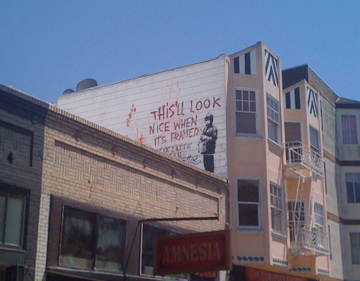
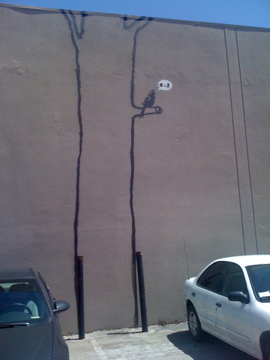
The Bay Area has been freaking out over the past few days about 6 Banksy pieces that have surfaced in San Francisco. We’re a medium-sized city, so it makes us feel special that an artist that big would come out and leave his mark. I, for one, had to take advantage of a sunny spring day and go on a taco-fueled, MUNI-powered mission across the city (cause, you know, why not?) to see as many as I could. But here on the quieter, slower side of the Bay, a couple other street artists/collectives have made visits. They may not be as big as Banksy (who is?), but spotting their work made me feel, I’m not gonna lie, a little warm and cozy about my hometown.

The blogosphere has been abuzz over Banksy lately. With the release of Exit Through the Gift Shop, everyone’s favorite British recluse has been hitting up spots where the film’s debuted. (His recent work in LA caused quite the stir when it was physically removed to be sold in a shady art gallery.) The San Francisco debut of the film went down recently, and we were all waiting, holding our collectively aerosol-stained breath, to see if any Bay Area pieces would surface.

They did. Warholian broke the news, spread the word and even got himself on TV:

I had to wait a few days, for a full day off (new waitressing gig = mucho trabajo) to embark on the mission. Luckily, Warholian posted exact locations on his Flickr stream (along with far better photos than I took). Oh, the digital age…

What was funnest about missioning around to find the pieces wasn’t really the art; it was seeing all the people come out. Folks were really excited to see the work, like a treasure hunt where the reward wasn’t some crappy Easter egg but sick-ass stencils that spawned social commentary—and a nice dose of civic pride. One guy I met was super stoked that a piece ended up abutting his soon-to-open bar (“It’s like free publicity!”). A group of European kids posed for photos by the Native American stencil while a hip dude explained in Spanish to a passer-by what all the fuss was about. On Haight Street, I met an old dude with a serious camera—miles of lenses and clicky gadgets—who told me, “I’ve never been that into this whole street art thing. Always looked like a bunch of scribble to me. But I read about this in the paper and thought, well, that’s pretty cool. So I wanted to come out and document it.”

Doubt this one will be winding up in a gallery

Yeah, my camera sucks. You should really just Google this shit.

Say what you will about Banksy—publicity stunt conspiracy theories and cries of being too mainstream—but that Bristol boy got San Francisco juiced, taking pictures and making missions and actually chatting with each other (usually a more Oakland phenomenon). And at least one cool old dude seeing street art as something other than vandalism.

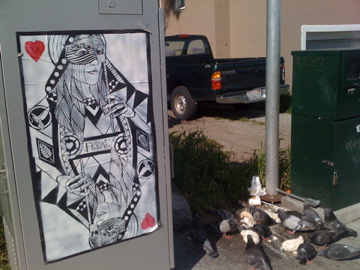
But I’ve been noticing more cool pieces around lately, on my own side of the Bay. One of my favorite street art blogs alerted me to that fact that Feral was in town, and I spotted one of his pieces (now gone) by the MacArthur BART station.

Abandoned furniture and trash-feasting pigeons: that's my town!

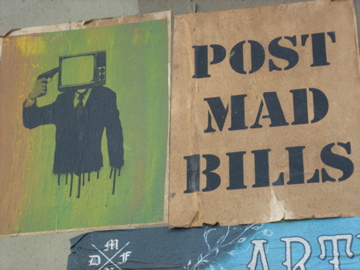
And up on Telegraph, the epicenter of gutter punks and flip-flop-wearing bros, I spotted one of TrustoCorp‘s guerilla street signs. These have been making me giggle for months, and I was stoked to see some stuff locally.

I’m not sure who did this piece, but I liked the placement of it—a busy intersection across from a Whole Foods—and its stark insistence on being noticed.

I’m continuing to think a lot about street art and what exactly it is that draws me to it—what exactly it is that seems so undeniably related to travel. It’s got something to do with place, with the insistence of place, the immediacy and intimacy of interacting with a place on such a visceral, physical level (the subject of one of my first ever blog posts). The words are forming, the drooling gibberish shaping itself into discernible sounds under my wet pink tongue (“mama,” “dada”).

In the meantime, I’m thinking a trip to Italy for Fame Festival might answer some questions and cure some wanderlust. Just in case the Bay doesn’t receive any visitors for awhile…

Bootleg Blues: Thoughts on the Illegal Alcohol Trade Around the World

It was not a subject I expected to get so drawn into. But there I was, hunched over the pale glow of my laptop, clicking links and watching videos and reading random blogs, that damn color pinwheel spinning from the stress of too many open tabs—like going down a virtual rabbit hole into a murky, liquor-soaked world of shadows and motorbikes and sick yellow skin.

Modern-day bootlegging. Prompted by a New York Times piece about alcohol in tribal Pakistan, NileGuide assigned me an article on the illegal trade of alcohol around the world. It was to be a straight-forward round-up, carefully presenting the information without judgment, condemnation or alarmist cries of “this shit is crazy!” But it kind of is crazy, is the thing, and got me thinking a lot about the prohibition/restriction of substances in a society, and about my own experience traveling in Morocco.

As you’d probably guess, all of the places I discovered with a bootlegging industry either outlaw or strictly regulate alcohol sales and consumption. The how and why of it was fascinating. There were religious reasons, of course, in places like Pakistan and United Arab Emirates, but more interesting to me were Sweden, Russia and these remote rural towns in Alaska. All of these places enacted regulations in response to severe alcoholism within the culture. In the Alaskan towns, the temperance calls came from the community rather than the government—largely composed of a Native American population, folks in these towns were sick of the ravages of alcoholism and wanted to just do away with the whole existence of the glimmering, vile elixir. Can you really blame them?

The problem, as any good alcoholic knows, is that people will find a way to drink anyway. (Shit, I never took a legal drink in my life.) Regulations lead to a bootleg industry rife with gangs, violence and product made with piss-poor ingredients that can sicken and kill those who consume it. It’s not too unlike the drug trade in that regard—which got me thinking, on this uber-stoner holiday, about places I’ve been that have suffered immeasurably due to the drug trade: Mexico and Colombia. As always, the suffering seems to break down along class lines: the people who really get fucked are the poor folks in these cultures.

In Morocco, I had the chance to hang with some sober people. What these people—three expats and one Moroccan woman—told me about the actuality of alcohol consumption in the country kind of blew my mind. “Of course people drink,” the retired American sisters told me. “You’re just not supposed to drink, so no one talks about it. People just kind of turn a blind eye.”

As we pulled into the beach resort of Agadir, they sneered slightly. “They’ve been building the town up,” they told me. “It’s becoming something of a playground for Saudi men, where they can drink and have their call girls without anyone knowing.” They later told me about medina bums that drink cologne—not too unlike old-school stories I’ve heard about how folks, during the Depression, would strain shaving cream and drink the liquid to get drunk. (One report of an Alaskan town claimed mouthwash and air fresheners have to kept behind the counter at grocery stores because people use them to make alcohol.) The gaping, aching disparity between how the rich and the poor consume alcohol astounded me.

In the Gujarat state in India, only the wealthy could afford the imported and smuggled bottles of whiskey, while in Russia, only high rollers could fork over what was a three-fold increase in alcohol tax. Poor folks in these places were left to consume shady moonshine, made from medical disinfectants, that led to sicknesses like toxic hepatitis and “yellow death.” Recent outbreaks had killed over 100 people in both places and sickened over 1000. In Gujarat, people rioted during last summer’s outbreak of poisoned alcohol deaths, accusing the police of abetting bootleggers and clamoring for the repeal of Prohibition laws: “Blanket prohibition has never worked in this free world.” The government responded instead with harsher laws: the death penalty for anyone caught bootlegging.

Then, on top of all that, you toss in the lucrative business of bootlegging, complete with gangs, bribed government officials and violent skirmishes, and you gotta ask yourself: how dissimilar is all this from the drug trade?

It’s too simplistic to just advocate for legalization—there are huge cultural and religious forces to negotiate. But it seems, at least in the cases of Alaska and Russia, that putting tight restrictions on alcohol hasn’t done a whole lot the curb alcoholism. It’s a fast, tangible, measurable action, but seems to have caused a hell of a lot more suffering. The slower, more expensive and difficult answer would be to increase social services, preventive education and not-for-profit recovery centers.

At the very least, legalization means regulation, both of the substance and the criminal underbelly that controls its distribution when a government doesn’t. I’ve never drank moonshine, but I don’t even want to think about all the dumb and dangerous shit I did to get alcohol, all the yellow rocks cut with Ritalin and rat poison that I consumed, about the fourteen-year-old kid “in the scene” whose heart exploded when he took a bunch of bad acid. The safety of banned substances, along with crime, led the US the repeal Prohibition, and I can’t help but wonder if a more feasible answer to combatting the drug trade problems in Colombia and Mexico would be at least a partial legalization.

The sober Moroccan woman I met painted a fascinating picture of alcohol in her country. She was upper-class, from an important family, had been to European boarding schools and spoke seven languages. According to her, everyone in her class drank. It was considered cultured and European to drink—though, since alcohol wasn’t an established part of the culture, it didn’t take the form of a nice Cote de Rhone with dinner; people binge drank. People did it, but didn’t talk about it, a sort of deeply steeped denial. You can only imagine how difficult it would be for someone to admit they have a problem with alcohol, in a culture where you’re not even supposed to be drinking. Toss in being a woman on top of that and, well, you’ve gotta be one tough chick.

Let me tell you—she is.

Smog City Street Art

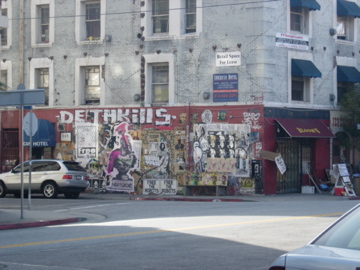
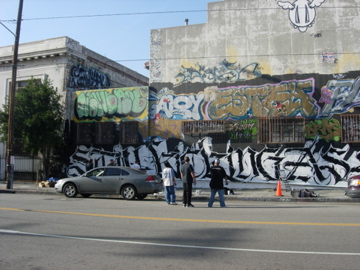
Second and Traction. I wouldn’t have ended up there if three degrees of separation and a vaguely pointing finger hadn’t sent me, the intersection pulsing on my iMap like a gleam off buried treasure. Does every town have a warehouse district—posed delicately between decay and revitalization, a hushed breath that sends the trash dancing ecstatically down deserted streets. Abandoned buildings, chain-link fences, art collectives, lofts, hip cafes on whose terraces a gothic bartender I once knew squinted her eyes against the LA sun (she never did get sober). Dogs and day laborers and cute girls on bicycles—and a shitton on graffiti.

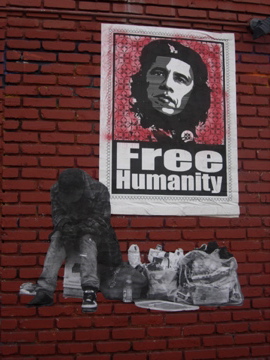
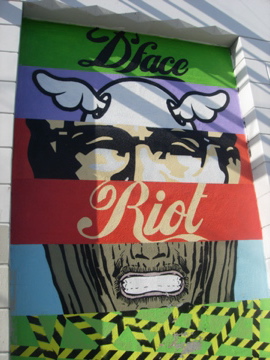
I’m thinking this little tract of Downtown LA is something like the hill (or dug-outs or BART tracts) where the cool kids in high school smoked weed. There were pieces from big names like So-Cal native Shepard Fairey and the UK’s D*Face (who recently made a stir with his Zombie Oscars installations), as well as wheatpastes and stencils and tags galore. I came across a friendly crew of dudes painting a legit mural on the side of an abandoned building that read “Still Kicking Ass.”

Damn straight.

Shepard Fairey

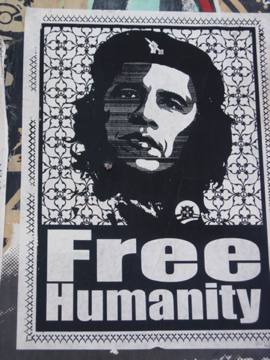
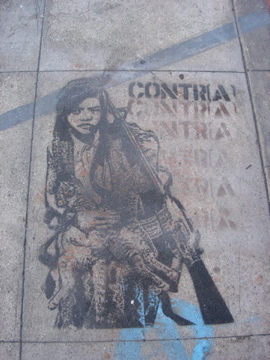
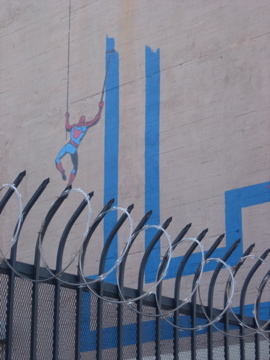
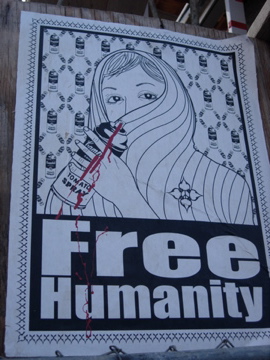
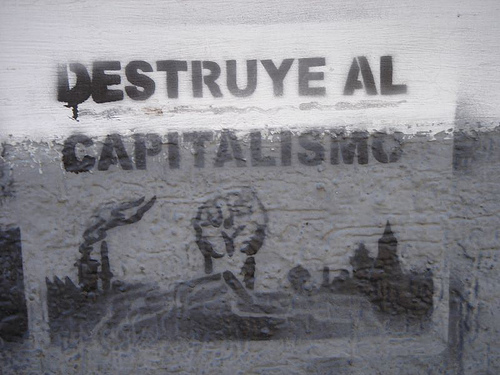
A lot of the work was heavily politicized—making poignant to satirical comments on the imperialism, immigration, consumerism, commodification and other fun subjects not typically conjured in my LA stereotypes. Just more proof that there’s more going on than teeth whitening and Botox injections.

Interesting comment on the commodification of political figures--especially considering the man responsible for the oh-so-famous Obama image had a piece up a block away.

Mad skills

Reminiscent of Banksy mice, no?

D*Face: Siiiick

Word.

Dudes painting mural

"Can I get a picture of your bird tattoos?" "Sure." "Aw, dude, show her your Booger tattoo."

At work

More pieces on the same building

One of Nomade's Roman fellows

Down on 9th and Mateo, another abandoned building was getting seriously hit up by some bad-ass murals, part of the LA Freewalls Project. Local boy Saber had just completed an impressive piece, as had D*Face.

Saber's mural

Detail: buffed graffiti

And, why not, a couple more gems from elsewhere in the city…

Sherpard Fairey & Saber alley, Silverlake (thanks for the correction, Daniel)

Note the can: Campbell's Soup. How Meta.

If all taggers and graffiti artists looked like this, they'd have a much easier time.

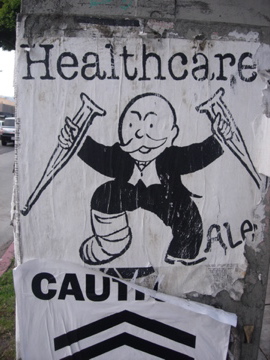
Health care reform passed while I was in LA. Was delighted to see the Monopoly fellow around.

So what does it all tell you, these smears of paint and peeling papers, about Los Angeles? If street art and place really do have as much of a connection as I suspect they do, LA’s told me this: that even within the belly of mass culture and consumerism, pangs of outsider aches burn acidic. And they don’t sit quietly, politely, hands folded and waiting their turn. They’re illicit, guerilla and goddamn beautiful.

Estudy of Estyle: Chilean Street Art and Figuring Out What the Hell It Is I Have to Say

There’s something I’ve been thinking a lot about, but struggling to find the words to explain: the connection between travel and street art. I’ve had fumbling conversations in which I attempt to articulate it, flapping my lips like hands gasping at butterflies, trying to gather vague supports for an unformed thesis. An idea has been forming in me, very far inside my brain, amid the murmuring currents of subconsciousness—like a toddler without the vocabulary to express herself, feeling emotions she doesn’t understand, but only knows are true.

And then a friend posts a video on Facebook that starts to explain everything I’ve been thinking and struggling to say. Thank God.

Chile Estyle has released the first documentary in what I’m hoping will be an ongoing exploration of the evolution of the burgeoning and blossoming Chilean spin on the global phenomenon of street art. And in its coverage of the specifically Chilean take on the art form, Chile Estyle touches on what I’d felt street art is doing all over the world: revealing (like a striptease) just a little more of the soul of a place.

I’ve been hearing a lot about Chilean street art, most recently in a photo essay by Oakland artist Obi Kaufmann (discussed in connection to his recent mural here). We stood around The Oakbook’s small gallery space, and I listened to Obi talk about the distinctions of Chilean street art: materials lending a unique aesthetic (due to the relative absence of aerosol spray paint in the country), and the culture of muralism leading to the acceptance, even support, of the community (you’re more likely to see street art on the sides of businesses and schools than abandoned warehouses). I can’t say I saw a lot of street art when I was in Santiago, nearly five years ago. Something has changed.

Judging from the picture presented by Chile Estyle, the explosion of street art in Chile has a lot to do with the country regaining confidence and reestablishing its identity. Artists in the video talk about seeing work from New York, Europe, Brazil, and taking pride in the fact that Chile can contribute works just as valuable and important. But, of course, it comes with their own distinct style, a product of their own history and culture.

This one's for you, Mom

The video discusses “Chilean graffiti identity,” informed by the country’s tradition of political muralism. Uber populist and at its core revolutionary, graffiti and street art are seen as an extension of the self-expression that acted in rebuttal to (right-wing) major media outlets—“walls are taken much like a newspaper.” The tradition has lent a culture and community far more tolerant of street art than in most places of the world; it’s seen as “a gift for the people,” rather than vandalism. And, as Chilean street art has begun to garner international attention (like in a recent exhibition at LA’s Carmichael Gallery), it’s become a source of national pride.

How different this is from the culture of street art around the world. And more than just isolated vestiges of self-expression, one can take Chilean street art as a product of the country’s past and perhaps one of best reflections of its contemporary culture.

This is what I’ve been suspecting street art could do. In moments of blinding conviction, I’ve felt that street art, in its democratic and uncommercialized glory, can capture placeness just as well as food or architecture or music or any number of things people look to when they travel. In a continual cross-pollination of artists and influences, cities wear a bit more of their souls on their walls, as though the murals and stencils and wheatpastes were images from its dreams. It’s the way a city like Tel Aviv becomes a mecca for political street art, the way the aesthetic now known as Mission School bloomed in the alleyways of the 90’s SF Mission, whispering its stories in neon—and the way the tradition of political muralism paved the way and painted the walls for a purely Chilean approach to the art form.

And I still don’t have the words for it, the right or complete words to explain it all—because of course, virtually the same things could be said about all art forms, in how they inform and are informed by place. But something in me sparks when it comes to graffiti, in the same place of my brain that travel ignites. I guess the only thing to do is keep digging, poking, on the internet and down alleyways, until I stumble upon the thing it is I’m trying to say—painted on the walls in plain sight.

Take Me Back to Bunker Hill: Finding What I Came For in Downtown LA

“Well,” my Dad asked, “did you find what you were looking for?”

I sat travel-dazed and dirty-socked at the dining room table. I’d fought the coming home blues all 372 miles up the 101, driven straight to my parents’ house to eat dinner, tell stories and delay actually arriving home a couple more hours. My car rested in the driveway like a tired horse, bag-laden and dirt-covered. I couldn’t remember having ever wanted to come home less.

Of course, my dad meant Los Angeles, its gritty and unglossy underside—had I found it? I’d made quite the to-do over my mission to dig in, delve beneath and uncover buried, bloody gems of LA’s uncommercializable heart—the skeletons in its closets, its alleyways, the voices that came through tattered paperbacks and the shrieking distortion of old punk LPs. Had I gotten there, found there, held a bit of there in my hands like it could be mine?

Downtown mural

I stayed mostly in Downtown, LA’s most un-LA area. Modestly tall buildings jangled with the light dancing off of cheap jewelry stores; young girls beckoned you to enter their stores, calling out the names of goods in Spanish; a legless beggar with perfectly combed hair occupied the pavement outside Clifton’s Cafeteria; Santeria markets abutted Art Deco theater marquees, sitting above boarded-up entrances and watching the street like purgatoried angels. Hipsters took morning strolls with their well-groomed dogs, past shopping carts and transient twitching, the encampments of misery that compose Skid Row. There were no Valley Girls, OC bros or Pilates-perfect MILFs. There was even a cafe that served Ritual coffee.

It’s called “Historic” Downtown, complete with markers and murals, and I crossed several groups of confused tourists, consulting street maps and looking up bewildered at the carcasses of LA history as if it say, “Huh?” You learn to take the term “history” with a grain of salt in California, but it went beyond that—this was barely even a Downtown. There were no bustling businessmen, no Banana Republics, no dudes hawking maps of celebrities’ homes on the street corner, no tourist facilities, not really any non-neighborhood locals. Working-class, non-white, unglamorous—this was Downtown LA.

I hiked over to Bunker Hill, a doomed and fruitless mission, I knew. It was once a down-and-out neighborhood that held, in the shadows of its slanted incline, flophouses and brothels, dive bars and cheap hotels, derelicts and drunkards and two of the best damn writers to come out of that cursed city. John Fante curled up in the liquor-soaked sweetness of the slum, while Charles Bukowski broke furniture and chased alcoholic insanity in its tenements. A 1950s revitalization project razed the ramshackle Victorians, paved over the shattered remains of lives and dreams and addictions, suffocating the howling ghosts neatly beneath office parks, wide streets and sterilized, sparkling sidewalks.

There was nothing to discover. I tromped up a San-Francisco-steep hill, glanced at the historical markers, cruised past the newspaper village of bare feet and cigarette butts outside the Central Library. I stood on a corner that will next week be renamed John Fante Square, and not a damn thing remained. Not a shadow, not an echo, not a ghost of a passing fit of madness. There was, to use a tired and perfect quote, no there there.

But of course, there never really had been. None of it was true, not all the way true, at least. Us writers and alcoholics are tragically skilled at romanticizing even the most sordid, harrowing of places and experiences—and in all likelihood, the actual Bunker Hill bore more resemblance to the modern-day Downtown than it did the gloriously gritty harem of passion portrayed in the novels I’ve loved. It was, most likely, a sweet little lie those boys told themselves, in their more tender of moments, when they ached for something to hold them, rock them, hum the lullaby of a childhood none of us really had. I know I’ve been guilty of rose-painting, perfuming the past, my own life, and it takes a photograph, something tangible, to jar me out of it, to remind myself how much it hurt, it bled, it puked and moaned; I saw people die, burn out, “I saw the best minds of my generation destroyed by madness.”

So in that way, what I sought was all a mirage anyway. The narrow alleys and sagging Victorians of Bunker Hill may have been gone, but had the illusory soul of the place ever been more than that, a fevered dream? There was a current-day incarnation, just down the hill—laced with more sinister, soul-eating of drugs, for sure, with the rattle of shopping carts and broken lives—but it was probably a more accurate representation of Bunker Hill than those exalted odes to insanity, like the moment of pure genius and bliss before the trip goes back and the come-down shatters in.

But maybe it was all a mirage, Los Angeles—an oasis that keeps glimmering just a little further out in the sand. Katie told me about a girl she’d met in a penthouse one day (“typical LA story—went out for a coffee, met the Del Taco guy, went up to his apartment with his friends…”): perfectly thin and gorgeous, a 22-year-old model who’d run away from her Midwest home at 15, found herself stranded in California when the boyfriend ditched out, came to LA, rose in the ranks and behind the flashing of cameras, sat now on a leather sofa doing rails of cocaine off a glass coffee table. “She was the total LA person—came from somewhere else, chasing this glamourous illusion, the LA dream. She knew it was a dream, she was totally aware of it, but still too addicted to the dream to disconnect.”

Here’s what I learned: LA is a place for seekers. It seems it always has been, at least for the last 100 years or so. The City of Angeles, of a fleeting fulfillment you can almost, but never quite, grasp. There’s an LA dream, that’s not too unlike the American dream, that this too can be yours, that you too can find it, have it, hold it. It’s a flickering projection of images, like on the backs of eyelids or clean white screens, that’s so close to being real you could almost weep, almost believe it.

So did I find what I was looking for? Yes and no. It may have all been a dream to begin with, like the utopias of the almost-cults I visited. It had been bulldozed and redesigned with crisp corners and clean towers; it was living on in the ragged throats and stained clothes of Skid Row. It was a memory so old you don’t know whether it was a dream or not; it was a love song for the one you never really, but almost, had.

Candy, Travel and Love in Los Angeles

On a smog-sighing spring afternoon in Los Angeles, I met my soul mate. Possibly two soul mates.

Tuesday was a charmed day, my last full one before I hit the highway and headed back up the green spine of California. I ultimately failed in my scurrying attempt to cram in everything I hadn’t gotten to in the previous days—but I did encounter, sheerly by happenstance, two kindred spirits, cosmically bound in a coruscating tango set to the tune of my greatest loves: the unexpected beauty of travel, and sugar.

I got to Glaco’s Soda Pop Stop the round-about way. I learned about the Highland Park neighborhood (where Glaco’s has operated since 1897) through Trekking Los Angeles, a non-profit that aims to leverage cultural tourism to bring financial benefit to underserved communities. A pretty bad-ass ambition, and especially interesting given the recent spark in the ongoing debate about the cultural benefits/damages of tourism at World Hum and Matador. But how would it play out practically? I tried out one of their neighborhood guides.

The Highland Park guide focused mostly on art galleries and community spaces, which though interesting yielded a pretty incomplete neighborhood guide. I cruised past several of the galleries, finding only one open, and discovered the crowning Southwest Museum to be closed indefinitely due to earthquake damage.
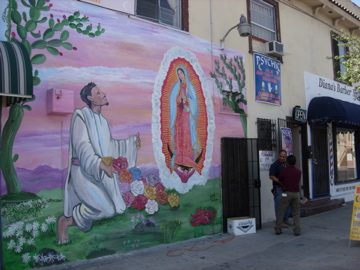
What I ended up finding coolest was just wandering the streets. Far from trendy and slick, Highland Park is a diverse, working class community (not too different from Oakland) filled with raspado carts, 99 cent stores, auto shops, old women walking under the shade of umbrellas, panderias displaying Nescafe, Santeria markets, Food4Less, fast food chains, the lonely hiss of traffic. And art. Graffiti bloomed electric in the alleys, while murals covered the sides of buildings, highlighting local history, cheerfully advertising for businesses or bilingually encouraging you to recycle your motor oil. If it hadn’t been for Trekking Los Angeles, I’d never have ended up in Highland Park.

But Yelp led to me to the real gem of the neighborhood. Judging by the magazine articles taped to the front door, Glaco’s is far from undiscovered. Which is a good thing. Because under the fluorescence and atop the linoleum lies one of the most killer collection of sweets I’ve ever seen. I’d come to the holy land of sugar fiends. Cane sugar fiends.

I walked starry-eyed through the aisles, along displays of glass bottles and vintage candy. As I stocked up on candy cigarettes, Bubble Up and chocolate taffy, I perused some of the ingredients list. High fructose corn syrup was nowhere to be found. At the check-out line, I asked the grayed, smock-wearing clerk if the sweets sold were all in fact original recipes, free of all the chemicals and crap found in American candy today.

His eyes shone, a web of smile wrinkles appearing. “Our products only contain cane sugar.” My heart fluttered. My wallet opened.

Turns out the clerk was John, the owner of Glaco’s and the man responsible for turning it from an old-school deli to a cornucopia of candy. Being a fairly mellow Tuesday afternoon, John commenced to guide me around the store, explaining his philosophy and pointing out beloved brands.

John was all about the taste. He wasn’t a new-agey health nut (obviously)—to him, products made from natural ingredients like cane sugar just taste better. “The big companies are all about cutting costs,” he told me. “They don’t care about taste.” He told me how he remembered, as a kid, when 7Up switched from using lemon and lime oils to extracts. “It was terrible,” he lamented, with the touch of nostalgic heartbreak reserved for unhealed childhood wounds. “Now this,” he picked up a bottle with care, “is the good stuff. Original Dr. Pepper formula, with Imperial cane sugar.”

John and I proceeded to bro down about ingredients for about 20 minutes. Coming from the Bay Area dining scene, it’s all about quality, natural ingredients, even at the bar—squeeze your own fresh juices, make your own simple syrup, even your own small-batch Vermouth, increasingly. It’s a trend based on taste. But for John, it’s no trend. The vintage candy and soda thing isn’t a gimmick, isn’t hip. It’s just the way sweets were always meant to be. A square-shaped old man with smiling eyes and a die-hard passion for sugar, I almost asked if he had any single grandsons.

Thirty dollars and one mean sugar buzz later, I headed clean across town to Culver City, the undercover hotbed of hipness. Some of LA’s most prominent contemporary urban art galleries are housed in the unassuming tract of wide streets and windy sidewalks, including one often featured on one of my favorite street art blogs, unurth. I checked out the whimsical exhibition by Brazilian street artist Nina Pandolfo at Carmichael Gallery, and chatted up the friendly dude gallery sitting. He told me not to miss the current exhibition two doors down, at Roberts & Tilton. And oh man, am I glad I listened.

The white walls of the gallery’s main room were lined with a single ring of photographs, hung right at eye-level. The black-and-white images were haunting, gritty, unflinching, and ultimately beautiful. They were the work of Ed Templeton.

Ed Templeton is a kind of a Renaissance Man of contemporary cool—a pro skateboarder, photographer, artist, editor of a magazine, and, after reading the press release for his current show The Seconds Pass, a damn good writer, I’ve decided:

There is a scribble of asphalt and meandering ribbons of concrete tangled all over North America in a contiguous line of material that connects each of us to whomever else is also in contact. I sometimes marvel at this, walking from my front door and standing on the asphalt looking down at its grimy blackness, wishing I could rest my ear down on it and hear everything like the Indians in an old western film. The pavement I’m standing on is connected to other pavement, concrete, or steel to almost anywhere I can think of. Certainly everywhere you can drive to. Someone in Burnt Church, Tennessee is standing on gravel that is connected by touch to my street, just like someone is in Halifax, Nova Scotia. I can be in New York City in 3 days from my home in the suburban sprawl of Orange County, California without ever touching the earth.

All the photographs in the exhibition were taken from cars. On the road, in transit, the photos captured those fleeting moments, those “ephemeral winks” that slide past the glass like a poem of images, a slideshow of humanity and place. Walking, biking, waiting for the bus, staring out through the windshield—they were snapshots of those little moments, seemingly small and sometimes lonely, that are somehow connected, or connect us.

I’d been roadtripping for 9 days, riding the veins of America, the journey of it as much a destination as the places themselves. Dusty towns, gasping palm trees, billboards and cacti, strip malls and faces, faces—it was like a projection of something, a movie flickering on my windshield, disappearing in the side-view mirrors. And a thread of something laid underneath it all, tying it all together, like some obscure plot line I couldn’t quite grasp, but that kept nudging, whispering at me in its language of images, the roar of the wind. It was the road, the black asphalt itself—and god-damn, if I could take a decent picture, it’d look something like the ones lining the walls of that gallery.

It might have just been the cane sugar coursing through the blood, but things were beginning to make sense.

Lauren Quinn is a writer and traveler currently living in Hanoi. Lonely Girl Travels was a blog of her sola travels and expat living from 2009 to 2012. She resides elsewhere on the internet now.

Join 490 other subscribers

Buy This Sh#t

Categories