Archive for the 'USA' Category


Dancing in the Fog: Weekend Wedding Part II

Everything grey. Not the soft, floaty kind of grey, but heavy, brooding, impenetrable—like being underwater, like walking through a dream: the landscape all sand and crippled trees, windswept by something that came before you, something you can’t see, some kind of endless passing of which the fog is only a part, only a symptom of a larger sadness—the solitary transience of the Northern California coast.

Destination weddings are fun, because the party doesn’t stop, isn’t confined to six hours in impractical shoes and unforgiving fabrics. And you get to feel like you’ve gotten away, vacationed, traveled. So it’s a two-for. Guests complain about them because they’re more expensive, discreetly accusing hosts of choosing distant locales to limit the guest count. Which could all be well and true, but my first experience at a destination wedding pretty much ruled.

To qualify, it wasn’t much of a destination—a two-hour drive down the Monterey Peninsula to Asilomar, what could have easily been a day trip. But something about it gave me just a taste of travel, a hint, like passing someone smoking a cigarette on the street—not the real thing, but enough of a whiff to remind you of the real thing, evoke some sort of not-so-secret longing you try to muscle through, distract yourself from, most days. Something about the weekend was twinged with longing (for what?), some kind of sickly bittersweet lonely. Maybe it was the fog.

Asilomar is a state beach and rustic conference grounds billed as a “refuge by the sea.” It’s got some history, some charm, some Arts & Crafts style flair. But the conference grounds/hotel was unfortunately bought out by some large hospitality chain in recent months, and the service has gone from homey mom-and-pop to corporate nickel-and-dime-and-don’t-give-a-fuck-about-quality. Whatever. The scenery is still beautiful and the wedding was still awesome.

The weekend started with a Friday afternoon BBQ and wiffle ball tournament that got froze out by the cold. We retreated to the bridesmaid cottage (which was more like a suburban home than a cottage, beige carpeting and all) for epic hanging-outage.

The cool thing about the whole weekend-long aspect of the wedding was that it really gave you a chance to meet people. Not just superficially, but, you know, to bro down. I suppose the destination wedding thing could be hell if you were trapped in some resort with someone’s insane family, but my friends Katie and Steven have pretty awesome friends. They’re scattered around the Bay, LA and NYC; the disparate groups had never really had a chance to meld, so the wedding served as the ultimate meeting (the whole reasoning behind having it be a destination affair). I’ve got a particular affinity for rad, smart, independent girls, and got to meet quite a few of them.
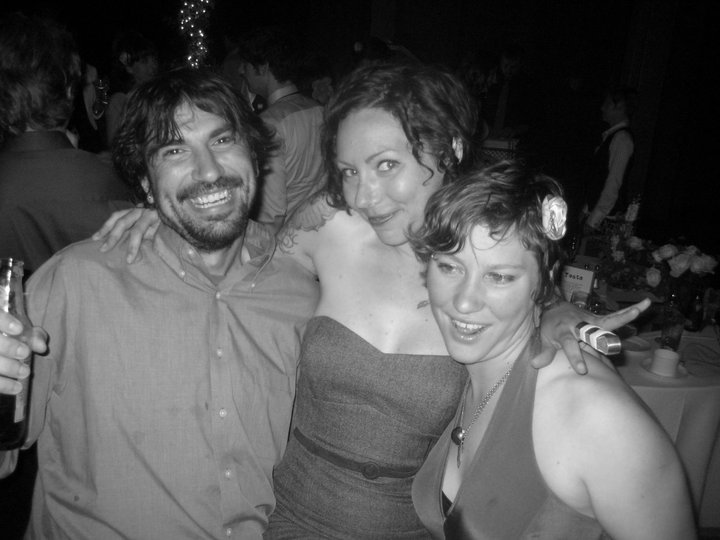
I also got to hang out with some super good old friends, the kind of people that have seen you grow, that you’ve seen grow—who you’ve walked through all sorts of brutal life shit with. The beautiful part is that we’ve managed to come out on the other side, all limbs in tact. (I’ve also got an affinity for survivors.) There’s not so many of us, you know, when it comes right down to it. And getting to hang out with a couple dope old friends that you’ve been through some shit with definitely serves to renew faith, lend some perspective, validate some small feeling inside you that everything might just be okay—almost like a small kind of prayer.

And then there was the dance party.

I like to get down; who doesn’t? But there was something different about this dance party. It wasn’t just the killer music (soul, 80s, old rock ‘n roll), and it wasn’t just the super cool folks. It was fueled by something within, some drive to… escape? That’s not exactly right, but close—a drive to push through a kind of pain, not just an immediate circumstantial sadness (checking the phone for text messages), but the deeper, desperate lonely beneath that (gone, gone, and left me here).
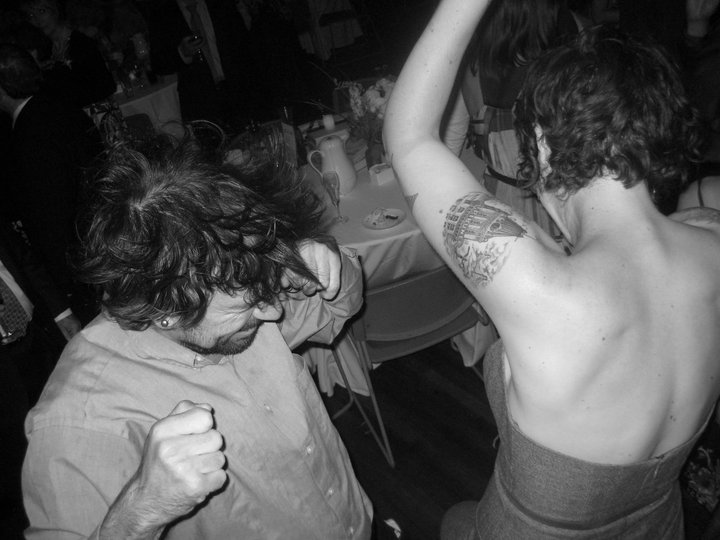
Whatever it was, I let loose like I rarely do, like I was trying to dance my way out of something. I thought of the kids that used to hang out the swimming pool I worked at as a teenager. It was North Oakland, an inner-city environment to say the least, filled with a bunch of little hood rats with nothing better to do than hang around the pool all day. Forget what they say about kids having no worries—a lot of these kids had pretty gnarly home lives. But I used to watch the way they’d play and find some sort of solace in it—the particularly child-like ability to shed all that shit and just play, find some small moment of release amidst the dysfunction and poverty and pain. Almost like a small kind of prayer.

Let’s just say at the end of the night, it was me, a dude who looked like Owen Wilson in Zoolander and danced like a gay stripper, and a ten year old girl who could break dance. Magical.

The next morning was all eggs and syrup and sleeping in. There’d been an after-party, then an after-after-party, and everyone was spent. We staggered around in the dream-like fog, hair half-curled and wearing sweatpants. People bundled up on the beach and ate the remainders of potato salad and cupcakes, wrapped in blankets and sleepiness and the grey, grey sky of California.
Garlic, Goodness and Fog: Weekend Wedding, Part I

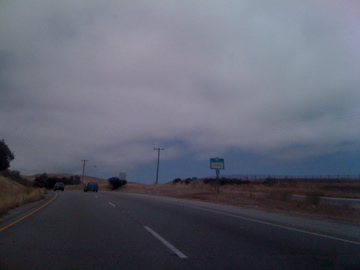
Like a line, pencil-drawn, like someone had sliced the sky in half: where the blue stopped and the fog began. We drove beneath the division, up the curve of coastal mountains, and into the gray like a tunnel. The windows dimmed and the road darkened.

We’d entered our weekend: a summer wedding on the California coast.

Ain’t no sunshine. Hardly ever. The final wedding of my summer of love (other people’s love, that is—5 wedding invitations!) was a destination wedding at Asilomar, a state beach conference/retreat center near Monterey. Which meant that no matter what the rest of the state was cooking in, we were wrapped in an impenetrable blanket of fog all weekend.

The 101 had been hot, pink forearms and moaning wind. Gabe and I hadn’t had the chance to really catch up in a couple years, and there was a lot to talk about: dating and work, sickness and family, the little turns our lives had taken, as though our roads were getting clearer, more defined: yellower lines and harder asphalt. He played me his new band’s demo (“crust/doom metal from the woods of Northern California”) and we fell into that comfortable quiet of old friends.

Then I felt it stir in me.

Which was funny, because I was only driving 2 hours away for a wedding. But it was there, undeniably: the sleeping beast in me, rolling over in its nocturnal slumber—the traveler.

I don’t really know when it will strike in me—or rather, when something will strike it in me. My whole last trip, that sense of adventure and curiosity and freedom that I live for was never ignited. I never got to that mindset. But something about that highway, something about the light and the wind and the road arching up over the brown, brown hills, stirred up the traveler in me.

It’s like a meditation, traveling. I stop worrying, I stop planning, I stop thinking. I forget myself and I just experience. I get a place where I’m okay, deeply and wholly okay, and I can just sit and listen to the world humming, feel it reverberate in my own chest, like a bass line or a very small bird. I can’t do it, can’t get there, sitting crosslegged in my bedroom—the only way I’ve ever gotten to that place is traveling.

And something about that drive, something about sitting there with a dear old friend and thinking about the way our lives have taken shape, got me to that place, there—just for a moment, just for a breath. Which is all it ever really is, all you can ever hope for.

And then it smelled like garlic.

And I mean garlic. Weren’t no vampires in these parts. We were driving through Gilroy, an agricultural town filled with cherry stands and artichoke carts and tons of kitschy garlic-themed restaurants and shoppes. Every year they have a massive garlic festival; I’ve been hearing about it my whole life, and had never gone.

Gabe and I turned to each other and nodded. “On the way back?”

“Shit yeah.”

And then we entered the brooding gray of our weekend.

If You Can’t Beat Em, Wear a Plastic Lei and Film Em

A long gleaming corridor. Palm trees and piped-in music. Our shoes squeaked along too-shiny floors as we walked deeper, further down, following the faint beating of drums and the smell of roasting pig, down into the belly of the beast: the Hilton Waikoloa Village, Kona.

Nevermind how I ended up there. Nevermind the maze of hallways, the gift shops, the cocktail lounges and swimming pool complexes, the shuttle ferry that glided down the artificial waterway, disrupting the shadows of high-rises, floors and floors of cookie-cutter hotel rooms, windows all right angles and white curtains. Nevermind that I’d paid $90 to wind up at the kind of place an independent traveler has nightmares about: a psuedo-cultural event at a corporate hotel. Nevermind that I felt like a vegan at MacDonald’s.

I was there and, goddamnit, I was going to have a good time.

Going to a Hilton luau to experience Hawaiian culture is like going on It’s A Small World to learn about global diversity. Which actually isn’t that far off of a comparison, seeing as though the great minds at Disneyland were employed in the developing of the Hilton, Kona (which explains why we kept remarking how much like Disneyland it felt). Commodified, codified, packaged up and watered down as much as the “2 Drinks Included!”, the Hilton luau was about as authentic as, say, Polynesian tattoos applied by a sun-burnt white dude with a sharpie.

I’m all for cultural experiences. And truth be told, the package tourism experience is real and true in its own right—something in the center of modern-day Hawaii, its economy, its culture, its day-to-day reality. So, in a way, you can’t get much more authentic than the genuine inauthenticity of package tourism in Hawaii. When you look at it honestly, it’s not any prettier than the corrugated-tin shantytowns that surround big cities like Lima or Rio—but still a huge part of life, real life, that deserves to be looked at.

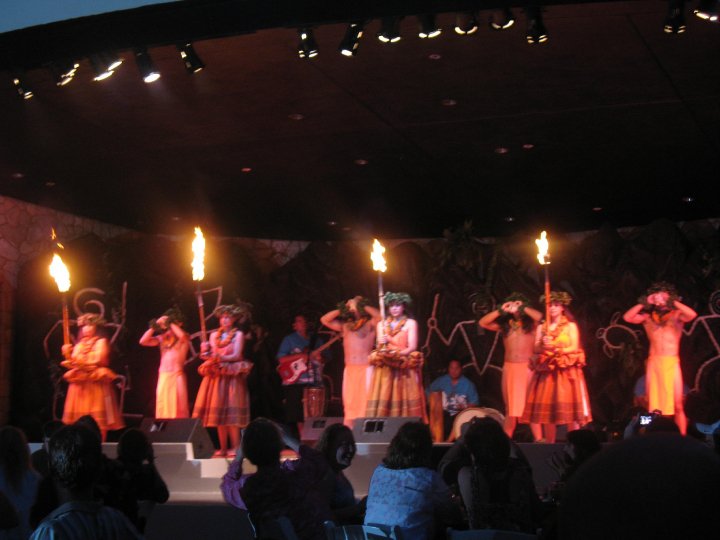
So, in the name of cultural anthropology (and of fuck-it-I-spent-the-money-so-I-may-as-well-enjoy-myself), I infiltrated the Other Side: threw on a plastic lei, ate 5 plates of mediocre buffet food, drank my sugared-to-shit blended virgin cocktails, watched the fire throwers and hula dancers and even danced along. Think Hunter S Thompson and the Hell’s Angels, only a lot less cool.

I did not pay the $30 to keep a copy of this photo. I went broke-style and took a picture of the picture with my phone.

During the opening participatory hula dance, all I could think of was that scene in Dirty Dancing:

Through the course of the show, there was much hulaing, conga shell blowing, relating of digestible chunks of Pacific Island history, and audience participation. As the night wore on, and the Lava Flows kept coming, some folks got a little more into the Hawaiian spirit.

A curious element of the whole affair to me was the Young Hunky Native Boy aspect. Young guys—some appearing to be Hawaiian, others just really tanned white guys—trotted around in loin cloths, flexing and shaking and posing like Chip and Dale dances to a chorus of female cheers. The best was the fire dancer, a methed-out-looking white dude with a sleeve of tribal tattoos who punctuated the band’s high notes with his own ear-piercing hillbilly yoodle, in what could only be assumed to be a white trash mating call, hidden under a psuedo-ethnic guise (we were hip to him).

It made me uncomfortable, the way some of the women in the audience were responding, as if on cue, to the unabashed display of sexualized exoticism. If it had been the other way around, if the cheers had been directed at the female hula dancers, it would have been disgusting, deplorable. I wondered what made it different, more acceptable, when it came from women. It seemed to me to come from the same place, the same heart-breakingly exploitative place: “a young dark thing for my personal pleasure.”

They say tourism is the imperialism of the 21st century. They say Hawaii has prostituted herself to the whims of the West, that she’s syphilis-stricken and soul-sickened under that thick hair and pretty skin. I’m not really here to talk about all that. I just know that us Americans gasp at the idea of Chinese ethnic minority theme parks—but, um, Hawaii doesn’t seem too far off. And certainly not a luau at the Hilton.

We had a nice waitress. As we were gathering our things, she came to wish us a good night. It had come out, sometime during the course of the night, down on the other end of the table, where we were staying. The waitress grabbed my sister-in-law’s hand, “Oh, enjoy P.” Then, a little quieter, “You know, it’s really a great thing, what G did.”

Against the backdrop of the Hilton, against the gleaming stage lights and up-lit palm trees, the crackle of the sound system and the bustle of bus boys, she was right.

Voices in the Dark: Coral Graffiti Along Hawaii’s Highway 19

Hot air. A plumb-cloud sky and a mile of black. This is not paradise; this is death. This is the rocky remains of an ancient burning, shot out from far below the surface. This is a graveyard of fire.

Sometimes the earth can be scarred like skin. This is what I thought as we drove up Highway 19, up from the Kona airport, along a coastline charred with volcanic black rock. Burnt earth and a whispering silence.

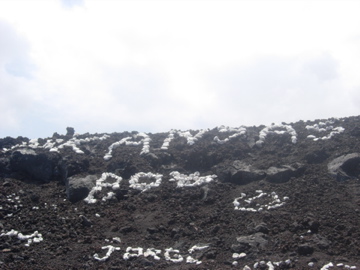
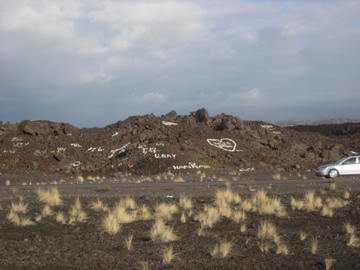
So it was startling to see, scrawled into the black, white words, like voices in the dark. They call it coral graffiti, Hawaiian for street art. It’s not really, but it’s the closest thing I saw. Hawaii isn’t very urban, and I definitely didn’t go into the urban parts—but coral graffiti was the local take on tagging.

It appears to work like this: you pull over on the side of the highway, hissing wind and heat. You arrange white coral gathered at the beach; you write messages, declarations of love and tributes to the deceased, sometimes a little hometown pride. It blazes against the black, long after you’ve whizzed away—becomes, not a relic of you, but its own entity, its own little prayer, living on in the stretch of rock and wind.

I didn’t write any. But I did pull over to snap some photos. Enjoy.

A Circle of Stones

“I believe that the land has memory—that the earth remembers the things it has seen.”

Lucille Clifton said that at a reading I went to as a teenager, in introduction to her poem “Auction Street,” about how it felt to stand at former slave auctioning blocks in Memphis. I hadn’t traveled yet, hadn’t experienced much outside of the Bay Area, but something in me knew she was right: that rocks and trees and dirt have memories, maybe even dreams—that they hold little pieces of their histories in them, stored emotions, tender and swollen as our own knotted muscles.

I kept thinking about that line, said in passing in some beaming wooden room years ago, on my last trip. Walking amid the wordless rocky ruins of an abandoned village with a heat in my chest and a trouble in my mind, nothing seemed truer. Because, after all, Hawaii is a tragic place.

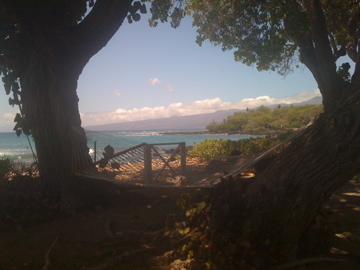
I stayed along the Kona Coast, a barren, burned-out mound of volcanic rock where the resorts stand out like green sores: lush, overly landscaped swaths of palm and grass against the expansive silence of lunar black.

P. was supposed to be one of them. Not a resort, but a tract of vacation homes: 7 acres divided into 10 lots, like much else along the winding 3-mile road that led from the highway to the coast. The land had belonged to a Hawaiian family who, amid the 80s mad-dash of development, could no longer afford the property tax and was forced to sell the land to a shady enterprise. A wealthy philanthropist came into contact with the family, bought P. from the enterprise, and built a personal vacation home there. My brother married the daughter of a the philanthropist’s good friend—which is how I came to find myself vacationing in a private, ocean-side villa earlier this month.

Sure, there was a gym and a media room and a billiards room and WiFi and groundskeepers and a gated entrance. But it wasn’t like a private resort. Not really. Because something had been retained, kept, preserved—not bulldozed and landscaped over (just landscaped around). The place quivered with a peculiar spiritual energy that made me hippie-out on heavy vibage. (And feel like I was on Vicodin.)

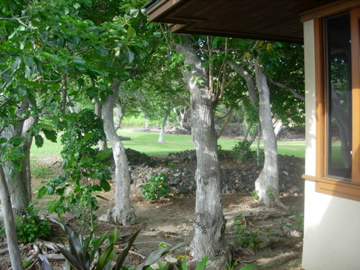
P. had once been a small Hawaiian village, abandoned for unknown reasons around the time Westerns arrived. Through a kind of cheat-the-locals-out-of-their-land swindle, a family came into possession of the land in the 1930s when they swapped their more lucrative property on a lusher side of the island for the rocky tangle of coast. As they bush-whacked into the overgrowth, the family discovered the rock-mound remains of the old buildings, as well as a burial site for what was later determined by archeologists to be a chief. The family was old-school, and believed in respecting the ruins; they didn’t move a stone, but left it in homage to their ancestors.

When the philanthropist came into possession of P., he respected the original family’s wishes and built his home around the ruins. He hired the son of the family, T., to be the property manager, an effort to maintain the sacred integrity of the place and undo some of the bad mojo that had cheated the family from their land.

That was as much of the story I knew as I walked the property the first day. Barefoot, the thick grass felt like carpet, and the air was soft and heavy and feeling of paradise. The path of grass snaked between the ruins, dotted by dense tangles of native trees. Neon birds flitted past, and the weasels darted like small, hungry ghosts.

I approached a perfectly circular mound to the immediate right of the house. Shaded by trees and covered in the round shells of their nuts, it seemed like a particularly potent spot.

As I got closer, I felt a warmth in my chest, rising into the base of my throat—not entirely unlike how I remember that first sip of alcohol: the healing heat, how something from the outside got inside, and suddenly made me feel more whole, less empty and aching. It was a curious, jarring feeling, at once intensely comforting and, well, disturbing in its unapologetic power.

I steered clear of the spot for the next few days. Frankly, I was freaked out. There was plenty else to do: I floated around the pool in an inner tube, did yoga on the deck, lounged in a hammock and read my self-help book on love addicition and co-dependancy. I’d glance sideways at the mound, avoid it, like it were a person watching me with too-blue eyes: it had seen through me and sat waiting.

T. came over to attend to some maintenance issues one day, and we got to talking. He filled in more of the history of P.—how he’d spent his summers there as a kid, how his grandmother had always told him about the spiritual power of the place and how he’d always felt it, even during his wild party days. He talked about respecting the land, saying thanks and being in tune. He told a story about an owl that lived on the property, that may or may not have been the spirit of his deceased grandmother, that had once come out in the middle of the day to watch him repair some of the stones the archeologists had moved.

If it were a movie, T. would have been wearing a lion cloth and the lights would have dimmed when he spoke, the sound of far-off drumming accompanying his tales. As it was, he wore flip-flops and a t-shirt, wrap-around sunglasses and an American moustache.

“P. has always been a healing place,” he told me simply. “I’m just glad that G. bought it, and it was able to stay the place it had always been.” He looked around the stately furniture in the vaulted-ceilinged living room, the hint of a wistful smile in the lines around his eyes. It was a far cry from the rustic shacks of his childhood, but I knew what he meant: it turned out as best it could, for the situation.

“That mound over by the house,” I pointed. “What was that?”

“Heavy, huh?” T. smiled. “We don’t really know. The archeologists thought it might have been a women’s house. Either way, it’s got some of the most powerful energy here.”

Later, I went over to the mound. Thinking of what T. had said, I bowed my head a little and asked permission before I entered into the center. I sat down cross-legged and breathed.

I felt the heat come—not a burning, but a warmth. I tried not to fight it. (He left.) It reached down, to some very tiny place inside, a very old and glowing wound. (A black kitchen and a birthday cake.) I looked at the trees, imagined their roots reaching down, back, on in at something (purple sores, swallowed by black)—like the pulsing red roots of teeth, the throbbing behind the bones of things. (He was sick, I loved him, he left.) The wind was gentle but urgent, speaking in a language of leaves (if I could have loved them more), like a mournful ballad sung in a language you don’t understand. (And left me here: gone.) The stones scratched and the shells dug in.

I heard a hoot. My eyes shot open and my spine twitched.

I heard it again, a belly sound, a calling. I thought of T.’s story: his grandmother owl in the middle of the day, watching over him.

It could have been a dove, cooing at the wind. But in the center of that circle, the ancient black of rocks, it sounded like the voice of P., the voice of the past—whatever it was, still was, had been and was still being, despite the house and the sprinklers and walking of foreign feet: a place of healing. A place that could somehow get down, down into the tightly clutched hurt of things, and coo.

Does the earth remember what it was? Does it carry its past in special little pockets, like a wound we hardly remember, but keep reliving, searching to heal? Well, fucked if I know. All I know is that, with all its resorts and rental cars, Hawaii feels like a beautiful young girl who’s been forced to marry a man she doesn’t love—and P. feels like the place where she goes, not to weep, but to pretend, to dream, to whisper her fantasies to herself, in the voice of the wind.

Beautiful: The Ridiculous Hair of Chaos in Tejas

Oh, kids these days…

Or actually, kids circa 1979. This year’s crowd at Chaos in Tejas was kind of like a time warp. I haven’t seen that many liberty spikes and back dreads since the hey day of the Telegraph Ave gutterpunk.

Now everyone loves a good Elmer’s glue mohawk with an anarchy symbol spray-painted on it. And who hasn’t shaved half their head before? It was like being a kid again…

By the end of it all, I wanted to wear a pink leotard and sparkly tights. To the dude who wore a tie-dyed t-shirt: rock on. You might have been the punkest of them all.

Sunset at the Super 8

Dusk and the birds come out.

Diving dark bodies against a fading pink—the kids are getting ready.

Ripples in the pool, empty cups and sagging neon intertubes, nodding “yes, yes.”

Drums and distortion and a screaming rage, rattling out of too-small speakers, a half-open door. Hanging over the rail of the balcony, smoking and slouching, bad postures and back patches.

A bird swoops, circles, disappears inside a nook under the drain pipe—small squabbling voices: hungry. Ready to be fed.

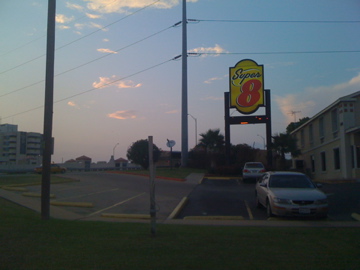
Skateboarding in the parking lot of the Super 8 as the light fades: pink and darkness stretching, chasing, reaching for the sun and consuming the city instead.

Night is coming, the shows are starting, the air exhales and a breeze from no particular direction blows across the pavement, the hot stretch of steel, winking windshields, “yes, yes.”

The birds keep circling, searching for something to take between their beaks. They are only aware of their wings, the wind—not of their dancing or the shape it makes against the sinking Austin sky.

Chaos to Kona: This Will Be Epic

SFO –> AUS –> SJC –> LAX –> KOA –> LAX –> SFO: This will be epic.

It happened like this: my brother’s family was going to Hawaii. It’s an annual thing. My sister-in-law has a good family friend who is famously, fabulously wealthy, and owns a private villa along the Kona coast (“It’s like your own personal Four Seasons,” my parents told me). They go down and stay at the house every year, usually with a big group of people in January (when you can watch the migrating whales from the pool deck). The imminent arrival of my new baby niece pushed the party back till the end of May this year, which gave me enough time to scrape together airfare and justify taking a proper vacation (travelers don’t vacation, see below…). I roped my hard-working best friend into getting some time off from her fancy scientist job and come along with me.

Aside from the not-paying-for-a-place-to-stay bit, it’s kind of the classic American vacation: a relaxing one-week Hawaiian beach vacation. We’re renting a car (which I’ve never done while traveling), traveling with family, have nothing on the agenda other than morning yoga, noontime naps and all-day sunbathing. Which means, of course, it was nearly impossible to justify. I don’t relax when I travel; that’s not the point. If I need to relax, I’ll sleep till noon and go eat ice-cream cones in Dolores Park. I travel to see the world, dig in, explore, run myself ragged on third-class busses. When I travel, virtually no sacrifice is too big: I’ll bankrupt myself, take as much time off work as I can without getting fired. But when it came to taking 5 days off work and spending $436 to fly to Hawaii, I balked. It seemed like a lot to do nothing, learn nothing, gain nothing but a couple pounds from my brother’s bad-ass cooking.

I took it on as a sort of spiritual challenge: a traveler vacationing. In a lot of ways, it’s going to be my first vacation in 5 years. Unwinding, unplugging. But of course, I’ll have to write about that. And bring my laptop along. And then a friend gave me some tips on non-touristy places to go on the Big Island. An independent traveler tackling the most touristy place in the US? Sounds like a killer article…

Already, I was chipping away at the “vacation” element of my vacation. And then came Chaos.

It’s the dirtbaggiest, DIY-est music festival of the year. Organized by one dude with a blog and Xeroxed flyers, Chaos is Tejas brings out some of the biggest names in punk/crust/sludge/metal for four days of sheer debauchery in Austin, Texas. Friends had been road-tripping out since its inception 6 years ago. I finally went 2 years ago, and partied like I was 15 (minus the malt liquor and methamphetamines). I stayed with a tattooer/artist friend of mine, and ran around the streets till 4 in the morning, lighting off fireworks at after parties and making out in the back of a truck with some dude while his friends careened us around the city. And that was stone-cold sober.

I remembered the festival as being in early May. A tight squeeze, but I could fit it before Hawaii, right?

Turns out Chaos in Tejas (which has entered the digital age this year with a Facebook page) is Memorial Day weekend. And I was leaving for Hawaii on that Sunday. Some friends were planning to drive out. A hair-brained scheme began to hatch.

The road-tripping part had to get chopped out, but here’s how it’s ended up working out:

Wednesday: Fly to Austin with Liz and Melissa.

Thursday – Saturday: Rock our effing brains out. Killer bands from all over the world playing nearly 20 different shows. 3 single girls in a sea of crusty boys: think “Girls Gone Wild,” but with more tattoos.

Sunday: Fly from Austin to San Jose. Meet Alicia at the airport. Fly from San Jose to LA, where we’ll connect and fly to Kona. Grab our rental car and traverse the dark turns of some deserted highway, arriving at the gate to the mile-long driveway.

Monday-Saturday: Chill-ax.

Saturday night: Red-eye back to LA.

Sunday morning: Fly back to San Jose. Get a ride back to Oakland. Be at work by 2:30.

It’ll be one end of the spectrum to another: ridiculous partying to ridiculous relaxing. Punk rock shows to private properties, dirtbags to nieces, stinky clubs to island paradise. 11 days, 2 destinations, 7 flights, 1 rental car, 3 girls in 1 cheap hotel room, 15 people in 1 oceanside villa, 99 bands and 1 me to live (and write) it all.

Domestic Travel for the 25% Club

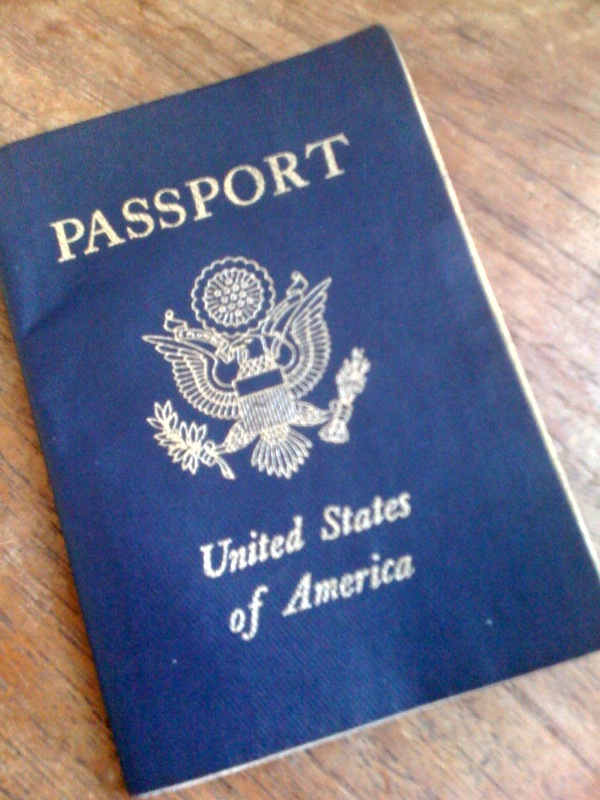
It’s a tired, tongue-worn statistic that staggers gasping into travel discussions across the internet: only 25% of Americans hold passports.

Usually meant as a sad accounting for the geographic and cultural ignorance of Americans, it has the opposite effect on those of us in that illustrious quarter percent. We are the daring, the open-minded, the shrewd and worldly elder all the glowing faces at the campfire are huddled around. We have seen the world, and we have stories to tell. (Whether you not you really want to listen.) The only real travel is international travel—all else (minus the notable exception of New York City) is a petty bourgeois venture in the money-sucking heart of homogeneity.

“Is domestic travel really travel?”—it’s the kind of inane question that you unwittingly discover yourself debating (with yourself) over a slice of open road and steaming cup of gas station coffee. Travel within one’s own country is never an exotic thing—a kind of half-traveling, going through the motions, faking the orgasm of discovery. But when you’re American, and that country is a sprawling continent composed mostly of people who never leave it, domestic travel can sometimes seem like the antithesis of travel: giving up, giving in and coping out. And paying entirely too much for hotel rooms.

I got to thinking a lot about domestic travel on my very unglamorous, utterly unworldly last trip: driving through Southern California. It was so different from the type of travel I’d been doing the last few years: I had my car, I spoke the language, could use my cell phone and credit cards. There was no hassle, no “other”—but it most definitely was still travel. And now, as I’m getting ready to dash off to one equally unexotic locale (Texas) and the ultimate “paradise without a passport” destination (Hawaii), I’m thinking even more about what domestic travel means as an American.

I didn’t grow up traveling. International travel was one of those unfathomable luxuries of the wealthy. So when I left the US for the first time, it was literally like the world opened up to me. This occurred during a very dark time—namely, Bush’s presidency. The prevailing image of America, and Americans, was pretty much everything I was against. I wouldn’t go so far as to say I was Canadian when abroad, but I didn’t want to be associated with anything American: capitalists, Christians, blond suburban girls. I was also broke, so traveling in places where rooms cost $7 a night was pretty much the only way to go. Thus, I left the country more than I left the immediate Bay Area and my ignorance went inverse: I knew the geography of Latin America better than the Midwest.

It’s true that the political tide has shifted, but it’s more than that. There’s so much to be against in the US—imperialism, corportatization, people who don’t believe in evolution—that it’s easy to forget all the good things. Our art is amazing; from hip-hop to punk rock to graffiti, pretty much everything I love was spawned out of the raging, pulsing cultural cocktail that is the United States.

And when I travel here, at home, I’m more able to dig in to those things that interest me—poke and scratch beneath the surface and get closer to what it means to be this, from this, born out of this. It goes beyond using the Yelp app in my phone to find a good coffee shop (which is goddamn useful). It goes beyond even just speaking the language, or doing so without an accent. Because I know the culture, am the culture, I know how to approach people, how get right in there and smile and make friends and discover cool shit I wouldn’t otherwise be able to.

The number one benefit of traveling within my own country is that I’m more able to dig in to what really fascinates me: people, how they live, the weird art/shit they make and the stories it tells. Domestic travel is a totally different beast from international, and I gotta admit that you don’t get the same knock-you-over-the-head rush. Rather than exploring the “other,” you’re exploring the known, and in that way, exploring yourself.

What does it really mean to be American? I used to think it had mostly to do with narrow-mindedness and consumerism. Maybe I’m just a cheeseball, maybe the Obama campaign really did give me some kind of hope, but I think it’s something much deeper than all that. I’m not sure what all it is, this being American, but I’m certain that somewhere down near the core of it is travel. There’s something very central about travel to the American psyche, a kind of open road that flows through the veins of the place, a Manifest Destiny born into us, to set wheels over earth. Stagecoaches, trains, automobiles, a country based upon more, upon Going West and Getting Yours. It’s not the jet-set , passport-stamping kind of travel. It’s visceral, grounded, rooted down into the earth, the dusty, craggy, bayoued and fertile earth.

Perhaps I’m settling into myself. Perhaps I’m just becoming accustomed to being a traveler and building a life around travel; being a member of that elite 25% isn’t so much a novelty anymore, it’s my life. I’m not the anxious teenager with a self-conscious mohawk; I’m the cranky old punk who doesn’t give a shit about dental-floss-sewn patches and would rather go to bed than party/do blow backstage (an actual anecdote from my weekend). And while my heart is in international travel, it doesn’t mean travel within the US is a waste of time and money (what I honestly used to think). It’s just a whole different experience, uses a whole different side of the brain.

Besides, what other country has Chaos in Tejas? (I’ll see you in the pit.)

A Woman in the Sun

I sat in the sun, butt naked and heat dazed, my starving skin soaking up all the UV it’d been hungry for since my trip to LA. The sulfur smell of the hot springs had stopped burning my nose, and I was in that drool state of relaxation where everything floats in and out of your consciousness like a dream. The bits of conversation from down the deck came to me in whiffs, like BBQ or the burning of some far-off fire.

“You know, Mark called me on Friday. And he started up again. And I said, you know, like we’d practiced, ‘I am not going to participate in this conversation with you.'”

The words roused me a little. Not so much really the words, but the careful way in which they were recited—deliberate, practiced, the memorization of an actor who knows the scene but hasn’t quite figured out their character’s motivation.

The patter of bare feet and a sleek ripple of water. “Oh, Myra, I didn’t tell you,” the voiced repeated. “I got to use that tool we talked about, when I told Mark: ‘I am not going to participate in this conversation with you.’ It felt so good!”

Wilbur Hot Springs is a retreat place, and that’s what I’d come for. That’s what we’d all come for, driven the two-line highway through pastoral postcards, past cheese-commercial cows, down a bumping dirt road where the dust plumed and twisted behind us like everything we’d meant to leave behind.

Wilbur is the kind of place that makes you lapse into cheesy cliches (partly because your brain is too full of steam to think straight). A Victorian mansion “nestled” into the “rolling” California hills, it’s an uber-NorCal experience, an “oasis.” Everything is solar-powered. The natural hot springs are directed into four flumes clustered around a clothing-optional deck. There’s a communal kitchen where guests cook their own meals, and instruments for evening jam sessions. Everyone talks in low, soothing voices, and the place smells like well-oiled wood. Sustainability and spiritualism; regrouping, reconnecting, getting off the grid and soaking in 114 degree water—you know, the kind of hippie shit a punk rock kid like me used to scoff at. Until I went up on a gift certificate a couple years ago with a similarly suspicious friend.

We’ve been jonesing to get back ever since.

Retreat is what these chatting women on the deck had also come for, and like retreat, they were something, a certain kind of woman, a younger incarnation of me would have scoffed at: middle-aged, middle-class, white, all-American. Bad hair and worry lines. I’ve grown less judgmental in my old age, and in my hot-spring-infused sedation, observed them detachedly, from an almost anthropological distance.

They’d come on day passes. They weren’t entirely comfortable, held their robes and towels around them self-consciously, seemed self-conscious about being self-conscious—they averted eyes, glanced this way and that before letting go and slipping naked into the steaming water.

I’d pieced together their conversations, about ex-husbands and astrology, how to figure your aura energy by the kinds of animals you attracted (“You got lizards and butterflies; I got bit by a tick!”). This day trip to Wilbur appeared to be the culmination of a healing workshop. The leader of the group was some kind of psychic—not a predictive one, she assured, but one that dealt more in energies, a kind of cosmic therapist. They weren’t super New-Agey about it, talked in a kind of down-to-earth tone that made them seem less like people on board some kind of bullshit train, and more like people genuinely seeking, genuinely lost and hurt and looking for something, some kind of solidity.

“I am not going to participate in this conversation with you.” The statement rang in my ears, plucking me out of my sun-drenched stupor. The speaker’s voice held in it all the excitement of a pupil who’d just felt a switch flip—who’d practiced the arithmetic but wasn’t sure the equation would work for them, with their own dull and trembling pencil. But it wasn’t a young voice and a glance at the body from which it issued revealed a gravity, breasts heavy and hips wide, a child-bearing body.

My God, I thought, to have lived that long and only now have learned to say that.

The woman’s comment, the thrill with which she yielded it, struck me as tragic, in a particularly female kind of way—that a woman could go that long in her life without having learned to say no before.

Boundaries. Standing up for yourself. Not taking shit. They’re vital things for us girls to learn. You flat out won’t make it in this world without them, I’ve come to believe, and I don’t just mean with manipulative ex-husbands. You’ve got to learn where the world stops and you begin, what is and is not okay with you, and how to be firm and true to that. Cause you’re not going to make it—ride the buses or walk the streets or, shit, travel the world—you’re not going to survive the barrage of shit hurled at you without learning the word “no.”

And there, on that sun deck, a wave of gratitude swept over me, like the spring breeze on my pink and steaming body, for my mother. My tough-as-nails, take-no-shit mother.

My mother, my model: pretty and blond and trained in karate. She worked in factories, held her own in the male-dominated world of politics, worked in West Oakland during the worst of the crack years, dared a scab to follow through with their threat to punch her on the picket line (they punked out). It stems from that: my childhood love of Tina Turner and my vow that if, when I was older, I ever went on a date with a guy who tried to make me do something I didn’t want to, I’d “kick him in the nuts with my high heels”; my busted-Converse affection for Riot Grrls, Le Tigre, Anne Sexton and Sylvia Plath. And it stretches before that: my grandmothers, no-nonsense Midwest girls who endured Depression poverty and marched in Civil Rights protests.

I come from a long line of tough ladies. I can’t ever forget I stand upon the ground they forged for me. It’s a generational adventure, this learning of how to be a woman in the world, and what my mother and grandmothers fought for is in me, my blood. So much so that it still surprises me, blinking-eyed shocks me, when other women ask me how I have the “bravery” to travel alone. It simply never occurred to me to not have the bravery.

In that sun-drenched moment, any residual judgment melted away, just like the knots in my lower back unclenched in the hot, healing water. It may have seemed tragically late to learn how to make boundaries, she may have had to take a healing workshop with a psychic, but this woman had learned. And she sat now, naked and free, gently turning pink in the sunlight of it.


Lauren Quinn is a writer and traveler currently living in Hanoi. Lonely Girl Travels was a blog of her sola travels and expat living from 2009 to 2012. She resides elsewhere on the internet now.

Join 490 other subscribers

Buy This Sh#t

Categories