Archive Page 15

Voices of the Khmer Rouge: The Exhibition and the Mystery

I never heard the term “Khmer Rouge” growing up. We didn’t learn about Cambodia in school, didn’t hear about it in TV or the movies. I must have been a teenager when I first heard those specific words, and I remember it sounding terribly exotic and glamorous: “Khmer,” smooth, black, still as glass; “Rouge,” like lipstick, like burlesque, Paris in the 20s. (Cambodia, Cambodia—where even the genocides have beautiful names.)

I did hear about Pol Pot. Not all the time—quite rarely, actually, and only in passing, but in a way that made in stand out in your mind, that made it tuck into some cramped little corner of your brain where nothing much else goes. How did you learn to make fire from two sticks? “I learn during Pol Pot.” Why were you running, pregnant, through waist-deep water in the middle of a monsoon? “To escape Pol Pot.” Who hung you upside down for days when you were caught stealing food? “Pol Pot.”

It was never the Khmer Rouge, but instead always this person, this invisible man, a dark silhouette that you could perhaps see passing, passing, passing through the house at night—like a ghost or a phantom or something even realer than that: Pol Pot.

So it was a type of linguistic division—responsibility placed not on a mass of people, a movement (ie: Nazis), but on a single person. Not a war, a genocide, but a man.

I kept thinking about that last night. I chanced upon—as I’ve been “chancing” upon everything in this project, so that you can’t really call it chance at all—the exhibition “Voices of the Khmer Rouge.” A massive audiovideo installation, “Voices of the Khmer Rouge” features 30 interviews with former low-ranking Khmer Rouge soliders, displayed with multi-lingual subtitles on some dozen computer monitors/headsets. It’s being shown at the Bophana Audiovisual Resource Center, an historical archive center with free, open access to the public. The exhibition opening happened to be last night. So I went.

It was sweltering hot in Bophana’s main floor, a space that was meant to have air-conditioning but didn’t. There were well-dressed Westerners and well-dressed Cambodians—lots of younger Cambodians, too: teens and twenties, what’s referred to as “the next generation,” all wearing the same type of short-leeve button-up top and slacks, conservative skirts. At a certain point, a herd of younger children filtered through, chattering softly; they were thin and dark and put on the headphones and stared.

The opening speeches were being translated into 3 languages—Khmer, English and French—and proceeded at a painstaking pace. I stood in the breeze of a fan and read the subtitles flashing on the screen.

All of the interviewees were poor villagers from a Northern province. Many of them had been young when they joined the Khmer Rouge—teenagers or even children. I’d read about that, accounts of that: the Khmer Rouge’s use of child soliders. Some had been arrested and forced to join, others felt they’d had no choice, and still others joined voluntarily, zealously.

So they’d mostly all been extremely vulnerable. They all spoke of experiencing hardship during Lon Nol’s regime and the American B-52 bombings: hunger, death, loss. They were angry, young, uneducated and desperate. These are dangerous conditions.

Their thoughts about the Khmer Rouge now ran the gamut. One man lauded Pol Pot as a hero who’d fought imperalism. He thought of him as a teacher and kept repeating that he couldn’t say Pol Pot is bad because, “If the student says the teacher is bad, then the student is bad too”—a logic steeped in the Cambodian brand of Buddhism.

There was a marked clarity when it came to the US’s involvement in the development of the war. One woman summed up: “Americans paid Khmers to fight other Khmer, and that’s what we were fighting: Khmer puppets.” Another man, with piercing eyes and deep wrinkles, spoke of how the power of the Khmer Rouge was set up by the “greater powers” of the world. He cited the US, China, Vietnam, Cuba, the Soviet Union—how they supplied money, guns, mines. “It was the greater powers that incited war. How could they have afforded it otherwise?”

He said that he was for the trying for former Khmer Rouge leaders, but that it wouldn’t be a proper trial if it was only trying them. “America must pay compensation too,” he said.

When I was at Tuol Sleng, my tour guide had said something about the Khmer Rouge that stood out to me. He said that they had “the trauma” just like the victims. Some of them killed, but they had to; if they didn’t, they’d be killed. “So they are victims too,” he said. “Indirect victims, but victims too.” That sense of division echoed in me: Pol Pot vs. the Khmer Rouge.

One woman, old and thin now, spoke of how she’d felt sorry for the people in the camps, but how there was nothing she could do. “That is war.” Mostly, she felt sorry for her Khmer Rouge comrades. She said how, when one would die, they would mourn them like a sibling. And I imagined an army of children in black pajamas, in the jungle with their semi-automatic weapons, stripped of their families, with nothing but each other.

Another man had been sent to be a solider as a child. During the fighting, he said, he’d lost his thumb, an eye, had a leg cut off; he didn’t even mention his missing front teeth. “I became a disabled person,” and he said it with a smile, a well-what’re-you-gonna-do smile—a battered little shell of a man.

Another man had a broad smile and smooth dark skin. He spoke of being afraid. “Maybe they will see this and come arrest me and execute me.” I thought of what my tour guide had said, how he’s still easily frightened, all these years later. “This would be very unfortunate for me,” said the man on the screen, and he smiled still, laughed. “It may sound like I’m joking, but I’m not.”

The project’s producers were on hand to discuss the work—two Danish dudes. They insisted that this was an art installation, because it wasn’t attempting to answer questions, only raise them. They refused to tell viewers what to think of the interviews; they wanted you to look at them and make your own conclusions.

“There are no conclusions,” I thought.

I waited around to speak with one of them. I was curious about a point he’d made—that he felt there were different levels of Khmer Rouge, the “really bad guys,” as it was convenient to phrase, and the other people, who existed in shades of grey—so many shades of grey, I’d thought, that you hadn’t knew existed before, like looking at one of those charts of the light spectrum in science class and realizing that all you’d ever seen was this small sliver of what was out there.

Another American girl had him cornered; I eavesdropped and they seemed to be talking about the same thing. She was debating that point fiercely, the kind guilty-by-compliance logic that had always made sense to me, before this. She was young, unwrinkled skin and braces, and kept shaking her head.

I finally got my chance to ask him. I told him my linguistic childhood ancedote. He spoke about the shades of grey, how he didn’t think it was as simple as just Pol Pot or all the Khmer Rouge. He again urged me to find my own answers.

“I think maybe there aren’t answers,” I said.

Which I think didn’t sound the way I’d intended. It wasn’t to say that the search was futile—because, after all, what the hell am I doing? (What the hell am I doing?)

No, I think the search is one of the most worthwhile things we can do. But I keep feeling like every layer I peel back, the further I look into it, the more complex it gets; it only opens the door to new questions. So we can look at it and we can tease it apart and try to know it, but I feel that at the center of it all is a great mystery, an un-understandability—the same mystery that’s at the center of everything, only maybe a little darker.

It’s a fact I feel I keep coming back to and keep coming back to, that all of seems to orbit around: the impenetrable mystery—smooth, black, still as glass.

Not Your Normal Expat Scene: Khmer Kids Coming Back to Cambodia

“This not your normal expat scene.”

That’s all I kept thinking last night, as I stood sweating and stomach-sore in the crowd. I’d dragged myself out to a show, what was described to me as an all-girl indie rock band that sang in Khmer. Killer. No traveler’s flu would make me miss this.

It was a funny mix—local men in dress shirts and slacks, women in those super foofy sparkly dresses; kids, some just in the crowd, others wearing matching shirts for some organization I couldn’t quite make out.

And there were your typical expats—Western, mostly white. Some of them were extremely well-groomed, reeking of cologne and hair spray and kissing their friends on both cheeks. Some of them wore that aren’t-I-so-cool-for-being-here look. Some tried to dance along or move to the beat, and it was sad and cute in the way it’s always sad and cute. And others just seemed to be there, watching, enjoying the show, because that’s what there was to do that night.

But the kids putting on the show—the kids on stage and holding the cameras and checking the sound—they were not your normal expats.

Your typical expat does not drop their “to be” verb (“She crazy”), doesn’t say “y’all” or “aight.” They don’t wear baggy jeans and puffy sneakers. They don’t start NGOs called Tiny Toones or hip-hop groups called Klap Ya Handz, written in Godfather font. They don’t breakdance or freestyle or bust—and they don’t do it in the language native to their new homes.

I’d heard about the show from Bel, a girl I’d found on Couchsurfing. We had plans to meet up for coffee and even though my stomach was already getting wonky, something told me not to flake.

She was a cool girl and we talked for awhile. Her boyfriend was a Khmer-American who’d moved back to Cambodia, with no intention of ever leaving again. “He’s the most patriotic Khmer you’ll ever meet,” she said, and later he showed me the tattoo of a famous Wat across his back.

“There’s a lot of foreign-born Khmers moving back,” Bel told me. “Lots of artists and young people. And they’re really motivated to do something here.”

I wanted to see this; I wanted to glimpse what this was. Sure, I knew of people going back to their parents’ countries for a visit, but to live? To give up everything they know to fight for something better in a country they hadn’t grown up in? This was something different.

And it was. The show place was buried deep inside the maze of a mall, shuttered shops and a blinking arcade, bowling alley and bumper cars. I got there earlyish, paid a $10 cover—normal for the US, but exorbitant for here.

On stage was a DJ, two turntables and a MacBook glowing. Two artists were on stage, doing ad hoc graffiti art on a make-shift wall. “Empire State of Mind” came on. It was like being at any hip-hop show at home—except a hell of a lot hotter.

The first act was a hip-hop group called Klap Ya Handz. They spoke in a working-class English, like kids that grow up in Oakland. But in the songs, they flowed in Khmer. For one song, they brought out traditional Khmer drummers that were, well, bad-ass. During another song, the lead girl did what she later called “Khmer hands,” a hip-hop take-off on the hand movements of traditional Khmer dancers.

Cambodia lost a whole generation of artists during the Khmer Rouge. Traditional dance was virtually erased and, after Pol Pot, there wasn’t anyone left to pass it on. I’d read accounts of the few survivors left trying to teach the next generation, and it being hard—they were more interested, as teenagers usually are, in contemporary things. Like hip-hop.

The headliner was Laura Mam and the Like Me’s. They’re a bluesy, all-girl rock band from San Jose, California (local love). They’re Khmer-American and sing in Khmer. The crowd obviously loved them, singing along and snapping photos and waving their arms. I was told that they came to play in Cambodia relatively often. Either way, they showed the same kind of passionate pride in their Khmer culture that the kids in Klap Ya Handz did.

They played a song called “Diaspora”: “for all the refugees living in diaspora around the world—and missing Cambodia.” The crowd went crazy.

No, this wasn’t your normal expat scene.

Your typical expat is someone of relative priviledge; they have, say, a university degree and the social mobility to pick up and move around the world. Maybe they studied abroad, or spent time backpacking around. In any event, it occurred to them to leave their home countries in the first place and they had the means, however meager, to do it. The ones I encounter are largely middle-class; the uber wealthy ones exist on another plane, and I only see them in passing—the immaculate girls on the streets of Hong Kong.

These kids were categorically Not That. They’re the kind of kids, in the kind of scene, that I miss when I leave the US; when I think about moving abroad, I think, “Man, there’s so much shit I’d be missing” and this is part of what I mean.

And they bring their Americanness—their very, very Americanness—back here. But they’re making something new with it; there’s that frenetic energy, that spark you feel when cultures collide and you see people that are so intensely passionate about what they’re doing, you can’t help but feel it too.

Of course, not all of them are coming back by choice. The US opted to deport foreign-born convicts, regardless of whether they’d served their time, and nearly 200 people who were, for all intents and purposes, American were sent “back” to Cambodia. They brought their culture, a street culture, and they brought their art. And they’re doing shit; they’re bringing this to the kids of Cambodia, the next generation (ie: Tiny Toones).

So basically, watch the fuck out for these kids.

There was a shirt I kept seeing in the crowd, tons of kids wearing it. Its design was a take-off on the Star Wars logo, and it read: “The Khmer Empire Strikes Back.”

This was my first glimpse into this, my looking-through-the-peep-hole into this. I fully intend on investigating this more during my time here. But last night, sickness was calling, and I had to head back to the hotel.

Holiday in Cambodia: “Ugly Foreigners” At The Tuol Sleng Genoicde Museum

Yeah, yeah, you knew it was coming:

A sun-pressed afternoon and I’m walking through the dim cool rooms of the Tuol Slen Genocide Museum. The crumbling cells, the tangled barbed wire, the blood stains on the floor—none of it seems real. A bird flitted through the room of brick cells during our tour; a child was giggling and running on the grass. Tourists snapped photos.

I didn’t feel anything I was supposed to, or thought I was supposed to. The rooms and rooms lined with photos on cheap display boards, gleaming plexi-glass—young faces, beautiful faces, virtually all with same expression. I can’t quite name it; it isn’t anger or fear or anything like that. Maybe it’s a lack of fear, a numbness, a well-isn’t-this-it, isn’t-this-the-end-of-it. I looked at them and they didn’t look dead, didn’t look like people tortured and starved and tossed off into a mass graves just a couple meters away. They looked real and their expressions, in the face of death, looked real too.

I’m waiting to catch my tour guide. He’d shared his own experiences during the tour—life in the camps, his family members that had died—and I want to ask him questions. How does he do it? How does he walk through here everyday and talk about it, tell his story to masses of Western tourists, panting and sleeveless?

“Everyone in my generation is traumatized,” he’d said, pointing to his head with both fingers, making a very small looping motion. “We all have the trauma.” How does he do it, how does he talk about it?

[“I don’t want to, I don’t want to take this job. But I needed to work,” he told me later, a bench in the shade. He’d gone to Germany last summer to study at a Holocaust museum. “That’s what this was, a second Holocaust,” and he showed me a page in the book he held, where amidst the Khmer lettering, more like art than language, a lone English word stood in parentheses: “Holocaust.”]

I’m waiting and rewalking through the first rooms, torture rooms. In each one is a ragged metal bed frame, rusted tools of torture, a photo on the wall of a body, bloody and dead and tied to the bed. There are blood stains on the floor and they look more like dirt, so that you could almost think that they were dirt and not someone’s blood, and again I don’t feel anything.

Three tourists—male, late 20s. Not American or European, some kind of Asian, I think. They’re laughing. There’s big signs that ask you not to laugh—a smiling man with a red slash across his face—and they’re laughing.

One of them picks up a torture tool. He swings it at the other in slow motion; he makes a comical grimace and their friend snaps a photo. They gather around the viewfinder and laugh.

I watch them, and it’s now that I feel something. It isn’t anger or rage, which would make more sense, I think—not even the how-dare-yous. It’s just a sadness—a deep, wordless sadness.

“That’s really fucked up and disrespectful,” I say. I don’t know if they speak English, but it doesn’t really matter.

And it’s at that point that I feel tears welling up—that I finally feel what I think I’m supposed to feel at a place like this. And I curse myself for having put on eye makeup that morning, and I curse myself for crying for something I don’t think I have a right to cry for, for crying here, in the middle of the museum. I curse myself for letting someone else’s ignorance bother me, and I curse myself for having said something when it’s not my job or my place—when it won’t change anything, not their disrespect and certainly not my sadness.

They stare at me. They have no expression, and maybe it’s their own kind of numbness. “That’s really hurtful,” I add, and walk away.

Phnom Penh: First Impressions, And An Open Letter

I want to tell you that there’s life here.

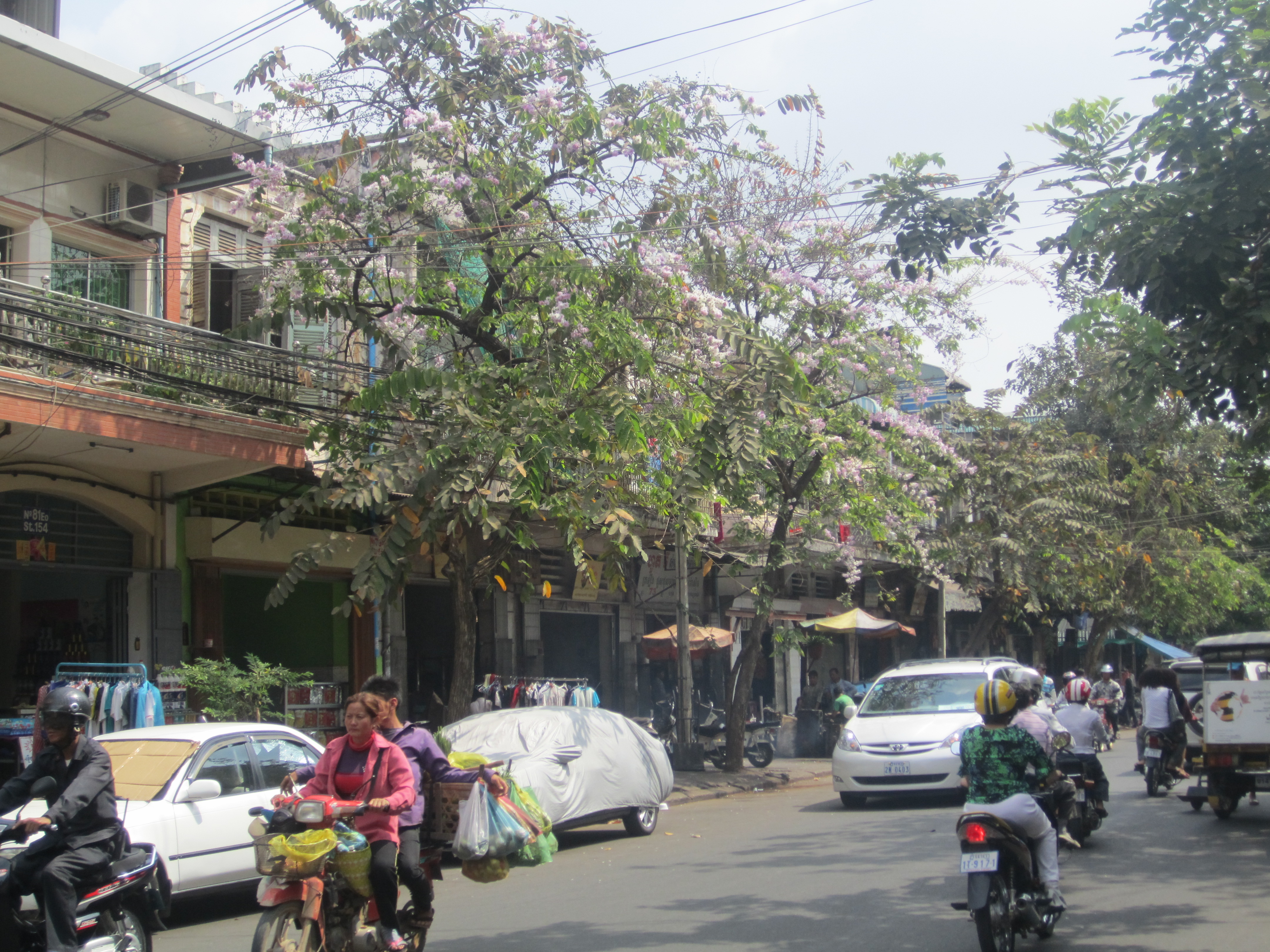
There are wide roads filled with motorbikes and tuk-tuks and more cars that I’d expected. There are smaller roads, lined with trees with soft pink flowers; there is laundry on the balconies. There are the umbrellas of the markets, the umbrellas of the monks—yellow above orange robes, a prayer in and of the themselves. There’s tourists and business men and beggars and children. There are a lot of children.

There wasn’t any of this when you left. There was smoke and emptiness; there was a camp of people on the medians. The buildings were shells, the lives were shells—bulleted carcases, metaphors of each other. A city punctured and bled.

But I want to tell you that there’s life here again. What you left devastated and destroyed; what you never came back to. It feels like a city, a normal city, and not as poor as I’d expected. There are billboards on the banks across the river, and construction cranes behind fences of corrugated metal. A smooth breeze comes off the river and the nights feel delicious on my skin.

This is the city that kept living—the way it grew in your dreams, I imagine, without you. This is the city you carried in you—its streets the same, some of the buildings too—but what fills them is all different, all changed, the architecture of absence. This is the city that kept living, when you did not.

After Vietnamese cities, Phnom Penh feels leisurely, luxurious, and it’s easy to feel enamored, to imagine none of it happened. But there are images, glimpses—dark things that I don’t understand, have nowhere to put, can only see.

Two boys standing beside the body of a man, limbs in an opiate sprawl along the sidewalk, next to a metal fence that ripples and warps. They frame him like boney columns—something vaguely Roman in the pose—and they each clutch a plastic bag. They raise it to their mouths and breathe, breathe.

Red-faced man with a bushy white beard, fat and eczematous, a Bad Santa—drinking a beer along the river, his arm around a thin, firm, dark body. A Bad Santa, bearing dark gifts and a cloud of soot.

Young girls, beautiful girls, white-skinned girls, legs and heels and tiny waists. Painted and primped and walking, neon-light shadow in the night, a click-click teeter. They’ve learned to balance, to walk on this, three and a half inches high.

Thin man, wiry man, sun-spotted and heat-blasted, something of a shell. He opens his mouth—a mess of rotted teeth, melted into one another. He speaks with an Australian accent. I don’t listen, or half-listen, instead watching his eyes, which shift ever so slightly—this way and that—like someone at the very beginning of sleep, when they still think the dream is real.

His story is practiced and performed: a stolen bag and a closed Embassy. Do I have money? Can I help him out?—-him, him, in this foreign land.

Children begging. In other countries they’d be gypsies, and some of them look like gypsies—but there’s something different to their posture. They don’t tug at your clothes, but approach with their palms up. Their whine is less pronounced, their words barely audible. There’s a restlessness, a shiftlessness, that they don’t have. Instead, there’s a permanence, an element of Here, to their movement that is, in a way, more lonesome.

A teenager walks the steep slope to the river, all black eyes and sharp bones—angular elbows and a collar bone shadow. He carries a long stick, and walks slowly along the cement embankment, where small black birds flit into nooks.

He walks up to a bird and swiftly stabs his stick at it—a flurry of wings. But he’s got it. He raises it to his face, slowly plucks the bird from its spear. He presses his thumb against its throat and pushes in slow, hard strokes. I can’t tell if it’s dead; I think I still see it moving.

He places the small black body in his pocket—a ragged strip of cloth—and continues walking, repeating, repeating. Is he killing them? Gathering them to sell? Are they food? Are they dead?

It isn’t so much the action of it that disturbs me—it’s the slowness with which he does it. It’s the calm of it all.

He continues off, along the steep slope, stabbing and gathering.

I don’t understand any of it. It’s life written in another language, a calligraphy dripping in mystery. It is beautiful and terrifying, and I don’t think for one minute that I’ll be able to understand.

A Tale of Two Tours: Part II, Khmer Village

White girl comes to town. Crowd gathers.

Duc had a prison-style dragon tattoo and a speech impediment, and he gave me the best goddamn tour I went on in Vietnam.

I kept seeing him around town. My first morning, groggy-eyed drinking coffee at a corner cafe, I saw him sitting at a neighboring table. He was selling his tour services to another sola Westerner, and it appeared to be working. He was younger than the other motorbike drivers, wearing a sleeveless shirt, something beat-up, kind of tough about him. He’s working it, I’d thought.

He looked over at me and we exchanged brief nods.

I saw him again that afternoon atop Sam Mountain, two skimpily clad female backpackers hopping off the back of his motorbike. Yup, I thought. Woooorkin it.

He asked me about my tattoos, peeled his shirt back and showed me a jagged dragon across his chest. The lines of it were half-blown out.

“You tattoo? You use neddle?” he asked me. I shook my head, “No way, a gun, man!”

He grinned a soggy-toothed grin. “Me, no gun.” I could tell, though I didn’t say it.

And again outside my hotel that night. He talked up his tour services, an English at once clear and garbled, that snagged and stuttered on certain words. I’d already booked a Delta tour with my hotel; I politely refused.

The next day’s tour was my third one in Vietnam with barely-to-no English spoken. We motored the Delta’s brown waters, through a “village” of tattered boats—faded wood, clutters of laungry, children flying kites from somewhere on the decks—and to a Cham ethnic minority village on dryland. It was fascinating, beautiful, but I had no context for it, no way to learn, to understand what I was seeing. I wanted to know more, felt it building up in me, bottling up, nowhere to go—an asphyxiation of unasked questions.

I was over it. Over the seeing-and-not-knowing tours.

Which I guess is how Duc sold himself to me. I sat later drinking coffee on a plastic stool in the shade. He pedaled his motorbike up, said hello. He asked how my tour had gone. I told him not great.

“You go with someone who speak English, it better.”

“Yeah, you’re right about that.”

He must have sized me up pretty well. He told me about a Khmer village about 15km away, very remote and isolated, “no one else take you there.” He kept talking and talking, and I thought, It’d be nice to see something with someone who can explain it. I also thought, If his tour guide skills are anything like his sales skills, it’ll be pretty good. I’d already spent too much that day, but said fuck it.

“Okay, okay,” I smiled. Then added, “You’re a good salesman.”

We drove through the Delta, its murky beauty: corrugated tin shacks perched on bamboo stilts like skinny legs, a Dali painting; ladders to reedy docks, leading precipitously down the muddy banks, into the muddy water (love, love, love that dirty water). My brain was on fire with images; I kept trying to scribble them down. Writing poetry on the back of a motorbike, it turns out, is very hard.

Duc kept pulling over along the way, to show me things, rice and seeds, things laid out on tarps to dry in the sun. He didn’t have to do that. He explained how the rice patties were harvested, how the people worked long hours, “very hard work.” He didn’t have to do that either.

Every now and then a vagrant stutter would lurk through his speech. But he’d work through it—drag his speech and himself through the snare of it—and something about it struck me as sad and somehow tender, like a bird with a broken wing.

I pretended not to notice.

We made a few other stops, finally pulled off and bumped slowly down a dirt road. The landscape changed—more cows, bone white and skinny-ribbed, flowering trees I hadn’t seen elsewhere. The houses were suddenly different too—thatching for walls as well as roofs, so the structures looked furry, like animals.

We crawled out of a cloud of dust as the bike came to a stop.

We begin to walk the town’s road slowly. He explained: a town of about 400, ethnically Khmer. There were a few towns like that along this strip of the Delta, a ribbon of land that had once been part of Cambodia. They stayed pretty isolated, stayed to themselves; residents rarely left. So traditional ways, instead of blurring with those of the Vietnamese, stayed pretty intact. And I could feel it, could feel the immediate difference.

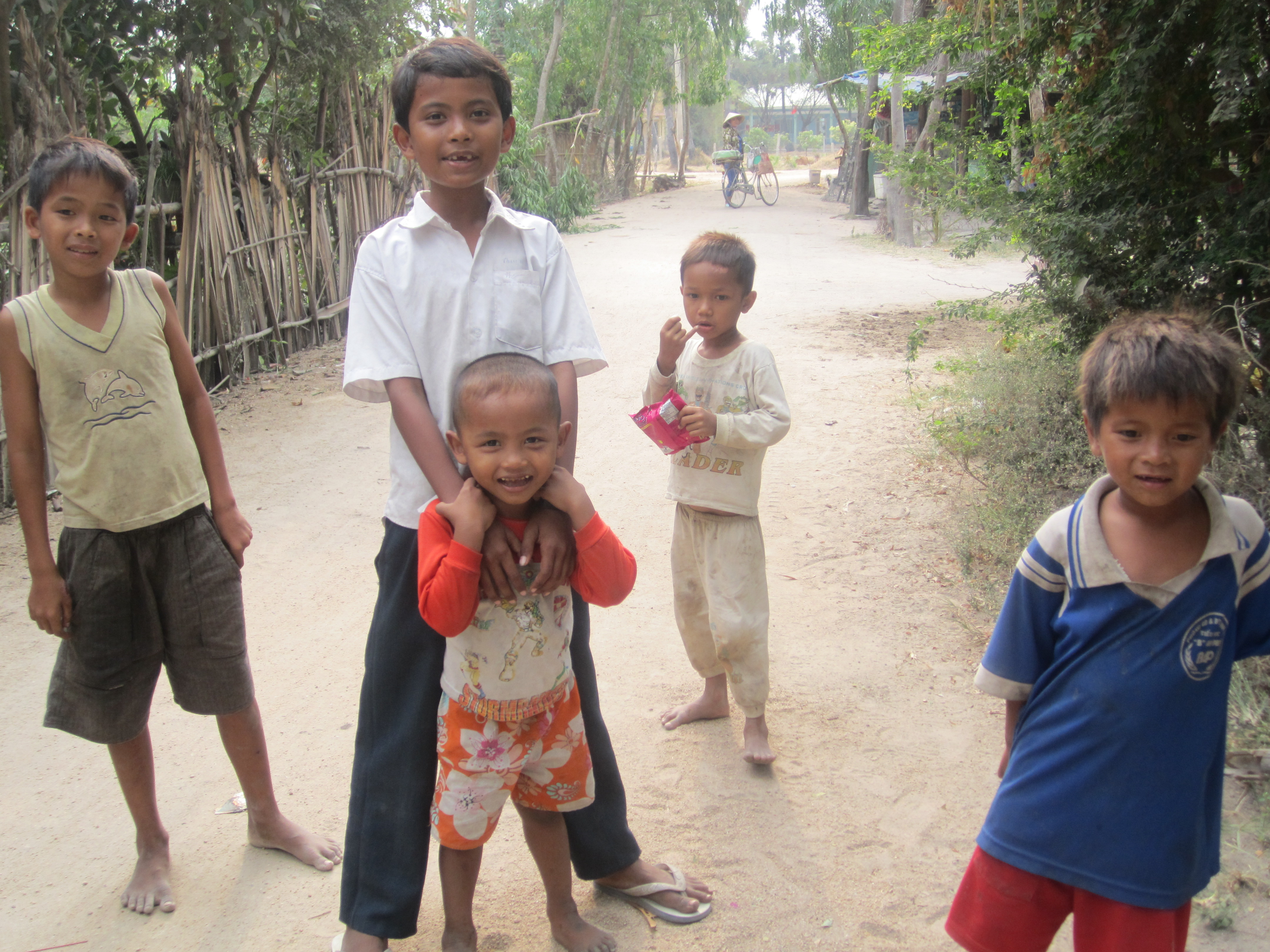
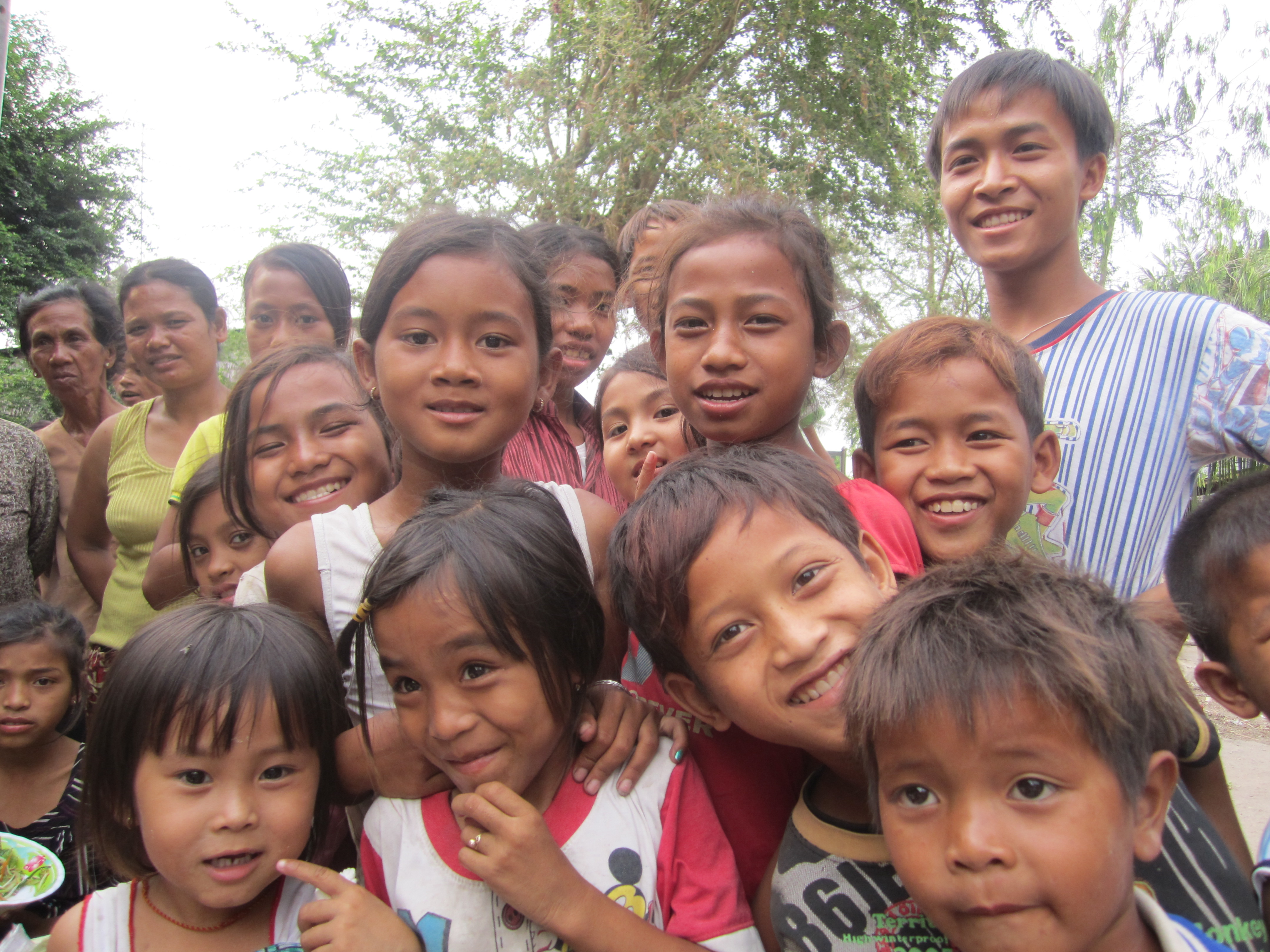
Curious brown faces began to appear. “Hello!” one of them shouted, then hid behind the back of another. “My name is—” then a chorus of giggling. I answered back hello, and they laughed more. We went on like that, as I kept walking.

Every face I passed seemed to smile. I was an outsider, an oddity, but they seemed pleased by me. I passed a baby in a hammock, being rocked by a rope that was tied to it, a mother tugging, tugging. She smiled too.

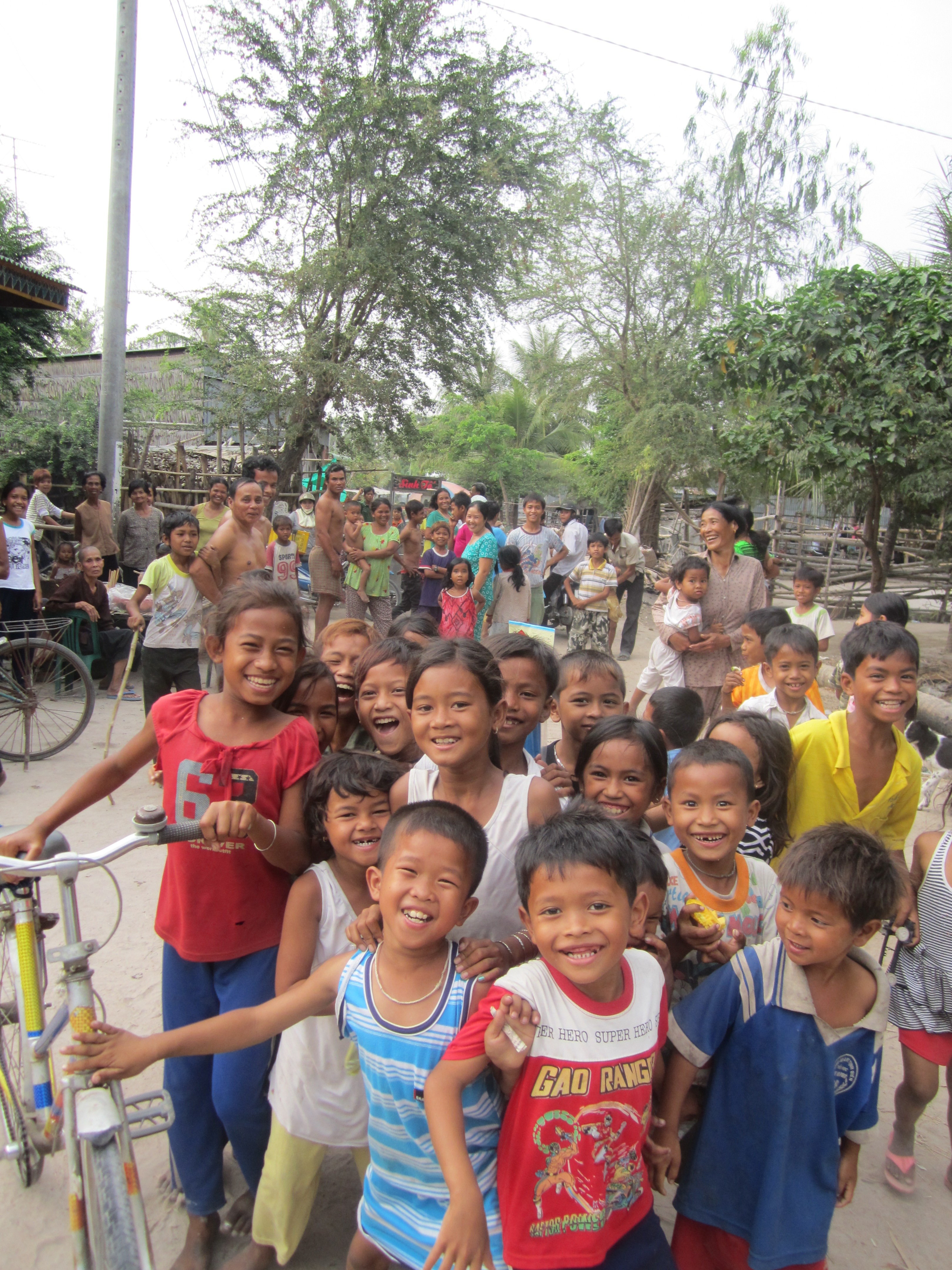
The crowd of children grew, big grins on small faces. Most were barefoot, their clothes thin and worn. They held their hands to their mouths, the girls chewed their hair, they smiled and smiled.

We passed a woman making these omelet/crepe things I’d had before, filled with sprouts and meat. I was hungry. I motioned for one and sat down.

This is when the real delight began to grow. And the crowd.

I’ve heard other travelers’ tales like these: being surrounded in some small village somewhere, stared at. But I’d never had to happen to me. I kept stopping eating, looking around—an entire circle of faces, just watching, watching, and smiling too.

I laughed—what else could I do? I searched for Duc’s face, hidden behind the crowd; his was smiling too.

A very small, very hunched and wrinkled old woman, tapped my shoulder. She handed me a short tin cup filled with water, and I thought I might cry. They were all so welcoming, so sincere; the children giggled and the adults watched and they all kept smiling. It struck me as about the sweetest thing I’d ever experienced.

Duc and I began to walk slowly back towards the motorbike, the village’s kids trailing behind us—a shadow of children. I turned around and waved. “Good-bye.” And a chorus of “good-byes” erupted and a flurry of waves, and we drove off, away: a precious little place I’d never be again.

And it struck me, there, on the back of that bike, that Ba Chuc must have been a lot like that town before the Khmer Rouge came. Only bigger.

We cruised back into town. I hopped off in front of my hotel, handed Duc $10 instead of the $9 we’d agreed on.

“Oh, you tip me? You happy?”

“Yes. I’m very, very happy.”

A Tale of Two Tours: Part 1, Ba Chuc

We were racing the sun. It was begining to glow orange, cut into pieces by the great green palm leaves. The Mekong Delta—the landscape of every Vietnam War movie I’d ever seen, where boat engines sounded like the echoes of helicopter blades.

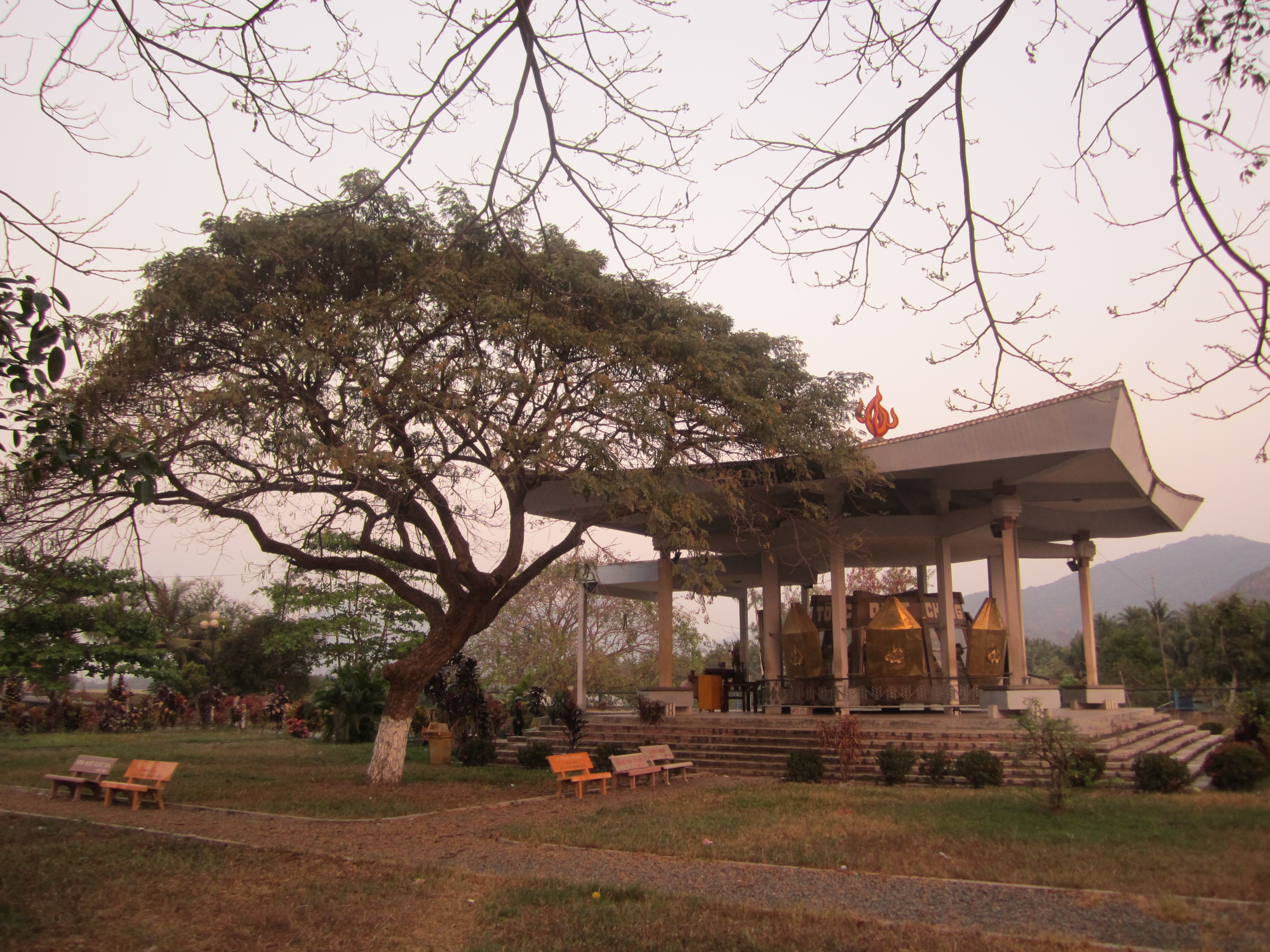
We were trying to get to Ba Chuc before the sun went down. It was the site of a Khmer Rouge massacre; a pagoda with the bones of the deceased had been constructed. I’d planned on visiting it the next day, but when Sam Mountain turned out to be a bust—cages full of endangered birds for sale, and small boys peeing between make-shift altars—I’d decided to make a run for it.

We pulled into a dirt lot with the sun low, barely above the squat structures—corrugated tin walls and thatched roofs. The motorbike driver didn’t speak English; he pointed at the sign on a small, concrete building. “Ba Chuc.” I handed him my helmet, and he leaned back to wait.

Inside was empty, a lonely government building—fading paint and dusty floors. The walls were lined with photos depicting the massacre. Along this stretch of border, there were several Khmer villages; it had, at one time, been part of the Khmer kingdom. In 1978, the Khmer Rouge had come into the town of nearly 4,000; only one person survived the massacre.

I’d read this all in my guidebook. Here, all the signs were in Vietnamese. The brutal black-and-white images didn’t need translation. I walked slowly, alone with the freeze-frame horror.

A barefoot woman entered the room. She was withered and hunched. She tugged at my sleeve, pointed to the picture of a girl’s body impaled through the vagina. She made a thrusting motion, her eyes desperate. She motioned around.

She kept pointing, I kept nodding—what else do you do? She held incense out towards me, made a motion for bowing. I didn’t want to buy any incense. Not so much that I didn’t want to buy it, but that I didn’t want to burn it, to bow—to mime the motions of someone else’s religion, someone else’s sanctity, someone else’s tragedy. Not mine, not mine. (I hadn’t wanted to go to my uncle’s funeral as a little girl, and it was the same feeling—an old feeling, buried feeling, that I’d forgotten—something in me saying, “No, no, no.”)

I walked over to the pagoda. It was in a grassy lot, mostly deserted. A large tree grew next to it. It was pretty, rural, littered with trash. Two teenagers sat holding hands. Three small, dirty boys played on the steps leading up to it. They leapt up, walked over to me, palms open. I shook my head (no, no).

They followed me as I walked in a slow circle around the pagoda. Behind glass, skulls had been arranged according to age: 0-2, 17-25… It didn’t seem real.

I circled around once, twice. I didn’t feel anything I thought I should be feeling (“There’s no right or wrong way to grieve.”) I didn’t feel anything, really, but numbness, and a “no.”

I walked back down the few steps, back towards the motorbike, the driver, another distance to be traveled in silence. A rock hit the groumnd beside my sneakers. I looked back, and the boys giggled. Had they meant to hit me? Was it malicious, were they playing, who was I, what was I doing there?

I walked back to the motorbike through the dirt-lot dusk, feeling nothing but “no.”

Saturday Night Fevered

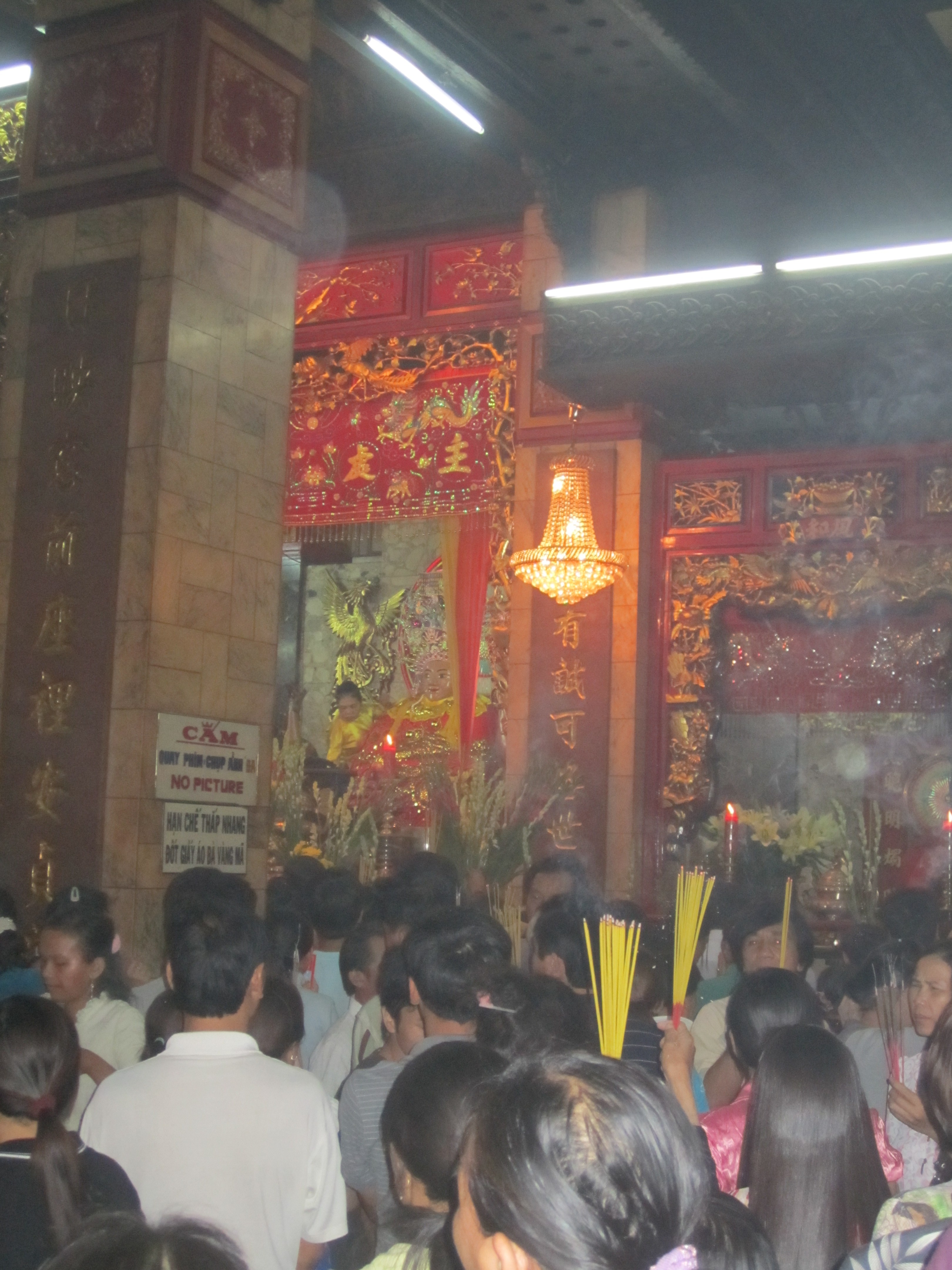
Long stalks of flowers and twisted plumes of incense burning. Nodding, bowing, chanting with their eyes closed. Trays of food—peeled fruit, shrink-wrapped cookie packages, an entire plucked chicken—held atop people’s heads as they murmur. Candles and coconuts, red glowing altars (to what, to what?).

Children and hunched-up old people, a constant bumping, bustling, brushing against—the Asian conception of personal space, or lack thereof, exemplified. Announcements on a loudspeaker (what, what?).

Smoking a cigarette while he prays. Sweeping rubbish out from under the feet of the worshippers—playing cards with footprints on the floor.

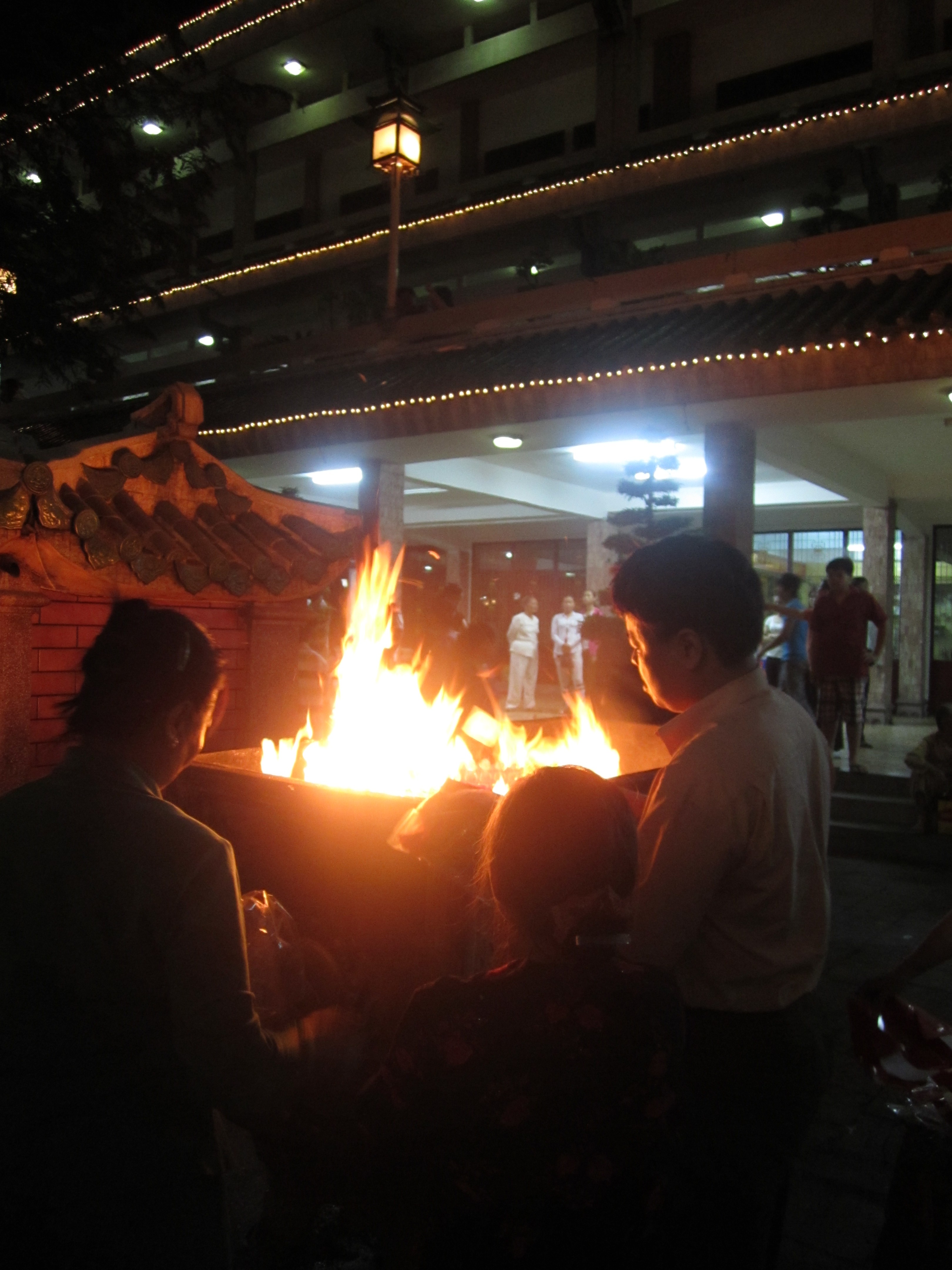
Photocopied money in buckets being carried, to be burned—tossed into a pit outside that shoots scraps of burnt paper all over, raining ash in the night wind. Smoke rising (to where, to where?). Calling to children—“Em oi! Em oi!” Some kind of urgency, some kind of plead—nothing Christian about this piety. Nothing solemn; everything sacred.

Security guard siddles up to me, glances at the furious scribbling in my notebook (for what, for what?).

A Buddha-looking diety looking down on it all—a halo of neon, flashing in technicolor.

——–

This was perhaps one of the biggest What The Fuck moments of my travels. I had no idea where I was, what was going on, what any of it was for—just that I was suddenly immersed in it, plunged into a cloud of incense smoke and chanting and riotous fervor. These were the notes I made in the middle of the madness.

The motorbike driver didn’t speak any English. We were coming back from another site outside of Chau Doc, a town along the Cambodian border in the Mekong Delta. The roads became cluttered, lined with food stalls and carts and bodies, bodies. They filled like a clogged pipe until they choked and he had to pedal the bike through the crowd.

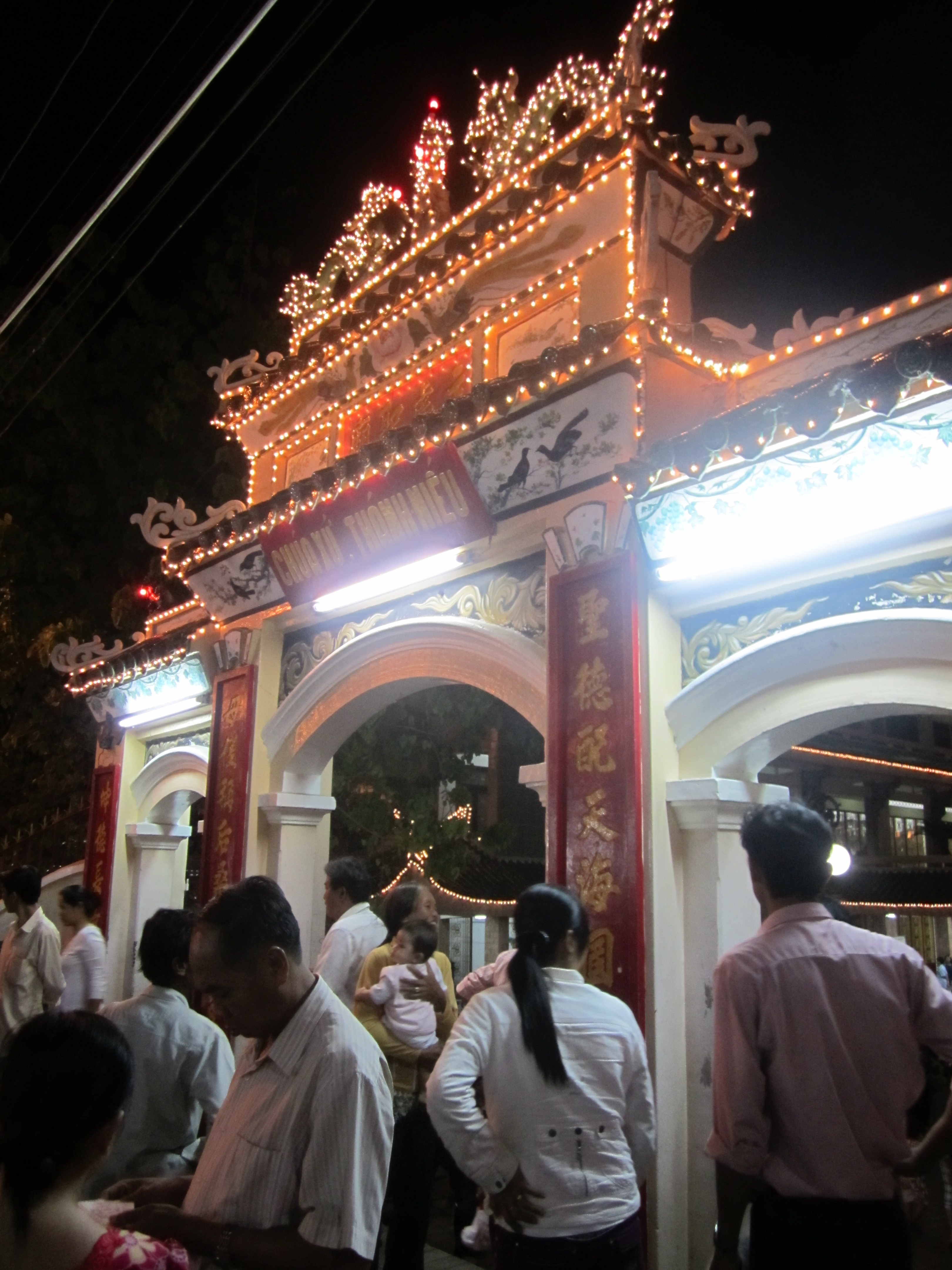
He stopped in front of a temple adorned with blinking Christmas lights. He pointed. I went in.

It was a funny thing, to be wrapped up in the zeal and fervor of it all without having the slightest clue what any of it was—an entirely sensory experience, a ritual out of context, a girl out of context, cultured-shocked.

When I got back to the hotel, I asked the English-speaking desk clerk, “I just went to some temple, up the road and—”

“You saw thousands of people,” she finished me, nodding.

“Yeah! What was that?”

She told me that they’re city-folk; they come to Lady Temple after the new year to ask for good luck. On weekends in February, March, even up through April, the otherwise sleepy town of Chau Doc swells with these Vietnamese travelers.

“Pilgrims, pilgrims,” the other clerk told me the next day. He’s younger than the girl, I thought, but he only seems it—he later told me that he’s almost 40. I wondered where the years went, behind his boyish smile.

“Other times, not so many people in Chau Doc. It very good for the business.” He looked out the glass lobby windows onto the town’s main market, overflowing into the street with tourists—not so many of them Western.

Snapped a couple of jostled photos before I saw the "No Camera" signs...

Expensive, Bad and Popular: The Mystery of Highlands Coffee

It was gonna be bad. And not just bad—cheesy, inauthentic and fuck-all expensive. And yet I felt that sneaky smile, that oh-God-I-hope-no-one-sees-me sensation.

I let myself get sucked into the air-conditioned arms of Highlands Coffee.

It’s the Starbucks of Saigon, and morbid curiousity led me to do it—the same cringing magnetism that inspired me to watch Eat, Pray, Love on the airplane (which I incidentally thought was more about codependency than travel). But it’s not just uniformed workers serving bland psuedo-Italian espresso drinks and pre-packaged sandwiches that makes it lame. It’s the utterly, unabashedly Western approach to coffee, and the inherent riddle of it: why does a country that already has its own distinct coffee culture need a Starbucks rip off?

Fancy coffee: it’s the international sign of gentrification. No, no—it’s not just an Oakland thing, or a Brooklyn thing. We in the States may have moved beyond Starbucks to point that we can, oh say, smell the different between Blue Bottle and Four Barrel (I’m not proud), but I think the basic phenomenon is inherently the same.

Case in point: I was in a one-day writing workshop with a girl who was working on a piece about the burgeoning coffee scene in Seoul—hip young kids hanging out for hours, sucking down the sweet stuff—and how it signified a shift towards all things Western.

Fair enough. But why would Vietnam need something like Highlands? Why would anyone forgo a 50 cent ice-cube-brimming glass of powerful black and sweetened condensed milk, drank sitting on a plastic stool under a sun umbrella on the sidewalk—for a sterilized, $2 cup-and-saucer of shitty espresso?

Well, for one, I wanted to use their Wifi and make use of their Western bathroom to wash my face and take out my contacts before an overnight bus. But the rest of the folks, I dunno.

As one might suspect, the majority of customers filling the two-story, corner-office location were Westerns. They didn’t appear to be tourists so much as expats—discussing business deals on their iPhones, explaining their credentials to suited men who sat nodding thoughtfully, glancing at papers and sipping their cups. They filled the cushy, comfy chairs, and their chatter filtered softly beneath the piped-in soundtrack of easy-listening versions of “Seven Nation Army” and Mariah Carey Christmas carols (yes, it’s almost March).

The longer I sat, though, the more the perhaps true draw of Highlands revealed itself to me. A well-dressed Vietnamese woman ate a piece of chocolate mousse cake while her son pretended to do homework. She looked over at him every now and then, and corrected him snappily—mispronouncing the English words he was studying.

A group of women sat on a wrap-around maroon sofa. Their voices were low, speaking in an accented English. I eavesdropped: they were a Bible study. Several members were from Manila, the rest from a scattering of Asian countries. English was, of course, the common denominator language to discuss their newly embraced religion.

And it struck me that both groups were, in their own ways, trying to be Western, adopting the language, religion, dress—and coffee. Was that the answer to Highlands success, or its mere existence? That it catered to people striving, striving? And that it didn’t even matter if the coffee was good (it wasn’t), or that I cost more than my breakfast and lunch combined?

Was that the great global metaphor hidden inside an expensive cup of coffee—the symbol of it? Was it just a different version of me waiting in line at the farmer’s market for 20 minutes to get my special blend of $10 beans?

Well, an hour of free Wifi and one cup of crappy espresso certainly couldn’t answer all that. But it did serve to quell the curiousity—and convince me to stick to the street stalls.

Saigon’s Secret Cities

Zero points for subtlety

It seemed like LA to me: glitzy buildings, endless traffic, neon lights reflecting off the hoods of gleaming cars. After two weeks in Vietnam, Saigon’s wide roads and rows of Western shops, its construction cranes turning this way, that way, like slow skeletal animals—it all seemed terribly wealthy to me.

And even more than Hanoi, there seemed to be no break in Saigon, nowhere to rest or even catch your breath from the heat and exhaust and honking, the billboards and the building, always building—more, higher, newer: an unrelenting city, like hot breath on the back of your neck.

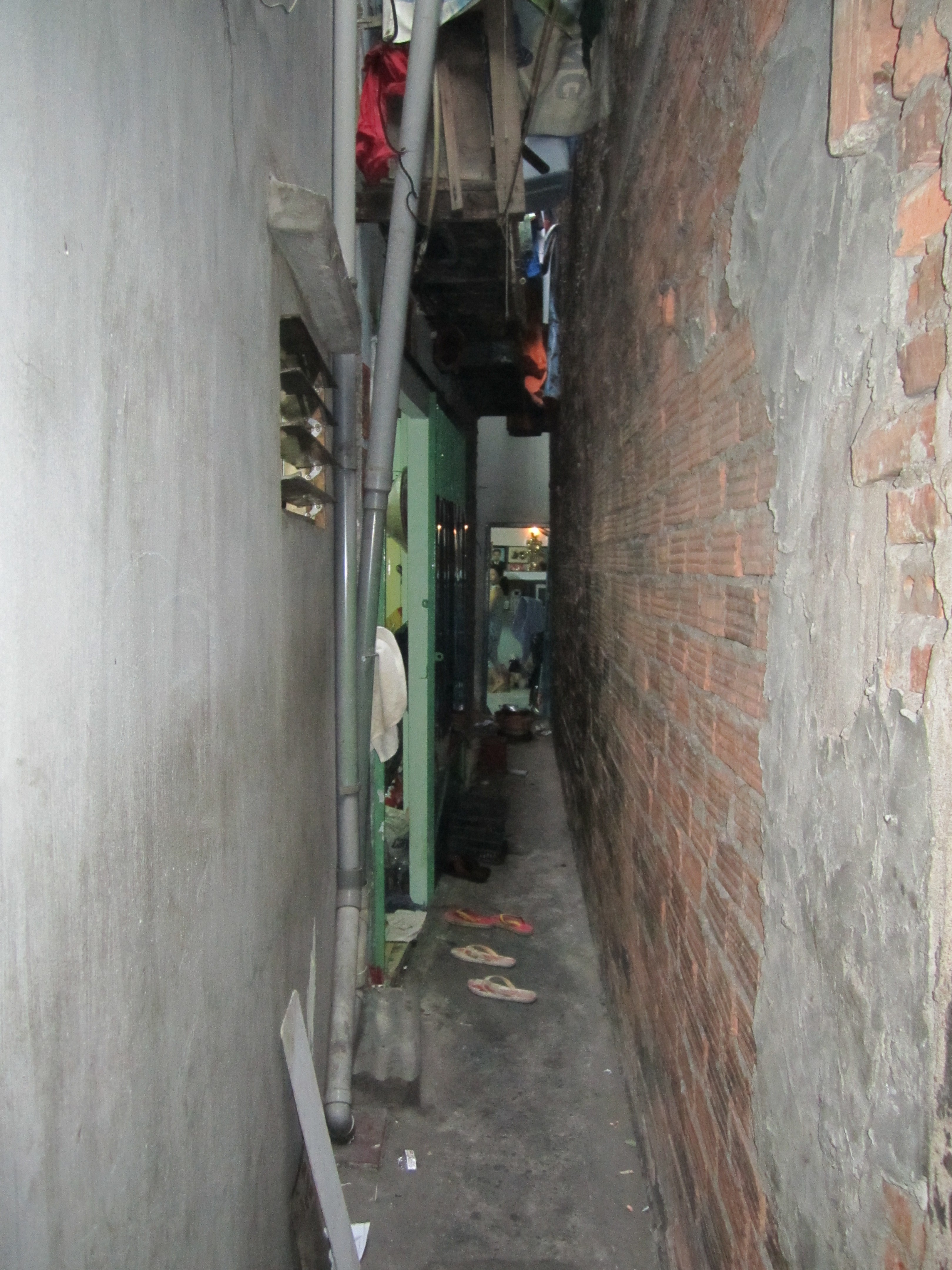
But if you looked, if someone showed you, you could find them—passageways, skinny portals to other places, other cities, secret cities just behind the surface.

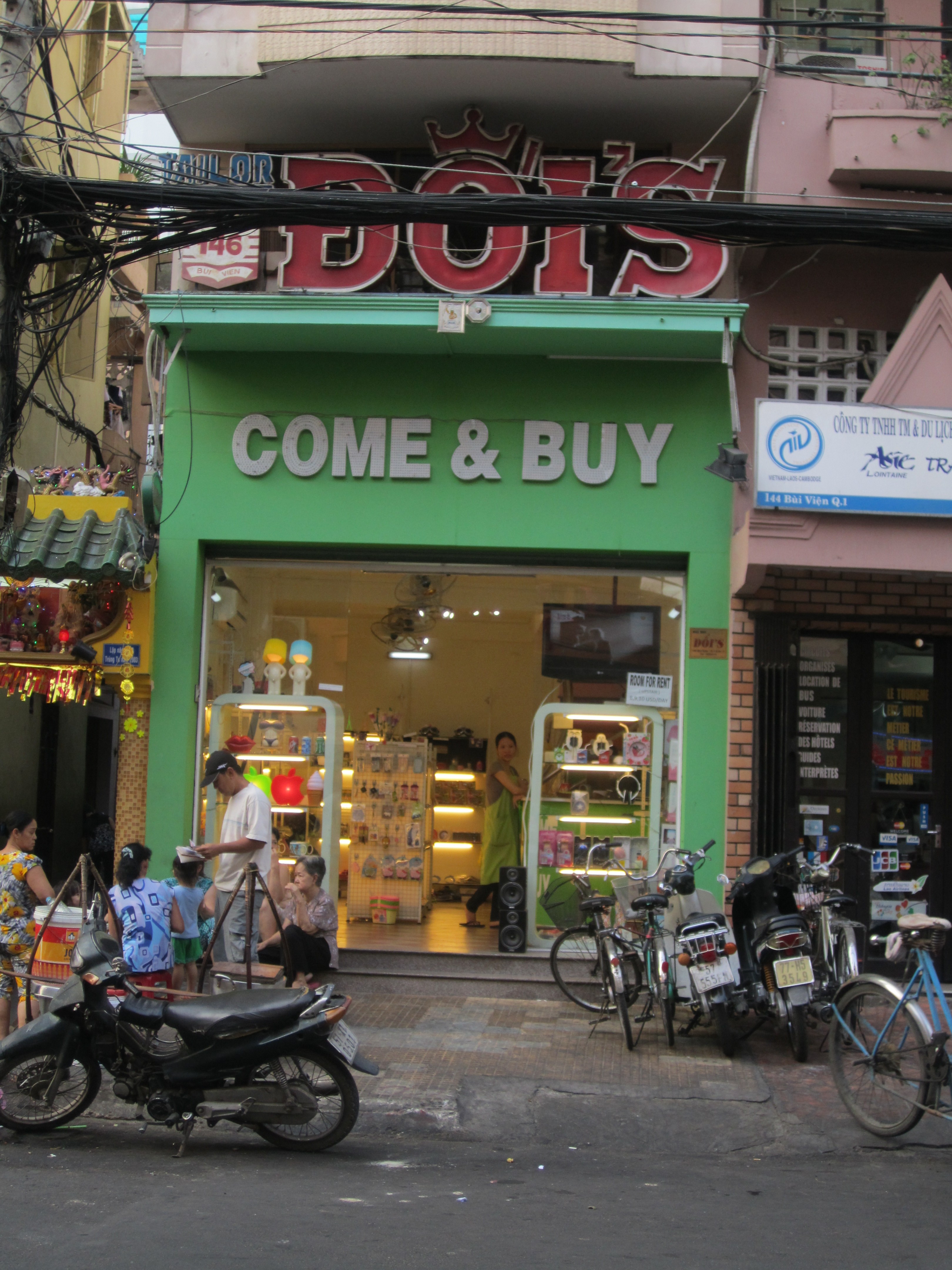
You don’t notice them at first—or you think they’re dead-end alleys, nothing gaps between buildings—no wider than a doorway, and you step through them, into them, into another world: alley streets that wind inside city blocks, where people sit in doorways and women crouch over grills of smoking meat and children run and laundry hangs and TVs flash beside flashing altars and telephone wires stretch in impossible tangles, like dreadlocks—in short, where everyday life is lived.

It’s cool and quiet inside—the buildings are high and the alley streets narrow. You pass a succession of doorways, more glimpses into the lives of the people inside, a flood of images: families huddled on the floor around a big cooker, eating rice; chickens clucking around; old men napping in hammocks; women lighting incense and raising it and waving it and tucking it in a crevice to smolder and smoke.

It feels like a Moroccan medina, those deep parts when you wander far enough—little shops set up in the front rooms of people’s homes, the random internet cafe, children running everywhere, squealing and toddling off into doorways. Only the smell is of fish instead of spices, and it’s motorbikes instead of donkeys you have to look out for.

But it’s the same sense of feeling strangely at home, even though it’s so far from your own home, anything you know of home. There’s something incredibly comforting about the living of everyday life. For those of us that have treaded onto the dark side—maybe for all of us—there’s something really precious about the doing of everyday tasks, a simple joy in being a part of the world, a simple part of it all—even if only as a passing shadow on the wall, a white girl snapping photos and peering in crevices and smiling and waving when the children exclaim “Hello! Hello!” in an English they barely know.

You wander and rove, twist and turn, and then suddenly you’re back out on the surface, the wide swarming streets, an assault of heat and honking. It feels addicitive—you want more, you want to go back, go back under. You find another small portal and dive into the cool dark shadows.

It starts to feel like water, like bobbing up and down, in and under the surface, submerging and coming up for air—only you’re not sure which is the breathing and which is holding, cheeks full and a quiet burn rising through the chest.

You move in a strange space through caverns, observing the private lives of organisms you feel you’re somehow distantly related to; you move through a still, dark world terribly foreign but also somehow familiar, somehow like home—at home, in the secret cities of Saigon.

Sylvio, Character Study

Too shy to take a picture of Sylvio. So here's some sunlight coming through the umbrella thatching. Let's pretend it's a metaphor.

Grizzlied OG with wiry sun-blasted hair, old-man eyebrows that look like a million little spider legs—walks around shirtless, smoking. Not a warm and fuzzy type at all. A tough old dude who smiles sometimes with his eyes, laughs sometimes with his chest (more of a grunt, really, accompanied by a low shake and a choir of smoke).

“The only problem is, what am I gonna do when I finish building?” Shrugs. “Eh, I’ll probably just make furniture. You can always make furniture.” An indeterminate accent—mentions being a kid in Canada, but it’s not that; there’s a twinge of something else. Speaks Vietnamese with the workers, seems to joke with them—they smile—but the tone is flat, and the face rarely smiling.

He shovels dirt in the afternoon, asks, “Is your Wifi working?” “Did you ever get your coconut?” Yes, yes. Disappears during the day to a place behind the buildings and shrubs and palms, where I imagine him weaving, hunched over shirtless in his baggy cloth pants—weaving more bamboo roofs and walls and beach umbrellas; carving and crafting wood into chairs and tables, shining the dullness until it glows.

Weaving, weaving, a neverending project—his own Buddhist sand garden. And you wonder what for. What is he building away from, or towards? The framed photos that hang over the doorway to the kitchen? Him with an 80s mane, tuxedo arms embracing a woman in layers of poofy sequins? The dim pictures of a little girl?—face obscured, leaning over sand, or in a park, maybe, leaves creating shadows that even in the still-frame seem to crawl like insects. Where are they?

I don’t ask. He doesn’t really create an atmosphere of asking. “How long have you been here?” I asked on the first night. “Just since last night,” he teased flatly, the hint of a twinkle in his eye that reminded me of my dad, only a little dimmer. “We knew you were coming, so we built it up.”

“Oh, well, you shouldn’t have.”

“Ah, no,” ashes his cigarette, clears his throat. “Nine and a half years, we’ve been here.” And looks around at the roof, the table, the trees and paths now consumed by night—looks around and down and doesn’t say anything more.

So he answers, and he certainly isn’t rude, but it doesn’t encourage any more asking. A tough old dude, a building dude, a man of that generation—the world covered with them, from every country it seems—as though there were something in that generation. Something they’ve seen, or that’s seen them, and they seem to withdraw very far inside, into their man caves of building and sculpting and staring off and thinking. Of laughing with their chests and smiling with their eyes, and leaving you never quite sure when they’re messing with you or when they’re serious or if you’re bothering them or bugging them—them, them, under all those layers of sun-beated skin.


Lauren Quinn is a writer and traveler currently living in Hanoi. Lonely Girl Travels was a blog of her sola travels and expat living from 2009 to 2012. She resides elsewhere on the internet now.

Join 490 other subscribers

Buy This Sh#t

Categories