Archive Page 17

Yes, I Travel; No, I Don’t Have a Trust Fund: Budgetary Breakdown of a Working-Class Frequent Traveler

It’s happening again. I’m busily getting my life in order—writing post-dated rent checks and filing my taxes (before Feb 1!) and generally preparing my life at home to cruise on autopilot while I go travel—someone will eye me narrowly, a half-slit of suspicion, and ask, “So, how do you get to travel so much?”

Which is actually a question within a question—an implicit way of asking, “Where the hell do you get the money?” Which, given that I work as a waitress, is also to ask, “Who’s giving you the money to travel?”

They initially don’t believe me when I answer, “I save a lot.” Which is to say, “I budget like crazy.” Which is to say, “No one’s giving me money; every penny I have I earn.”

I’ve found myself breaking it down, taking it further, explaining my budgeting technique and demonstrating iPhone apps as Exhibit A in the No, I’m Not Secretly Rich defense trial. Which isn’t so much an effort to prove myself to other people (okay, maybe it’s a little that), but really to answer the question for myself. Because honestly, I don’t know how I afford it all either.

Through this recent round of explaining, I’ve begun to see more clearly that I’m a bit peculiar when it comes to money. I’m not sure where that comes from either. My family was pretty poor when I was growing up, and money was always a stressful issue, so it might grow out of that. Or it might just be who I am.

Either way, I’ve always been a budgeter. I’ve always kept meticulous track of my finances, my expenditures and income. I’ve never paid a bill late. I can always tell you exactly how much I have in my checking account. This is not normal. There weren’t any other 19-year-old punk kids who drew charts in their organizers with savings schedules and projected income based on the averaged income from the previous months. (Where there any other punk kids with organizers to begin with?)

So it’s not a new development, not solely a product of having a goal, something I love, to work towards and save for. Nor is this meticulous budgeting necessarily a product of not having anything but my own ability to work to fall back on. My background is purely working-class; there’s no trust funds, no investments or money market accounts, no heirlooms, no looming inheritances, nothing to pass along the generations but a propensity towards denial and socialism. My parents have done everything they can for me, given me everything they could give me, so it’s not like I’ve never had help. But I work for everything I have. Here’s how I do it.

Exhibit A: Realistic Budgeting

I live comfortably on $2,000 a month. This includes everything from necessities like rent and health insurance to indulgences like lattes and dinners out. It’s really important for me to work in modest indulgences, and to hold myself to them, to not try to “work harder, push more, save more.” Because it’s important for me to not feel like I’m constantly scrimping and saving for some future goal (and thus living in the future), but also allowing myself to enjoy today (and thus live in the present).

I long ago figured out how much I need to live comfortably and happily, to not feel like I’m depriving myself—a budgetary form of crash dieting. The number has slowly crept up the older I’ve gotten, because adult life is expensive; but my income has also crept up. Which brings us to…

Exhibit B: Knowing How Much I Earn

This sounds pretty basic, but when you work in a cash-based industry, it’s really easy to lose track—to wind up with a drawer full of twenties and no real idea how much you’re actually earning. A lot of people I’ve worked with over the years have no clue how much they make, and no idea where the hell the money all goes.

I currently take home between $2,500 and $3,000 a month. Which means I’m earning $500-1,000 more than my expenses. There’s a fuck of a lot you can do with that kind of money. Such as travel. And get tattooed.

Exhibit C: Treating Saving Like a Bill

I deposit money into my savings account on the 15th of every month. I treat it like another bill, instead of a if-I-have-money-leftover kind of thing. It’s pretty simple, and that’s all I have to say about it.

Exhibit D: Keeping Track of Everything I Spend

And I mean everything. I like to think of this more as “thorough” than “neurotic” (you say “potato”…). iPhone apps have made this infinitely easier, but I used to do it by hand, in my organizers, with crooked-line charts and bleeding ink.

Exhibit E: Maintaining a “Prudent Reserve”

In addition, or underneath, all my regular saving for travel, there’s a baseline I never dip beneath. I maintain a $2,000 “prudent reserve” for total emergencies—my car explodes, I break my leg and can’t work, etc. So even when I’m coming back from a trip, I’m never completely at zero. If disaster strikes, I’ll have enough to live on for at least a month.

The end result of all this is that I know where all my money is going, and exactly how much is coming in. There’s no murky intransparencies. I don’t have to stress out; I can be comfortable in the fact that there’ll be enough.

I realize this sounds like a lot—when I’m done explaining it all to someone, their eyes have invariable glazed over and they no longer doubt me when I say that I don’t have secret trust fund. They’ll shake their heads and say something to the effect of, “I could never…”

And I realize that this all sounds terribly tedious and like a lot of time and work. But for me, the energy I put into budgeting is far less than the emotional energy of worrying that there won’t be enough, that I won’t be okay. Budgeting for me allows for a kind of freedom—and not just the freedom to travel and do what I love. But that’s nice too.

Vietnam, Look For Me Cause Here I Come: How to Get A Visa

Yes, travel is exotic and life-altering and profoundly moving. Yes, you encounter new environments, new people, new customs, and in that way, also encounter some new piece of yourself. Yes, you become more cultured, more able to pepper cocktail conversations with ledes like, “Well, when I was learning tango in Buenos Aires…,” and “There’s really no comparison to actual Italian gelato…”

But there’s also the nitty-gritty, the laborious and unglamorous, the tedium of trip planning. It’s not fun, there’s no scene cred, and no one likes to talk about it.

So, with twelve days left until my departure to Southeast Asia, I’m taking a pause in the string of earth-shattering lyrical narratives to discuss the oh-so boring details necessary to Vietnam travel: visas.

The first step to any obligatory activity, whether it’s commuting or house cleaning, is to get yourself a killer soundtrack to lessen the annoyance. For this, I suggest listening to Abner Jay on repeat.

Having to obtain a visa before visiting a country is a strange and confusing process to those of us native to countries of privilege. As an American, you’re more or less used to waltzing up to a customs window, flashing a smile that gleams of tourist dollars, and getting your stamp. Some countries, like Chile and Brazil, charge you of reciprocal entry fee, a kind of fuck-you I can appreciate. But needing to arrange a visa prior to arrival? What kind of criminal do you think I am?

Once you get over the indignity that the majority of the world’s other citizens are subjected to, you’ll need to actually procure the said visa. Here’s what I learned, thanks to research and Thorn Tree, one of my all-time favorite travel resources.

There are no “visas on arrival” for Vietnam.

Other countries in Southeast Asia, yes. Vietnam, no. It’s pretty simple.

There are different types of visas.

For your basic Vietnam tourist visa, there’s a few options. You can go for a one- or three-month visa; you can also opt for single- or multiple-entry. There are no longer six-month tourist or business visas. This means that, if like me, you’re planning on cruising in and out of Vietnam for a period longer than three months, you’ll need to get a visa extension while you’re there. That’s a beast I’ll tackle when the time comes…

Visa costs aren’t fixed.

Figuring out exactly how much a Vietnam visa will cost is an adventure in obscurity. The Embassy and Consulate websites conveniently don’t tell you how much visas cost. Through poking around, I discovered that if you go directly through official channels—that is, the Embassy or Consulate—you can expect to pay anything from $70 for a one-month single-entry, to $150 for a three-month multiple-entry.

There are several companies (like this one) that facilitate visas, and their prices are far from fixed. Discounts apply for groups; the larger the group, the deeper the discount. Prices for these service range from a $20-$50 discount from official prices.

Going through the Embassy or Consulate is expensive, time-consuming and worrisome.

In most situations like this, I’m skeptical of companies with cheesy websites that offer deeply discounted prices on official services. So I’d decided to stick with getting a visa from the Consulate. But this meant handing over my passport. I’d either have to mail my passport to the Embassy and wait for it to be returned (hello anxiety), or get up early one morning and head out to the Vietnam Consulate in San Francisco. Here, I was told I’d need to give them my passport for processing, which would take around 5 days, and then come pick it up again. It sounded like a pain, but preferable to mailing my most sacred of travel possessions.

The night before I was to roust myself and cram onto the train with all the suit-and-ties, I discovered that…

There’s a way around all this. Kind of.

So, you can actually negate the visa process, in a way. You can get what’s called a Visa Approval Letter, an official document that allows you to get what is essentially a visa on arrival. The pluses are that it’s much cheaper, your passport doesn’t have to leave your possession, and you can do it from your computer. The two big catches are that you need to be arriving into one of the international airports (Hanoi, Da Nang, and Ho Chi Minh), and you need to be ready to pay a $25-$50 “stamping” fee.

I used Vietnam Visa Pro, and while the actual entry into Vietnam remains to be experienced, I’m so far super happy with them. I paid $30 for an approval letter for a three-month multiple-entry. I paid via Paypal, which I liked since I’ve heard horror stories about stolen credit card numbers from shady foreign websites (incidentally, just had my credit card number stolen, but that’s another story). I heard back from the company promptly, and had my approval letter emailed to me in 2 business days. Printed it out, made copies of my passport photo, and am ready to roll!

Now all I’ve got to focus on is amassing some more exotic-sounding stories.

Tirana Took Some Piece of Me, Under Seige And Too Far Away

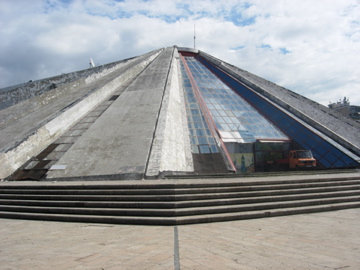
The Pyramid, where protests took place

Sometimes when you travel, a place will steal a piece of you. And sometimes you’ll leave a little piece of yourself in a place—which might be the same thing—some piece of you you hadn’t really known was there, that took the foreign air (smoking chestnuts and car exhaust) to be awakened or realized. And you’re sure you can only ever know that piece or be that piece there—which probably isn’t true but is nonetheless how it feels. Because all it can do is feel, not quite be articulated or explained or rationalized. Which is part of the magic of traveling.

Tirana is one of these places for me—not perfect, far from paradise, but a place I just slid into, like a peg in one of them little holes. I think about my Albanian homies often, and we keep in touch (like everyone else) via Facebook. So I knew when it was snowing there last month, saw pictures of familiar rooftops hazed in a dingy white. I saw pictures from New Year’s, from parties that looked like the ghosts of parties I’d gone to—or rather, parties that had never stopped, kept going, where some piece of me might still be dancing amid the smoke.

And so I knew this morning that shit had gone down. Before I looked at the New York Times or Reuters or listened to NPR, I saw via Facebook. Which made it impossible to detach from, which made it all the more real.

Vincent had been a fellow traveler when I’d been in Tirana, but the lure of the city had inspired him to move there (and helped me to acknowledge that it wasn’t just me being crazy, that the city really does have a kind of special something). He’s been the most vocal of my Tirana friends, though I did get word that everyone I know is okay.

Vincent posted this first-hand account, far more compelling than any news story I read:

I was surprised how well cars can burn, they make hissing and exploding sounds as they slowly die, and usually after two or three minutes, their horns and lights switch on until the circuits are burned through, its like their dying lament.

It’s a funny feeling, I can’t explain it, but I want to be there. For what? To protest? It’s not my fight. To watch shit burn, to run the streets and raise my fist and feel the sting of tear gas? No, that’s not it. To be curled up in someone’s apartment, watching newscasts and hearing the echoes of sirens and shouts and maybe gunfire? Perhaps. To feel that that piece of me I left there, that was so so alive there, is safe?—and that all those people that saw that piece, that shared that piece and maybe even a small piece of themselves, that they’re all safe too?

Because nothing is really safe, and no one is really safe, least of all the parts of you you don’t know, that you’ve littered all over this planet like loose change, like strands of hair, like earring backs and lines from old forgotten poems someone else remembered and reminded you of, when you least expected it, on Twitter of all fucking places—and it sounded like an echo of an ancient sadness and you don’t know what the fuck all this is or means, but just that it doesn’t feel safe, or doesn’t feel like you can save it—which is not at all the same thing, but is all too easy to confuse. And you’ve been confusing it your whole damn life without knowing it.

All of which is to say that you can never predict how this shit will make you feel, what it will bring up. Which is my own way of saying I hope all my Albanian friends—that I love without really knowing, the way I love a part of myself without really knowing it—are safe.

Backporch


The end of a Sunday,
pink on the edges,
the moon a white wound.
Birds laughing
in some other language
as they fly off someplace
behind the roofs,
the wires and branches
that tangle like lives.

A crippled incest
crawls off to die
somewhere amid the vines
that wrap around the stairs
like green fingers
around the throat of this—

cars hissing
against a light
that is already gone.

Untellable Non-Stories: Researching The Intergenerational Transmission of Trauma

What do untellable non-stories look like? Let me give you an example of such a non-story.

A mother is frozen in non-mourning for her dead family. She looks at her child with unshed tears and does not see her child.

“My mom had a girl,” Lynda told me. “She had four kids. Right, Steve?”

“I think so.”

“Three boys and one girl. Actually, I’m not sure; she never really talked about them. But I know she had a girl.

“Sometimes she would tell me how I looked like her, her other daughter. Except she’d had hair the color of corn. She’d always say that: ‘poat.’ Hair like ‘poat.'” She paused, repeated the word: poat, a strange sound from another life, one that hung in the air with its own kind of weight, gravity. “That is ‘corn,’ right Steve?”

Steve nodded, and Lynda looked down, off, some abstract place on the carpet: a thread that had gotten lost, fallen out, would never be noticed except in this one second.

This induces a sense of non-existence and depression in the child. The child wants to rescue, reassure, or enliven the parent and gain life for itself; it feels guilty and worthless when it fails. This is an example of how trauma can continue unwittingly across the generations.

Lynda smiled bravely and raised her eyes.

Excerpt from “Transmission of Transgenerational Trauma

JR, Women Are Heores

So I, like a lot of people, have been nursing a major crush on Parisian street artist JR‘s work. It toes the lines between street art, activism and travel—or, more accurately, it searches out those lines and plasters photographs all over them. I got to check out his work in person back in September at FAME Festival (still one of my best travel experiences ever).

This week, a film about his Women Are Heroes project will be widely released, beginning in France and eventually making its way around the world. Here’s the English-language trailer:

So there might be glimmers of gimmick and paternalism. So it might be argued as “parachute-in” activism that does just as much to promote JR’s name as it does the situations and people he’s trying to highlight. That might be true, it might not. But I do get the distinct feeling that JR’s heart’s in the right place. You can’t deny that his work garners attention, makes people stop and think—and that it’s goddamn cool looking.

The Women Are Heroes project made me think about the Madres de Plazo de Mayo. When I was in Buenos Aires 5 years ago, the mothers were still meeting every Thursday to march, to demand an answer—an act of unforgetting. Because mothers don’t forget. I went to see them, and while I didn’t understand a lick of their Argentine Spanish, I could still feel it: that particular sorrow of a mother. You can’t argue with that; it’s something that we all know, that runs deep through the fabric of human existence, probably all existence (have you ever heard a wolf cry for its babies?). And I think JR touches on that.

So, I’m for sure gonna check out the film. I’m also super excited to see what he does next; I’m especially looking forward to his upcoming “Wrinkles of the City” project, which explores the memory of a city and its inhabitants. What’s more, I was stoked to see photos of his work in Phnom Penh, on the Women Are Heroes website.

The Blues

Sometimes a harmonica sounds like a train,
a far-off train
as it passes
some lonesome landscape—
the sound of something leaving, an echo
through the window at night.

Which sounds like a heart breaking,
or the quiet wail
that escapes
when a heart breaks—
like steam through a valve
or a cry between lips
(“stay, stay”)—

when something leaves
and all you’ve got
to hold onto
is the sound of its going

and even that isn’t yours.
Even that leaves too.

The Ghosts of Footsteps

Crisp blue and puffing chest, the glare of sunlight off the smooth flat of the Bay. My first run since a week-long flu, down along the Bay Trail, with its breezes and San Francisco views, pretty despite being directly beside a freeway.

I passed a little woodsy alcove. It’s mostly rocks and open space down there, but every now and then, beside a freeway exit, an overgrown patch of cluttered trees and shrubs is tucked alongside the trail.

I caught a glimpse between the leaves: a little stream, heavy from the rains; a long piece of wood placed over, a makeshift bridge; the dead remains of footsteps, the ghosts of footsteps, a path going in. Something was hiding in there.

I thought about the books I’d read as a kid—-Bridge To Terabithia—how kids in the country or in the suburbs, or in any event, not inside the city, would always have these places to hide. A creek or the woods, some undeveloped patch of something—a place they could escape to, along with their fantasies and maybe a stick to poke things with, to build empires in their minds where they were safe or powerful or in any event not in their own lives, some other place.

And I remembered how terribly jealous I’d be those kids—those kids in books, not real kids—because I lived in the city, and there weren’t any places like that. Or there were—under freeways, or the woods behind parks—but they were already filled up, claimed by junkies and derelicts with cardboard palaces, people retreated to their own fantasies, their own escapes, their own Not Heres.

There was a thin strip of dense trees behind the jungle gym at Children’s Playground, in Golden Gate Park. I’d wanted to go in there, to climb around, explore, find my own something magical. It was shady in there, I couldn’t see in, and I wanted to know what all mysteries lay in the damp earth and shadows.

“Don’t go in there,” my mother’d said.

“Why?”

“People live in there. There’s trash and needles and it smells.”

And I’d known, even then, that you could catch things with needles, things like death. I’d thought of sarcoma spots and sunken eyes, sick beds and the scatter of Chinese food containers, and I hadn’t wanted to go in there anymore, but I’d still wanted to go somewhere.

It was a good run. My shin splints didn’t hurt, although I did get a tightness in my chest, like a squeezing, that made me stop and walk for awhile. I stared into the open and soaked it in, and was ready to run again.

Glimpse Correspondent Spring 2011!

So… this is big news.

I’m among the ten writers and photographers that have been selected as a Spring 2011 Glimpse Correspondent.

I’m stoked because (as noted in the previous two posts), I keep wanting to cop out. Cause this is scary shit. And as I begin to contact NGOs and service agencies, a new fear is cropping up: I’m afraid of being The Do-Goodey White Lady. As in, what right do I have to write about this shit?

Two things have kept me going so far. One of them is the uncomfortable feeling of a story writhing around inside you, wanting to get out. The other is the absolute conviction that this is a story that needs to be told and, more importantly, needs to be heard.

And now a fuckton more people will be hearing it.

So, cool. Now I can’t cop out.

The Calm Before The…

You haven’t heard from me in awhile. 11 days is the longest I’ve actually gone without posting since I started this blog, over a year ago. But it’s not cause I’m bored and not because I’ve given up, not because I’ve run out of things to say (I don’t think that’ll ever happen—sorry).

It’s because I’m filling up.

It’s like carbo-loading before a big race; it’s like tapering off your work-outs to store energy for the moment when it really counts, the thing you’ve been training and training for—sometimes, this time, without even knowing you’ve been training for it. The alignment of events is freaky, which only serves to confirm what my gut tells me is true: this is the trip I’ve been waiting to take.

I kept wanting to cop out. Which is how I knew it was for real, something I was truly scared of. “This is silly,” I’d catch myself saying. “You don’t need to write about all this; just go to SE Asia and bomb around and see the sights and don’t worry about writing this story you’ve been feeling swim around in your blood for the last ten years.” I found out my landlord won’t let me sublet, that my health insurance premium has gone up, and that I’ll literally be bankrupting myself by taking this trip. Why not just scrap the whole thing and curl up in the safety of the familiar?

But I’ve learned recently that what is familiar isn’t always safe. Take, for instance, the smell of alcohol and cigarettes on the desperate breath of a desperate boy: this is familiar. Take all the little ways I’ve learned to abandon myself, to not have to feel feelings, ways I’ve gathered like precious gems I won’t dare let go of: these are familiar. Take the black panic of a forgotten memory, the way it murmurs like voices behind a locked door; take running and running from this thing inside you that won’t sit still, not ever: this too is familiar.

Sometimes what is unfamiliar is actually safest. Or the thing that might save you, save that piece of you you’ve been trying to smother your whole life.

So a friend put over 700 songs on my ipod recently—really cool, diverse, obscure stuff. Some of the most interesting: Cambodian Cassette Archives. Considering how much art and music was destroyed during the Khmer Rouge, the fact some of these tracks survived at all is astounding. The synchronicity spooked me, especially considering that this friend didn’t know anything about my upcoming trip.

I was watching TV at my parents’ house, aimlessly flipping through channels. I stopped on some award show for humanitarian efforts, teary Hollywood stars giving medals and clapping solemnly. An NGO that works with disabled Cambodian youth was being highlighted.

I spent the other night wiggling down the rabbit hole of hyperlinks and Google searches, and found a couple NGOs that deal with the exact issues I’m hoping to explore in my travels—in short, the effects of trauma on the children of survivors, people who didn’t necessarily experience the initial trauma themselves.

Finding these organizations, obscure and underfunded, was like a kind of validation—that I’m not making all this shit up; that what I’ve observed over the course of my life isn’t anecdotal but part of a larger phenomenon, a star in a constellation, the part of the survival story that doesn’t get told: what happens when the physical horror ends, when you come to the US with a head full of nightmares and a pocketful of nothing, delivered into the heart of East Oakland or Long Beach or DC. That for a whole generation, this is where the story begins.

And goddamnit, it’s a story that deserves to be written.

So I’m reading my ass off. I’m writing individuals and organizations about interviews and site visits. I’m taking notes and making lists and drawing arrows, the connection between things I’d always suspected were connected, but couldn’t ever really prove. And I’m not blogging so much.

Do you ever get the feeling that you’re standing on the edge of something? Has there ever been shit you’ve kept black your whole life, but always kinda knew was still there, a type of gravity everything kept coming back to and coming back to?

Little memories have been popping up the last couple weeks, like sparks flashing—things I’d forgotten or hadn’t thought about in a really long time, except in passing. I reread my last post, and realized it was no accident that I compared Pol Pot to a dead uncle. Because I have my own dead uncle I don’t remember, don’t think about, except in passing.

So what happens when you dive into that black? When you unlock that door and let the murmurs have a voice?

I don’t know, but we’re gonna find out.


Lauren Quinn is a writer and traveler currently living in Hanoi. Lonely Girl Travels was a blog of her sola travels and expat living from 2009 to 2012. She resides elsewhere on the internet now.

Join 490 other subscribers

Buy This Sh#t

Categories